
Temporary and less dramatic than surgical BBL.
Within Aesthetic Medicine, the demand for booty reshaping has led to the popularity of Non-Surgical Gluteal Augmentation or “Liquid BBL”. Although the surgical Brazilian Butt Lift (Autologous Gluteal Lipografting) is still the standard procedure for substantial volumetric increase, some patients, among them those without enough fat for harvesting or those who have contraindications for anesthesia, want an injectable treatment.
At Lin Health Europe Clinic, we see “Liquid BBL” as a separate clinical procedure of molding the body with a Dermal Filler or Biostimulator injection. The success of this operation is totally dependent on what drug is used and what the patient’s anatomical objective is. Surgery moves biological tissue by liters, which is a completely different thing from Liquid BBL that uses exogenous compounds in specific areas to treat localized depressions, such as Trochanteric Depression (hip dips) or to increase the projection of the skin. It is necessary to be conversant with the difference between Hyaluronic Acid (HA) gels and Poly-L-Lactic Acid (PLLA) stimulators in order to set realistic patient goals for volume, duration, and safety.
Pharmacological Agents: Hyaluronic Acid vs. Poly-L-Lactic Acid
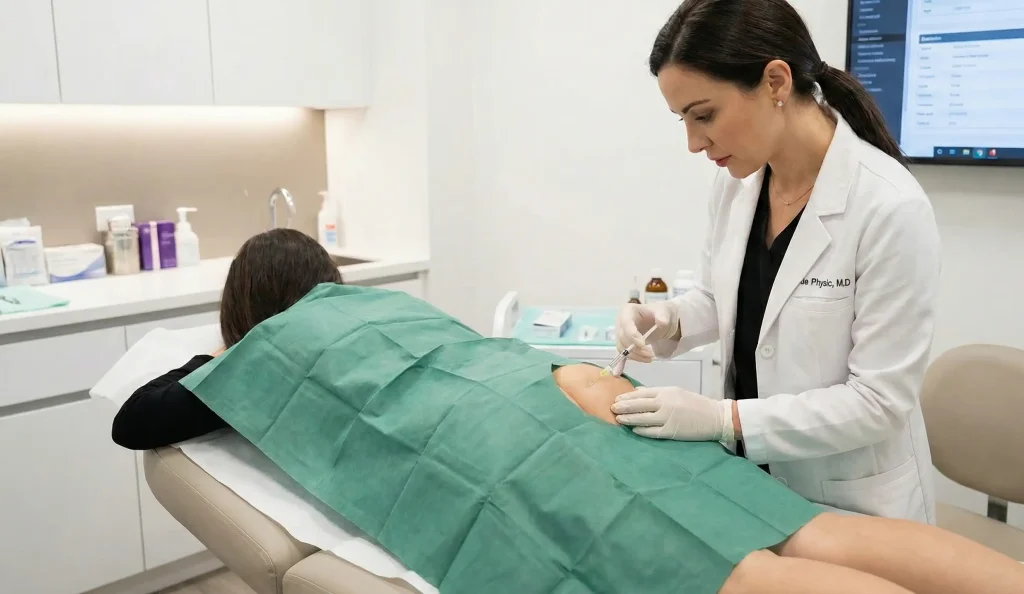
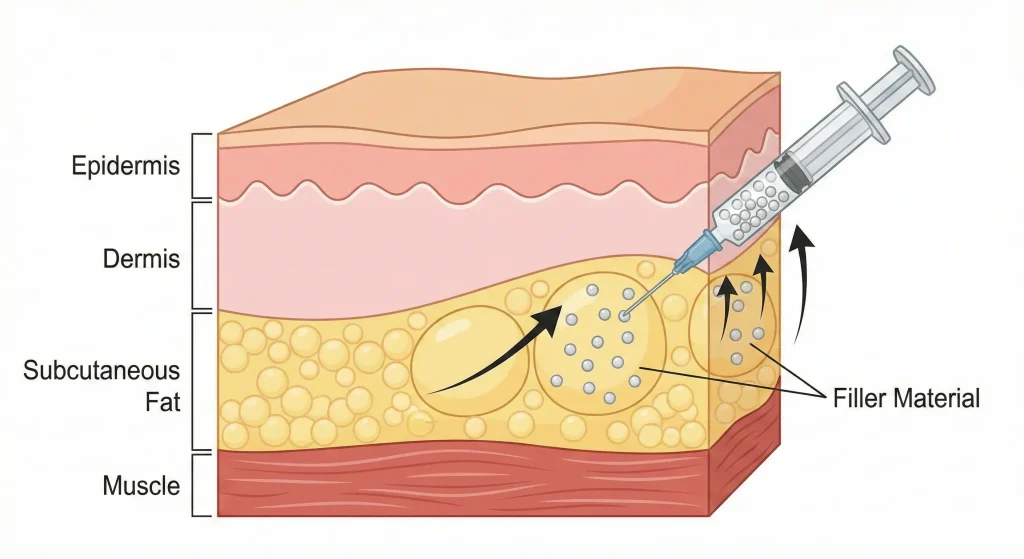
“Liquid BBL” is a term that describes two major groups of injectable devices, each working through a different mechanism. First is the Hyaluronic Acid (HA) (e.g., HYAcorp), a cross-linked, macromolecular gel. The watery nature of HA explains its ability to give instant volume by simply placing liquid within the subcutaneous layer. The pleasure is instant but it gets degraded metabolically by the enzyme Hyaluronidase after a while.
Another type is Poly-L-Lactic Acid (PLLA) (e.g., Sculptra, Lanluma), which is a Biostimulator. The microparticles of PLLA do not release any significant volume in the short run; they rather activate a mild subclinical inflammatory process. This leads the fibroblasts to produce new type I collagen (Neocollagenesis) together with elastin. The phenomenon of “lift” and skin tightening caused by PLLA is a natural biological process of tissue regeneration, which can slowly be observed []. It is the results of the initial patient assessment if they want instant features (HA) or gradual thickening and firming of the skin (PLLA).
Volumetric Limitations and “Hip Dip” Correction
In terms of volume, Liquid BBL is nowhere near a surgical lipofilling procedure. A surgical BBL usually consists of transferring 300cc to 800cc of fat per buttock. On the other hand, a strong Liquid BBL session might be able to fill 100cc to 200cc in total. Trying to get the surgical volume from fillers is dangerous and will never be advised by a doctor because of the health risk of migration, encapsulation, and the huge expense.
Hence, the main application of Liquid BBL in medicine is not a total increase but rather localized contouring. It can be selected as a remedy for the trochanteric depression (“hip dips”) problem, i.e., the hollow just below the top of the hip bone and the largest part of the thigh bone that does not have fat because of the muscle attachment. Precisely and accurately, the injected gel may fill the pit thus making a curve of the body. In addition to this, the procedure can be used to edit the scars and asymmetries resulting from plastic surgery, it is a “finishing tool” instead of providing any building blocks.
Vascular Safety and Granuloma Formation
Although it is non-surgical, Liquid BBL still entails a risk. The superior and the inferior gluteal arteries supply a lot of blood to the gluteal region. An intravascular injection, which is an inadvertent one, may cause occlusion of the vessel, tissue death, or embolism. To reduce the risk of such an accident, medical practice nowadays chooses blunt-tipped cannulas instead of sharp needles, and the injections are strictly superficial and subcutaneous.
One more possible problem is that of foreign body granuloma development. In case big lumps of filler instead of small micro-droplets are injected, the body may react by isolating a large area of it that is felt as hard and sometimes painful nodules. Semi-permanent fillers are more prone to this kind of risk. To prevent the impurities, the “Rule of 5s” – massaging the area vigorously – is implemented after a PLLA treatment. At Lin Health Europe Clinic, we perform the filler administration above the gluteus muscle fascia with the help of ultrasound, which puts the deep debris at a full safe distance.
Longevity and Metabolic Biodegradation
The major difference between surgical and liquid augmentations lies in the permanence. Autologous fat, once revascularized, is permanent living tissue. Injectables, on the other hand, are temporary and biodegradable. Hyaluronic acid may stay in the gluteal region for up to 12-18 months; this somewhat depends on how tightly the gel molecule chains are and how fast the metabolism of the individual is.
PLLA Biostimulators can provide an effect with an even longer duration since the collagen matrix formed is of a higher durability than the injected gel itself. However, patients should keep in mind that to sustain the effect, there will be a maintenance need for treatments. We generally recommend a yearly, smaller-volume ‘top-up’ session to compensate for the natural biodegradation of the product. The total maintenance thus makes Liquid BBL a long-term commitment financially when compared to the “one-and-done” nature of successful fat grafting.
Candidate Selection: The Lean Phenotype
The best match for Liquid BBL is a biologically different patient from that of surgery. A surgical BBL needs a donor site with enough fat (BMI is usually > 23). Individuals with a Low BMI (< 20) or those with an athletic “gym build” lack the subcutaneous fat to be taken via the liposuction method. Liquid BBL will probably be the only option for such thin patients when seeking augmentation.
Besides this, Liquid BBL is suitable for patients who are unwilling to have the downtime of surgery. It is common knowledge that a surgical BBL requires that the patient stays off his/her backside and wears a compression garment for a good number of weeks. After a Liquid BBL, the patient can continue with their routine (only a bit of exercise restricted). A person whose skin is so loose is not a good candidate for fillers because the gel’s additional weight can make the sagging worse; they would have to opt for a surgical Gluteal Lift (skin excision) instead of volumization.
Frequently Asked Questions About Injectable Gluteal Augmentation
Severe gluteal ptosis (sagging) and extreme skin laxity constitute the main contraindications. Giving volume to loose tissue will likely worsen the sagging; thus, a surgical gluteoplasty (lift) is the appropriate intervention.
PLLA serves as a biostimulator. It triggers a controlled, subclinical inflammatory reaction that recruits fibroblasts and leads to new collagen formation, thereby thickening the dermis after 3-6 months.
The answer is yes. A direct intravascular injection into the superior or inferior gluteal artery could be inadvertent and it may lead to tissue necrosis or embolism symptoms. This risk can be minimized by using blunt cannulas in the superficial subcutaneous plane.
Certainly. To the extent that vascular occlusion, migration, or overcorrection might be some of the complications, the injection of the enzyme Hyaluronidase will hydrolyze the HA gel thereby reversing the effect.
By passing through or under the gluteus maximus muscle, there is a great chance of damaging the sciatic nerve and the occurrence of a fatal gluteal artery embolism. Thus, it is highly recommended that all injections be subcutaneous.
Goldberg, D. J., et al. (2013). Poly-L-lactic acid for the treatment of gluteal lipoatrophy. Dermatologic Surgery.
Pavicic, T. (2015). Anatomy and aging of the buttock. Dermatologic Surgery.
Hexsel, D., et al. (2012). Noninvasive buttocks augmentation. Clinics in Plastic Surgery.
Mendieta, C. G. (2006). Gluteal reshaping. Aesthetic Surgery Journal.