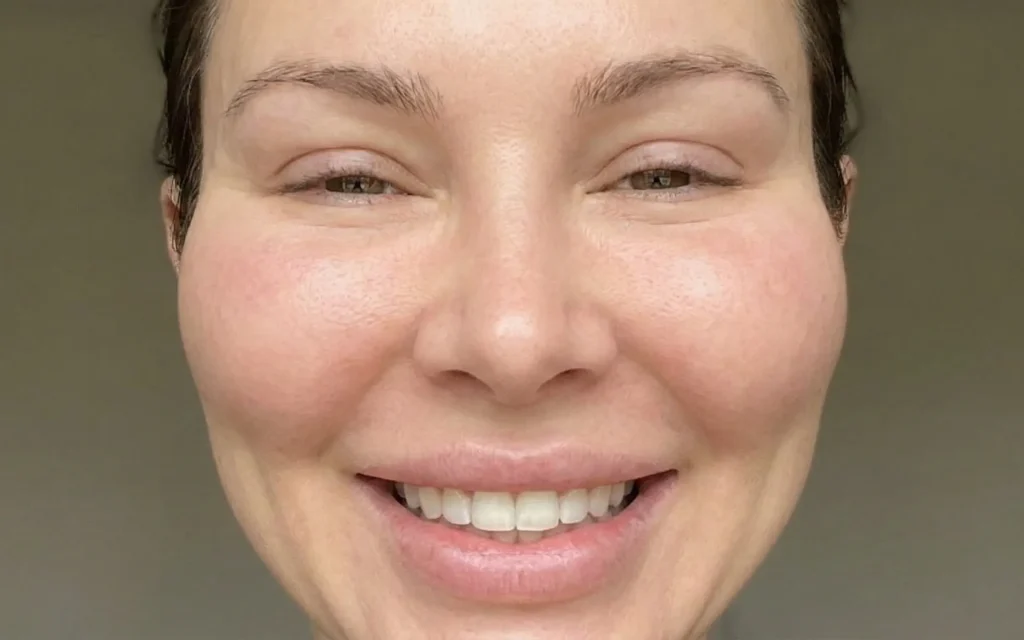
An overfilled, puffy facial appearance.
With the rise of social media, “Pillow Face” has been used as a synonym for the horrors of aesthetic medicine. It stands for a face that has been filled so excessively and in such a wrong way that the face looks puffed up, over-rounded, and practically featureless – like a soft pillow. The patient does not look refreshed and facelifted but inflated and disfigured. Their eyes frequently look smaller because their cheeks have been swollen so much that they are at the level to squint their eyes. The natural lines of the face – high cheekbones, a well-defined jawline, deep nasolabial folds – are covered and repressed by a layer of gel.
At Lin Health Europe Clinic, we come across people who have filler on their wish list but they are terribly frightened by it because they always associate it with the look of the pillow face. Nonetheless, a pillow face is not an adverse effect of dermal fillers; it is the result of bad decision-making and poor working methods in the use of a dermal filler. The use of an injector that fills instead of lifting the structures when he/she attempts to treat a sagging face is the cause of a pillow face. The best way to guarantee that you won’t have it is to get to grips with the anatomical mistakes that produce this expression.
The “Balloon” Error: Volume vs. Lift
The cardinal mistake behind the creation of a pillow face is a misconception of aging. The human face sags because of the action of gravity and the more so the less the bone is supporting it, due to loss of bone mass. The skin cover is becoming very thin due to the shrinking skeleton underneath.
The newly trained provider only sees that the skin is getting loose and he/she thinks, “I must fill this to be able to tighten the skin.” The person injects large amounts of filler into the cheeks and midface with the idea of pushing the skin out, like inflating a balloon that has lost air. On the surface, the wrinkles disappear, but the facial topography is destroyed. The face no longer has highlights and shadows. A skilled provider, on the other hand, understands that one cannot simply fill their way out of sagging. If the skin is indeed very loose, it is a facelift or thread lift that is needed and not 10 injections of filler. The filler must not be used for inflating the skin but rather to restore volume that, in time, has diminished.
The “Sunset” Eyes: Malar Overfill
One of the hallmark signs of a pillow face is the eyes. Normally, when a person smiles, their cheeks go up. However, in a pillow face, the anterior malar fat pads, aka the cheekbones, are filled with so much product that the only direction they can go is up.
When the patient smiles, this filler volume, being heavy, reaches the lower eyelid, and this is compressed. Squinting therefore, results in the eyes becoming smaller and appearing to be buried. The lymphatic circulation of the eyes can even be limited and this can lead to permanent bags and water retention (malar edema). This is prevented by adhering to the orbital rim. We refrain from injecting deep, heavy filler into the fat pads that change when you smile (dynamic fat pads). Instead, we put it on the side of the stationary bone (zygoma) to give a lift that pulls the face backward, not one that pushes it forward.
The Nasolabial Trap: Chasing Lines
Another prevalent reason for a pillow face is the fixation on getting rid of nasolabial folds (the smile lines.) People frequently insist on having these lines completely flattened.
However, to get rid of nasolabial folds completely, a huge amount of filler is needed in the mouth area. The mouth is the area mainly used for moving facial muscles. The consequence of overfilling the mouth with filler is a heavy monkey-like muzzle (simian deformity) that looks stiff and unnatural when talking or eating. Additionally, it adds bulk to the lower half of the body, thus making the “pillow” look more dominant and heavier. At the Lin Health Europe Clinic, we heal the cause. Instead of directly filling in the fold and therefore distorting it, we naturally soften the line by lifting the cheek away from the fold.
Product Choice: The Sponge Effect
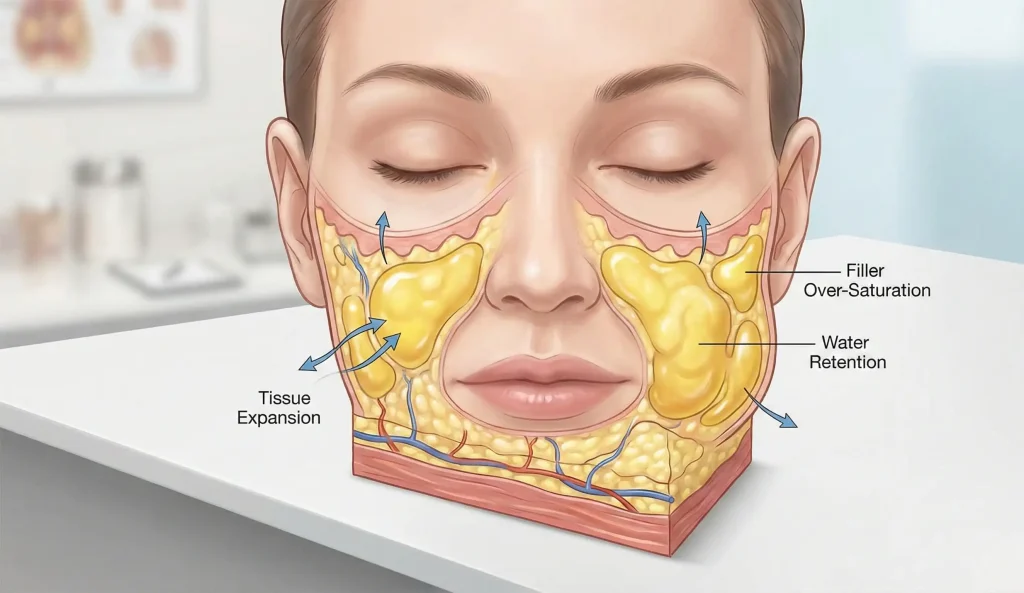
Hyaluronic Acid (HA) fillers, being hydrophilic, attract water molecules. Some fillers are intended to be very soft and watery for use on lips, whereas others are hard for use on bones.
Pillow Face is often caused by using the wrong product in the wrong layer. If a highly hydrophilic filler is placed superficially in the cheeks, it will absorb water from the body over the next few weeks. A 1ml injection can swell to look like 2ml or 3ml. This “sponge effect” creates a boggy, undefined puffiness that fluctuates with your salt intake or hormonal cycle. We prevent this by using low-hygroscopic (low water attraction) structural fillers for the midface. These gels provide a crisp, defined lift that stays stable and doesn’t morph into a water balloon over time.
Dissolving the Pillow: The Reset Button
Pillow-face is reversible; the good news is that it is not permanent. Because Hyaluronic Acid (HA) fillers are the culprit almost all the time, the process can be reversed.
At Lin Health Europe Clinic in Turkey, we don’t give more when re-treatment of an overfilled face is required. Instead, we get to the heart of the problem with hyaluronidase – an enzyme that breaks down HA filler in half to two days. It is a face “reset” that we do effectively. In a day, the problem is totally solved, and the face is brought back to its original condition before the filler was used. After the swelling is gone and the skin has returned to normal (usually after 2 weeks), properly, with a structural approach, small, precise quantities of filler can be put deep in the bone to contour and lift, instead of making bulk. This approach, “Deflate and Reflate,” brings back a person’s natural beauty and thus filler, when done correctly, is invisible.
Frequently Asked Questions About Pillow Face
No. Puffy look (or “Pillow Face”) is a symptom of overfilling or improper placement. Properly placed deep on the bone to imitate skeletal support, filler will define and lift the face without visibly adding bulk.
Some signs are your eyes looking smaller when you smile, cheekbones that have lost their definition (just a round curve), and a heavy, swollen feeling in your face that does not go away.
Sure. We can administer an enzyme called Hyaluronidase to the areas that were overfilled. This breaks down the hyaluronic acid filler in 24-48 hours, effectively giving your face its natural shape again.
Highly “hydrophilic” (water-loving) fillers are those that tend to cause more swelling and if used in large amounts, they give a puffy appearance. Usually, products with “Vycross” technology or those that are stiff “G-Prime” possess properties that are preferred for deep structural lifting to avoid this.
If you have a lot of sagging and loose skin, a facelift is the solution. When very loose skin is “filled”, a huge amount of volume is required and therefore, you will inevitably get a Pillow Face. A facelift skin is tightened without skin volume being added, thus you won’t get a puffy look at all.
Funt, D., & Pavicic, T. (2013). Dermal fillers in aesthetics: an overview of adverse events and treatment approaches. Clinical, Cosmetic and Investigational Dermatology.
Harris, S. (2020). The Alienization of the Face: Overfilled Syndrome. Journal of Aesthetic Nursing.
Fitzgerald, R., et al. (2010). Facial aging and the role of the malar septum. Aesthetic Surgery Journal.