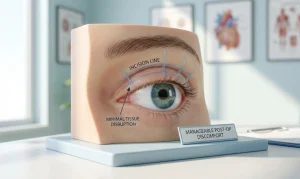
Thread lifts last about 1–2 years.
The quest to defy age and regain a youthful, well-defined face shape has led to the spectacular rise of thread lift, a procedure that is often touted as a “lunchtime facelift” or a “fox eye” procedure. This non-surgical method is a perfect compromise for patients who want to fight the signs of gravity without the downtime, scars, or permanence of surgery. However, the marketing hype surrounding thread lift has often outrun its medical reality, so it is quite confusing when it comes to its lasting power. Patients normally come to the clinic with wrong ideas such as that the results are permanent just because the threads are “surgical” or, on the opposite, that the lift disappears as soon as the thread dissolves.
It is quite a multi-faceted and complex issue when we want to understand the true thread lift longevity. Even though one of the factors is the type of thread material (PDO, PLLA, or PCL) used, the duration of a thread lift is much more than that a simple mechanical ‘lift’ of the skin; it is a biological effect too. Your collagen production capacity and the amount of stretch you put on the threads to do the work or mechanical load also matter. The first thing we do at Lin Health Europe Clinic is give thorough patient education because we are sure that a good knowledge of the biological mechanism behind Thread Lift—especially understanding hydrolysis and neocollagenesis—will help you better manage your expectations and get a satisfactory result for the longer term.
The Biological Mechanism: Mechanical Lift vs. Neocollagenesis

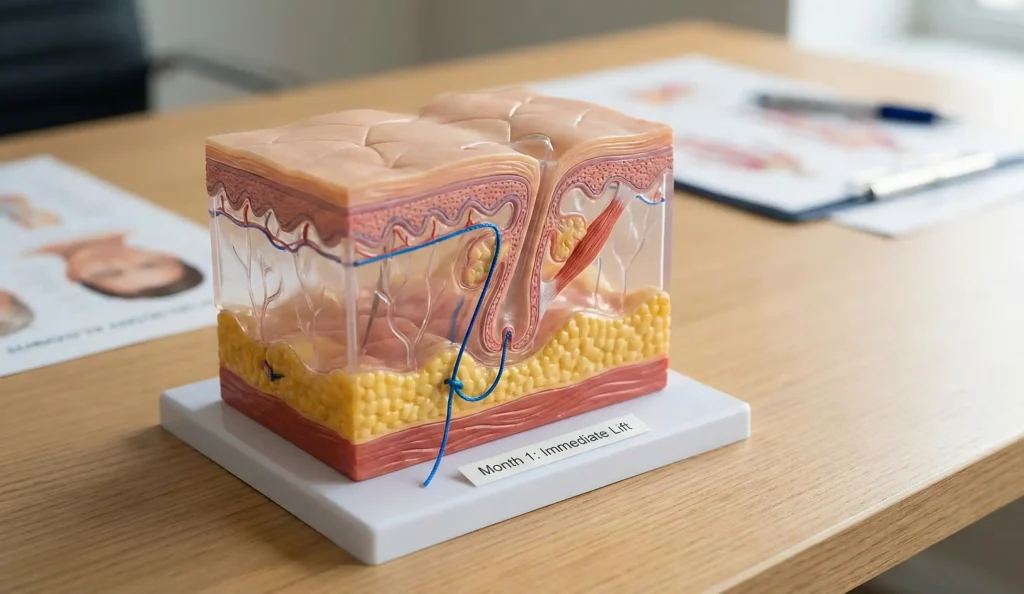
In order to understand really how long a thread lift lasts, you need to be able to differentiate the two main elements, i.e., the quick mechanical lift and the slower biological response. When a barbed thread lift suture is embedded in the subcutaneous fat layer, the tiny hooks or barbs hook the tissue and thus mechanically lift it up. This is the instant “snatched” look, which you can notice immediately after the procedure. However, this mechanical fixation cannot last long because the threads that are made of Polydioxanone (PDO) or other absorbable polymers are simply designed to degrade over time.
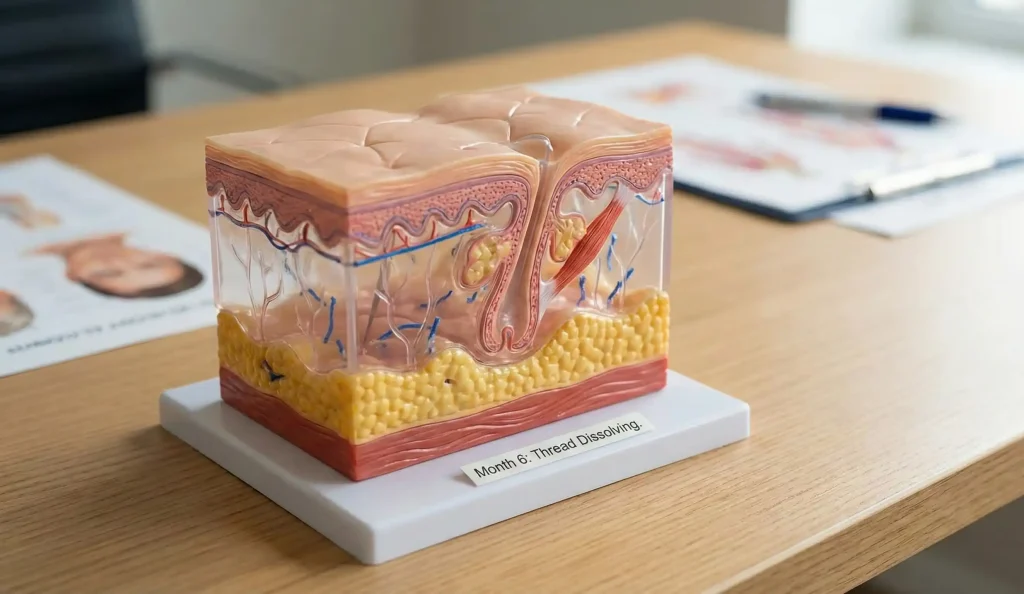
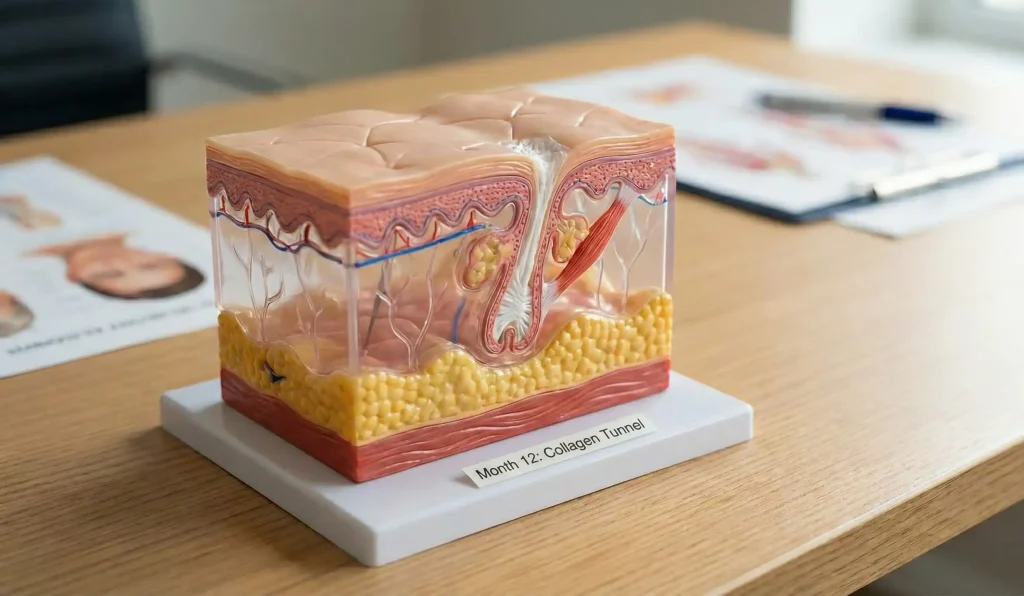
What makes thread lift genuinely last over time is the body’s response to the thread as a foreign body. The degradation of a PDO thread, triggering a small inflammatory response, is how the hydrolysis process starts. This inflammation activates fibroblasts (the cells that produce connective tissue). These fibroblasts ‘coat’ the thread by synthesizing a channel mainly consisting of Type I and Type III collagen. This phenomenon is called Neocollagenesis. Even when the thread has totally disintegrated and become waste (usually around 6 months), the new collagen framework that has been built around the thread remains just like a biological scaffold, which keeps the elevation and skin tightening for a good few months after. So, the “lift” is a way of describing something that lasts much longer than the thread itself.
Material Science: PDO vs. PLLA vs. PCL
How long a thread lift procedure lasts depends on the type of thread used chemically. Polydioxanone (PDO) is the most common of the three materials. PDO threads have great tensile strength but are absorbed very quickly. An ordinary patient can expect a PDO thread to lose its strength at around 6 months of use and be completely gone at around 9 months. Hence the visible effect of a PDO Thread Lift usually lasts for 12 to 15 months, the second half of that time being the collagen scaffold.
Nevertheless, newer products provide a longer-lasting effect. Poly-L-Lactic Acid (PLLA) threads (of which Silhouette Soft is the best-known brand) are like the injectable biostimulator Sculptra in that they are stronger and slowly break down more than PDO and thus remain in the tissue for a longer period (12-18 months). Through this longer existence, the collagen response is stimulated more vigorously, and the thread lift effect can be seen up to 2 years. The most durable alternative is Polycaprolactone (PCL). It takes this thread more than 2 years to be completely degraded. While PCL undoubtedly lasts the longest, it is made of a material that is stiff and inflexible, so a patient with thick skin whose suture can thus be hidden will be the only one to benefit from it, whereas PDO will still be the option.
The “Heavy Tissue” Fallacy: Why Results Fail Early
The greatest factor influencing the thread lift duration is not the thread at all but the patient’s features. A Thread Lift depends on the barbs and friction for the tissue to be held against gravity. The amount of load that it can support is limited. If a person has heavy and thick skin or a lot of subcutaneous fat in their jowls (a “heavy face“), the force of gravity will be greater than the tensile strength of the barbs. Under these circumstances, there will be no early dissolving of the threads; the tissue, instead, will simply “slide” off the barbs, thus the lift being lost prematurely, often after about 3 months.
This physical constraint is a very good excuse for us to be more selective while consulting patients at Lin Health Europe Clinic. The right candidate for thread lift, which will remain effective for a long time, is a person with mild to moderate skin laxity and minimal facial fat, that is, a person who does not need a reconstruction but just a “touch-up”. For individuals having heavy jowls, the best approach is likely to be the combination therapy in which we use liposuction to lessen the facial weight prior to thread insertion. When the mechanical load is lessened, the thread lift can be held considerably longer, thereby giving time to the collagen to set a firm structure before the barbs lose their grasp.
The Critical Recovery Window: Protecting the Vectors
The durability of a thread lift is frequently sealed within the first two weeks after the operation. This post-procedure period is very important for integration. During these two weeks, the threads are just “floating” in the tissue and held only by the friction of the micro-barbs since the fibrotic healing response has not yet occurred. Physical activities (eating a burger, yawning, dental work) that involve the opening of the mouth excessively would cause the barbs to either snap or become detached from the delicate subcutaneous tissue.
The loss of that specific lift vector becomes permanent once a thread breaks or disengages. The result is asymmetry, and the overall durability of the Thread Lift is also limited. To prolong the effect, we put the patient on a strict regimen: a seven-day soft-food diet so as not to exert too much force when chewing, and a “facial rest” during which we keep the number of expressions at a minimum to avoid overuse. We discourage running or any other high-impact sport for two weeks after the procedure. The less the tissues bounce, the better the threads stay attached to SMAS or fat layers, and thus the fibrotic healing can secure the lift for a full 12-18 months.
The Cumulative Effect: Why The Second Lift Lasts Longer
Many people believe that as soon as the thread lift is gone, the face will be back to how it was before the treatment. A biological harvest is left behind by the operation, though. Because of the fibrosis (i.e., the network of new collagen fibers), the skin gets thicker, firmer, and more resistant post-treatment compared to pre-treatment. This is referred to as “collagen banking.”
The above phenomenon is the reason why thread lift outcomes are said to be cumulative. When the patient comes back 12-18 months after the first treatment, the second treatment starts from scratch. At the time of the second round, the tissue is already strengthened by the collagen of the first round; therefore, new threads will be added to the pre-existing collagen scaffold. As a result, numerous patients experience the longevity of their second thread lift even greater than the first one, up to 2 years or sometimes more. By considering thread lift as maintenance rather than a one-off solution, patients can accumulate these gains and thus stay lifted and firm without ever having to go under the knife.
Frequently Asked Questions About Thread Lift Longevity
On average, the exposed good looks of a Thread Lift can be seen around the face for about 12 to 18 months. The lifting PDO threads themselves disappeared after 6 to 9 months, but the new collagen framework which they have generated continues to keep the lift for a longer definite time.
No, a Thread Lift won’t last forever. It deploys absorbable sutures that the body digests. In contrast to a surgical facelift, which scrapes off the excess skin, a Thread Lift only moves the already existing tissues, and hence will ultimately give in to gravity as the collagen breaks down.
The thread fragments are completely metabolized by hydrolysis into water and carbon dioxide and they are naturally eliminated. No trace is left behind. What you will retain is a natural meshwork of your own collagen which gradually loosens over time.
One of the major causes of Thread Lift premature failure is poor patient selection (heavy skin/jowls) or an accident during recovery when the mechanical disruption (thread snapping) occurs. If the tissue is too heavy for the barbs, the lift will not last the full duration.
Yes. Being a non-surgical procedure and leaving no scar tissue, Thread Lift is safe to be repeated every 12 to 18 months. Actually, repeated treatments may result in better longevity of the effects due to the cumulative collagen production.
Suh, D. H., et al. (2015). Outcomes of polydioxanone knotless thread lifting for facial rejuvenation. Dermatologic Surgery.
Savoia, A., et al. (2014). Outcomes in thread lift for facial rejuvenation: a study on 33 patients. Journal of Cosmetic Dermatology.
Abraham, R. F., et al. (2009). Thread lift for facial rejuvenation: assessment of long-term results. Archives of Facial Plastic Surgery.
Gulay, K. (2019). The biology of thread lifting: Neocollagenesis and tissue integration. Aesthetic Plastic Surgery Journal.