Overuse can restrict circulation and slow healing.
Among various body contouring methods, the use of a compression garment after Liposuction or a BBL, popularly called Faja, has gained almost legendary reputation. On social media, influencers deceptively declare that, “The tighter faja, the smaller waist. Thus, patients are led to believe that in order to get a snatched silhouette they have to endure pain.” So, it’s not uncommon to see people actually going aggressively sizing down and squeezing themselves into 2 sizes smaller garments in the hope that the mechanical force will reduce their swelling.
The thought that “tighter is better” is not only a mistake but a very dangerous one. Punctiliously, compression is necessary for the closure of the dead space and the management of the edema. However, over-compression goes against your body’s physiologic response. When a faja is too tight, it changes from being a medical device to a tourniquet. Besides causing one, it may even cut off blood supply, damage the skin, and essentially fluid can be trapped in the wrong places.
At Lin Europe Clinic, our patients are taught that the purpose of a faja is to support the tissues as if a “second skin,” and not to strangle them like a corset.
Faja Too Tight? This Is What Happens
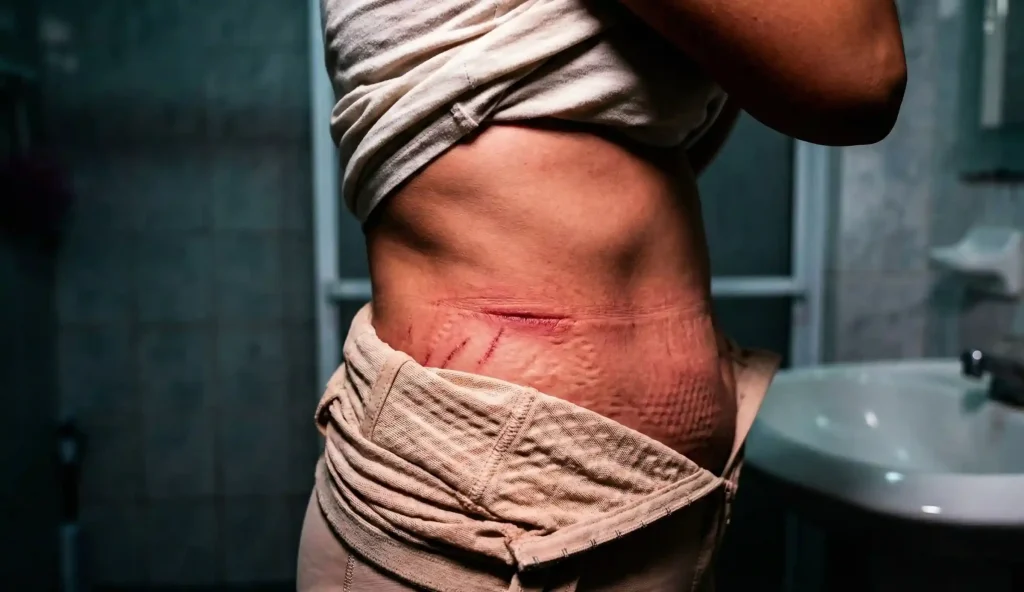
When the Faja is tight, it simply restricts blood flow and, later on, the situation may get worse if it is worn for a longer time, resulting in the formation of wounds and ulcers. When talking here about wound formation, it can mean tissue or skin necrosis which might result in infection and thus further delay the recovery time period.
Skin tissue requires a good supply of blood in order to remain healthy and viable. The blood contains both oxygen and nutrients which the cells need to carry out their important functions, as well as waste removal: This is why you need to ensure that a faja fits correctly.
The Tourniquet Effect
One of the fastest and most dramatic consequences of restricting the blood flow when wearing a tight garment is the swelling in the lower extremities and its accompanying problems. In order for blood to be able to circulate properly through the legs, the faja has to be loose enough at places such as the groin and the top of the thighs.
What is regularly referred to as “The Tourniquet Effect.” The blood that is pumped through the arteries reaches the legs but since there is no room for the blood to flow back through the veins, the feet, and the lower legs will first swell up and eventually become cold and blue.
The condition described here is a particularly serious one and is called venous thrombosis (blood clot in the veins). It is extremely dangerous because a clot that breaks off and travels through the venous circulation may eventually block a vessel in the lungs thus causing death. If you discover that your feet lose their color or become purple immediately after wearing your faja, the garment is way too tight and has to be taken off immediately in order to restore circulation.
Skin Necrosis: The “Faja Burn”
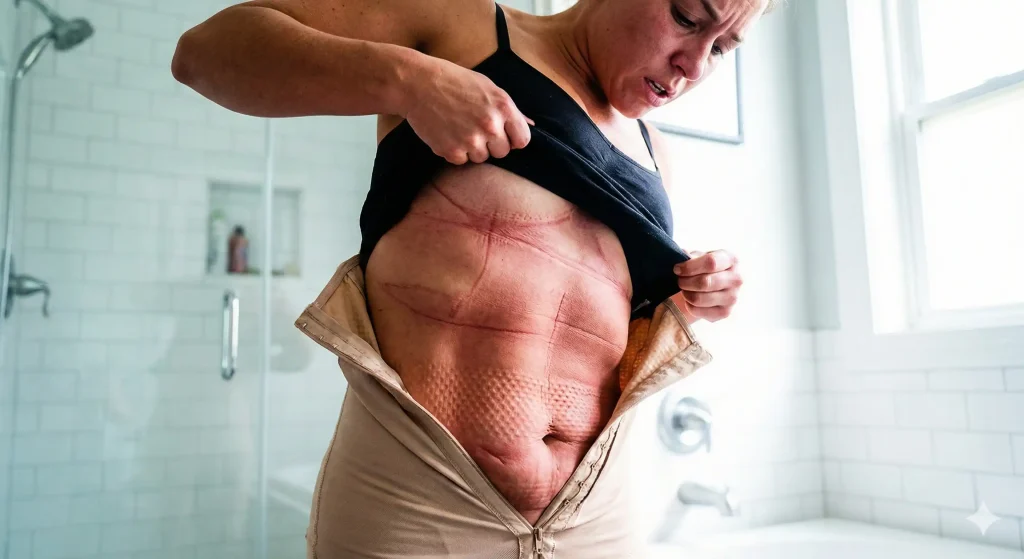
We constantly talk about oxygen as essential for the survival of skin cells. Surgery results in the skin being physically traumatised and, therefore, its blood supply may be insufficient. If a tight faja is combined with an unyielding element at some place such as a zipper, a seam, or a fold of the cloth, then it can press down on the tiny capillaries for hours uninterrupted.
This phenomenon is the cause of what is known as Pressure Necrosis, in other words, a bedsore brought about by the garment. The area will show red patches, and the mark will be irritated and hurt as if it had been burned, and if you do not take care of it, then it can turn into a black, dead area of skin that in the end will either scar or be an open wound.
Most times, the situation is the result of wearing the faja along the waistline (when the garment creases as you sit down) or the iliac crests (the bones of the hips). Wearing a combination of the faja and Lipo Foams (soft foam boards) is essential as the latter will evenly distribute the pressure and thus prevent such toxic heat spots from forming on your skin that is still healing.
Lymphatic Blockade: Which Traps The Fluid
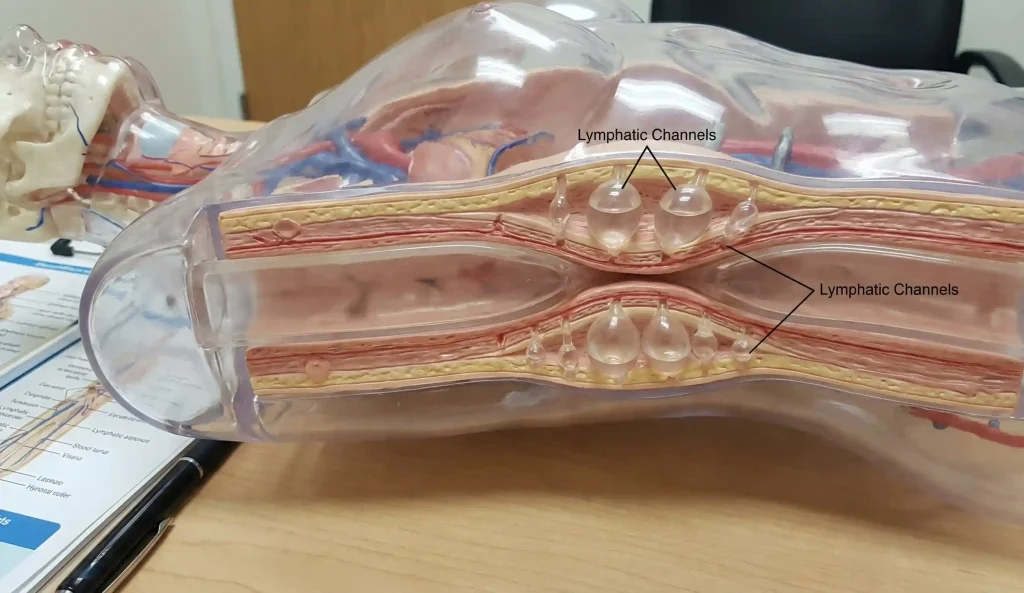
The lymphatic system works as a drainage system by low pressure and thus lymph, in contrast to the blood which is pumped by the heart, moves very slowly and in a totally passive manner, relying almost entirely on the surrounding tissue movements and their pressure for its flow.
Once you start wearing a stage 2 faja that applies crushing pressure way before the time, you are simply closing the walls of the fragile lymphatic vessels. Hence, the fluid ends up being trapped rather than drained. It results in chronic fibrosis and hard lumps because from protein-rich fluid stagnating to tissues and hardening paradoxically, the use of a faja that is too tight in the long time may actually cause you to be even more swollen.
Breathing and Digestion Issues
Postoperative recovery requires oxygen. If your rib cage is confined by a faja, you will not be able to take full, deep breaths using your diaphragm. This will make you resort to taking short, shallow breath which increases the risk of atelectasis (partial collapse of the lung base) and also pneumonia.
In addition, too much pressure from the faja onto the abdominal area can cause a buildup around the stomach and intestines and is often accompanied by severe instances of acid reflux, nausea, and constipation. In case your need to unzip your faja just be able to have your meal, then it is a sign that it is too tight on you. Healing burns a lot of energy, and if you are not able to eat or breathe correctly, your recovery will be prolonged for sure.
The Lin Europe Standard: The “Snug Hug” Test
Lin Europe Clinic puts safety first over the “snatched” look during the early healing phase as though we had just performed the operation. For this purpose, we fit our patients immediately after the surgery in a “Stage 1” garment which is of low-compression and high-elasticity, thus allowing for the initial swelling and the shape changes.
We show the patients the “Slide Test” method. You must be capable of sliding your flat palm under the same area on combing the faja with the skin of the body that is on the inside. It should feel like a nice hug or wearing a supportive swimsuit which provides you with security to the extent that you are not out of breath. Only once the swelling has gone down and the skin is fit to handle the pressure do we switch our patients to the tighter “Stage 2” fajas, generally 4 to 6 weeks later.
There is a constant check on your skin to see if there are any signs of redness with every follow-up, meaning that your desire to have a figure of the hourglass shape will not happen at the expense of your health.
Frequently Asked Questions About Faja Fit
Some signs that your faja is too tight include if you have numbness in your legs, trouble breathing, very bad acid reflux, and if the garment is rolling down and hurting your ribs or waist by cutting in.
You usually wear a faja for sleeping during the first 6 weeks after surgery, but the faja has to be comfortable enough so that you can sleep well; if the pain caused by the faja is such that it prevents you from sleeping, then you need a larger size or to loosen the hooks.
They are friction burns or pressure ulcers caused by the garment rubbing against the skin or digging in at the creases; one can recognize them as red, raw blisters and if they are not treated, the scars that are left can be dark and permanent.
Usually, after 4 to 6 weeks post-op, once most of the liquid swelling has gone and the wounds are completely healed, patients change to a tighter Stage 2 faja.
Indeed, a faja that compresses your buttocks (the area where fat was grafted) will destroy the fat cells that were transferred; hence, you should always make sure that the fabric of your faja over your butt cheeks is loose and does not compress them.
Chow, I., et al. (2015). Postoperative management in body contouring. Clinics in Plastic Surgery.
Kenkel, J. M., et al. (2008). Hemodynamic physiology and thermoregulation in liposuction. Plastic and Reconstructive Surgery.