Yes, thick skin increases the risk of pollybeak deformity.
Rhinoplasty tops the list as the toughest plastic surgery, mainly because the allowable error is so tiny – measured in millimeters. Among many issues and topics brought up by patients online at odd hours, hardly any is as infamous and distinctive as the “Pollybeak Deformity.” Essentially, this condition represents the supratip area becoming overly convex and swollen, resembling a parrot’s beak and causing the tip of the nose to curve downward. Profiles with this abnormality don’t display a smooth contour or a subtle supratip break. Instead, the nasolabial angle seems heavy, bottom-loaded, and ill-defined.
Theoretically, thick, greasy skin individuals have every right to worry about the Pollybeak. Although this problem may occur after any rhinoplasty, it is found disproportionately in thick-skinned patients. Nevertheless, it should be emphasized that the culprit here isn’t the thick skin alone; it is how the surgery interacts with that skin. In most cases, the deformity results not from the skin being thick, but rather from a discrepancy between the skeletal framework that has been set back and the skin’s capacity to shrink over it. At Lin Europe Clinic, we are specialists in ethnic and thick-skinned rhinoplasty. From our practice, the comprehension of “dead space” and the scar formation mechanism is the secret to avoiding this complication even before the first cut is made.
“Dead Space” and the Resultant Scarring – How Does that Work?

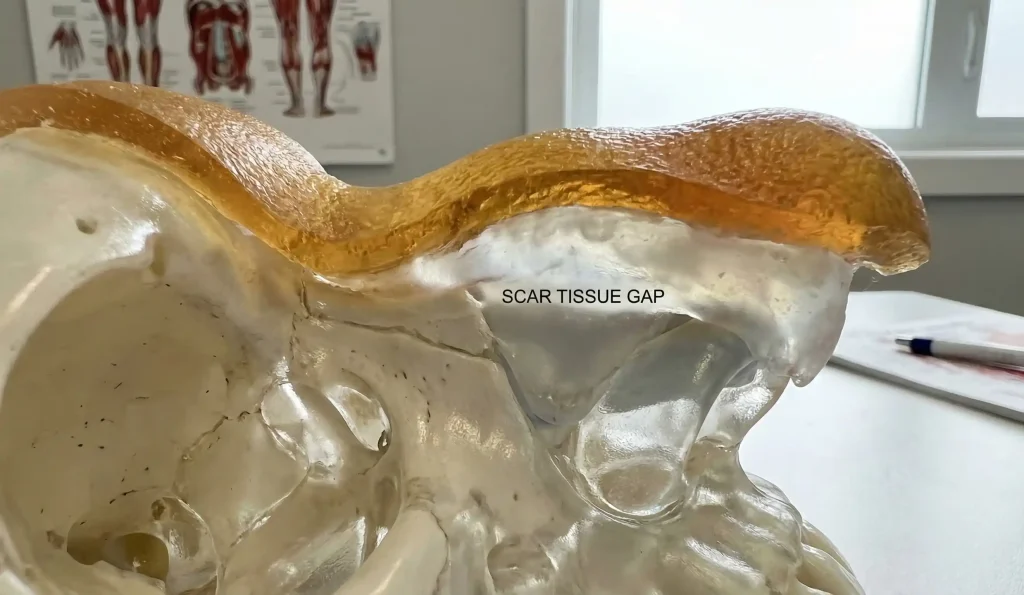
Consider the nose in the form of a tent to figure out how thick skin is responsible for the Pollybeak. Cartilage and bone are the tent poles, while the skin is the tent fabric. Therefore, in a typical rhinoplasty case, the surgeon adjusts the poll to be smaller (tip and bridge reduction) aiming to refine the nose. When a patient is thin-skinned, the skin is elastic—like spandex—and it can easily conform around the new framework that is smaller.
Fortunately, in thick-skinned patients, the “fabric” behaves like thick leather or neoprene. It is not capable of shrink-wrapping effortlessly. If the surgeon massively reduces the cartilage bed underneath, the new lower bridge, and the thick, unyielding skin would be separated by a gap. This gap is called dead space. The body can’t stand vacuum/empty spaces and it adapts by filling them. The body is going to fill the dead space left after this surgical procedure with scar tissue that is dense and fibrous. This buildup of scar tissue around the area of the supratip causes the skin to be lifted and thus the internal, outwardly visible bump of Pollybeak is formed. So, in fact, the deformity is a little ball of scar tissue simulating the shape of the bone that had been removed.
How Cartilaginous and Soft Tissue Pollybeaks Differ
It is necessary to point out that there are actually two kinds of Pollybeak deformities and the choice of treatment depends on identifying one correctly. The first one is a Cartilaginous Pollybeak. This is the result of a technical mistake when the surgeon left too much cartilage on the dorsal septum (the bridge) while excessively removing the tip. In effect, you get a high bridge and a low tip that structurally form the beak shape. This can occur regardless of skin type, and the only way to fix it is surgically by trimming the excess cartilage.
The type that impacts clients with thick skin is the Soft Tissue Pollybeak. Here, the surgeon may have done the bony and cartilaginous work impeccably, thus making a beautiful, straight slope on the operation table. Yet during the skinning process, the thick skin refused to lay down. The structure beneath is ideal, but it is hidden in a mound of subdermal scarring. This is an extremely important point because premature surgery for soft tissue Pollybeak by mostly completely removing the scar tissue can result in the formation of more scarring and a vicious cycle of recurrence.
Why Thick Skin Isn’t Always A Good Reason To Have ‘Less Is More’
Quite a few patients with large, bulbous noses instinctively wish for a ‘tiny’ nose. They associate that with a drastic change in size. On the contrary, for thick-skinned patients, the main causes of Pollybeak deformity are very aggressive reductions. When there is too little of a structural framework, the epidermis collapses and thickens.
The paradox of thick-rhinoplasty is that for a nose to appear properly shaped and smaller, you sometimes have to preserve or even boost the structural projection. So, instead of cutting the bridge all the way down, the highly skilled professionals leave a strong bridge and push the nose tip forward and outward. Once tip is pushed outwards, the thick skin is stretched over the surface just like when the height of the tent is raised so that the wrinkles in the canvas get smoothed out. The tightness of the skin reduces its thickness and also takes away the dead space, which means scar tissue will have no area to build up. In this way, the nose appears smaller and more elegant not because it measures less but because it carries its own style and has a certain refinement instead of being simply packed.
Taping and Steroid Treatment – What Happens After Surgery?
Differentiating thick-skinned patients from normal skin ones in the biological tendency involved in supratip scarring is so extreme that the surgery itself is only half the story. The other half is post-operative care that is so rigorous that the scar tissue is kept in check way before it becomes hard. Patient adherence becomes the key element at this pitching stage.
Generally, these two methods of treatment are combined. Firstly, compression taping is performed on and off for several weeks or even months at nighttime only. By exerting external pressure skin is pushed down to the cartilage surface, dead space is closed and fluid accumulation is prevented, which is basically through physical force by the tape. Secondly, and definitely the most crucial method, is Kenalog (Steroid) Injection. One month into the post-surgical period, if the doctor recognises that the supratip region is swelling or becoming harder, he will administer a tiny dose of steroid locally to scar tissue by injecting. As a result, collagen synthesis is interrupted and fixing of scar tissue is induced through the destruction of those that have already been formed, thereby flattening the elevation. Being a complication is out of the question since it is just a routine measure in thick-skin rhinoplasty to manifest the underlying contours.
Lin Europe – The Clinic Where Heavy Envelope Is The Master Confirmed
We at Lin Europe Clinic in Turkey, know that thick skin calls for the adoption of an entirely different surgical approach from thin skin. Therefore, we do not resort to a “one-size-fits-all” reduction technique. Our surgeons are experts in Structural Rhinoplasty which is a technique that essentially focuses on making the nose a stronger one rather than one that is weaker. It is acknowledged by us that the “Snoopy” or “Pollybeak” look is probably a case of failure to support rather than failure to reduce.
By implementing rigid cartilage grafting techniques—from septum or rib—our practitioners create an unbreakable nasal tip tripod structure. As a result, we can resist the heaviness of your skin, and the definition that we bring forth during surgery will be the same one you see when looking in the mirror a year later. In addition, our post-surgery care plan includes a detailed schedule for the evaluation of scar tissue development. We don’t wait for a Pollybeak to form; we anticipate it. Our team is proactive with taping protocols and steroid therapy, guiding your thick skin to settle smoothly and safely. At Lin Europe Clinic, your skin type is not a limitation; it is simply a variable that we manage expertly.
Frequently Asked Questions About Thick Skin Rhinoplasty
Patients with thick skin generally have large pores and oily skin along with a nasal tip that feels fleshy and rounded instead of bony. You can barely see the edges of the cartilage underneath.
Usually not. Even though swelling may go up and down, the organized scar tissue (fibrosis) is permanent. If the bulge is caused by fluid (edema), then it might go down, but if it is mature scar tissue, then intervention is necessary.
The injections can be a bit uncomfortable, the pain is like a pinch followed by a pressure sensation, but they are very quick. To reduce the pain, we sometimes apply a numbing cream or mix the steroids with lidocaine.
It usually starts more visibly when most of the swelling has gone down which is around 1 to 3 months post-op. The localized fullness in the supratip area, where the scar is probably forming, will become noticeable.
Yes, revision is difficult because the surgeon has to first cut through the dense scar tissue that was formed from the first surgery and then repair the support that was probably removed, which often means using rib cartilage grafts.
Tardy, M. E., Jr, et al. (1995). The cartilaginous pollybeak: etiology, prevention, and treatment. Facial Plastic Surgery.
Guyuron, B., et al. (1996). Supratip deformity: a closer look. Plastic and Reconstructive Surgery.
Ghavami, A., et al. (2010). Middle eastern rhinoplasty. Plastic and Reconstructive Surgery.