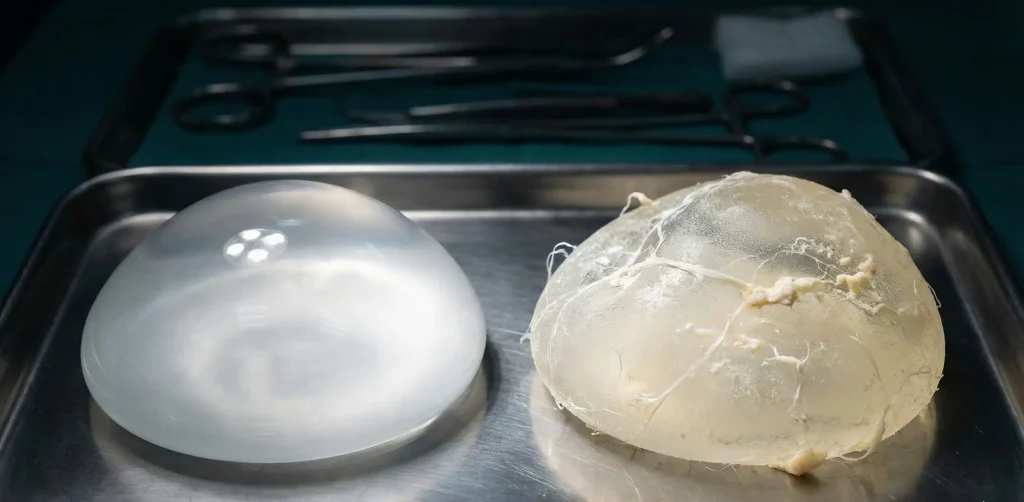
They age and may weaken over time.
Most people focus mainly on the immediate results after the breast augmentation surgery, but very few actually think about what will happen in 20 years. However, breast implants are foreign bodies that are placed in a living and changing environment where they are constantly exposed to body heat, muscular pressure, and are under immune system surveillance 24 hours a day.
It is a justified question whether the implants inside the body age and how this affects the person. Silicones used in medicine nowadays are chemically very stable and do not “rot” as organic materials do, so the aging of the implant is very slow, but it is not in a vacuum. The implant shell and your tissues interact chemically and physically in a complicated way which eventually results in changes of the implant that may be felt as well as the two natural breasts becoming different both in appearance and in the level of safety. Lin Europe Clinic emphasizes that understanding the aging of implants and tissue is the key to making conscious decisions about long-term surveillance.
The “Eggshell” Effect: Calcification of the Capsule
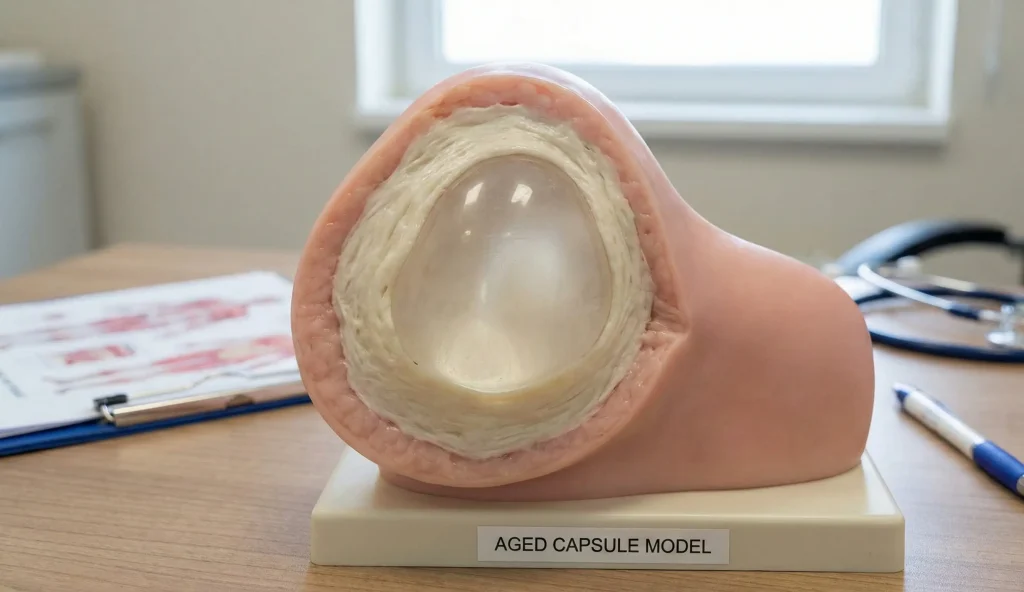
One of the most obvious characteristics of old implants is the changes that occur in the scar tissue around the implant. After surgery, your body ejects the implant by forming a layer of collagen which is called capsule and at first it is soft and easily deformable.
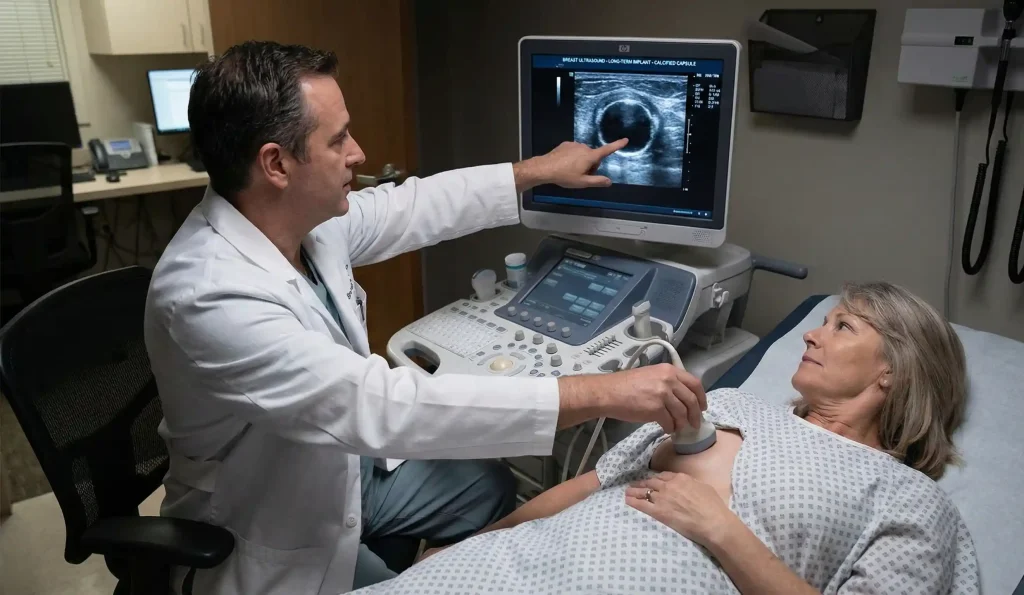
Nevertheless, a scar tissue deposited over a lifetime can become calcified. The cells incorporate calcium crystals into the collagen fibers just like they do when they make bones. Thus, what was once a soft capsule may after twenty years become a hard and brittle shell akin to a ceramic or an eggshell layer just under the skin. Women whose capsules have become callous often describe the breasts as ‘crunchy’ and/or excessively firm. Although it is not a malignant condition, it is very difficult to interpret mammograms since the calcifications mask tumors, this finding is in fact a visible sign that the body has enclosed the implant in a “rigid tomb”.
Gel Bleed: The “Sweating” of Silicone
One of the less known causes of implant degradation is gel bleed, especially affecting the older generation of implants from the 1990s. The silicone elastomer shell, which makes the implant structurally sound, is actually a semi-permeable membrane that allows by diffusion silicone of molecular size less than its pore size to move through it, so very small silicone molecules (polymer chains) can slowly move out through the intact shell even without a tear before the full rupture of the composite skin.
The ‘gel bleed‘ or ‘gel weeping‘ mechanism describes the fact that minute amounts of silicone fluid eventually find their way and accumulate on the surface of the implants, thus irritating the surrounding capsule. The macrophages, which are the body’s garbage collection units, try to get rid of the foreign oil by engulfing it but then carry it to the closest evacuation site i.e. the lymph nodes located in the armpits. This explains why women who have had very old implants for a long time show signs of ‘siliconomas’ which develop on the nodes as a result of the deposition of the silicone fragments that have migrated from the gel bleed process. They are generally innocuous swellings but they resemble breast cancer and so the women are exposed to unnecessary alarm and biopsies.
Shell Fatigue: The “Paperclip” Physics
Implants are not just static objects; they are rather dynamic devices adapting and reacting to the movement of the body including breathing and walking. Additionally, if the implant is placed under the muscle, that muscle will compress it thousands of times a day, which really becomes a cycle of continuously folding and unfolding the implant.
In simple terms, this is how the implant shell finally gets “shell fatigue.” The concept is the same as when you bend a paper clip up and down until it breaks. Although the shell may be designed to resist these stressors, at the end, it will show fatigue and the shell will be marked with deep creases or ‘fold cracks’ at areas of high stress where the material is already compromised. This explains why, with increasing time, the risk of rupture also goes up; an implant which was nearly indestructible at the beginning of year one may turn out to be delicate by year twenty. So the rupture of an elderly implant happens not so much from a fall on that point where the trauma occurred but rather because the shell gave up at a fatigue point and, therefore, the gel remains within the pocket as a result of a silent rupture.
Pressure Atrophy: The Thinning of You
It is also important to consider that the natural tissues covering the implant may get damaged over time. An implant is a device that always has to exert force on the skin and gland; it is a constant, low-grade internal pressure application.
This is what we call pressure atrophy: the natural tissues have become thinner because of the presence of an implant that pressed continuously on the tissues. It is by the passage of 15 or 20 years that the natural tissue layer-thickness can reduce significantly such that the implants are felt or seen quite easily since the “padding” of the natural fat is gone. In pictures, this is what contributes to a ‘non-aged’ look wherein the breast resembles less a natural mound but rather a ball under thin skin. Occasionally, with large implants, this pressure is so great that even the rib cage is mildly remodeled.
Biofilm: The Silent Colony
As a matter of fact, the surface of every implant is covered by a biofilm – a thin layer of bacteria. It is not an infection with bacteria that multiply, but rather a colony of bacteria in a dormant state living on the implant surface.
Sometimes, this biofilm can become worse and, as a result, cause the activation of the immune system slowly and continuously, which can lead to the breast becoming both hard and painful over a short period of time. This situation is known as “late-onset capsular contracture.” Basically, the immune system has been unable to get rid of the dormant bacteria and it reacts by aggressively contracting the capsule to wall off the infection.
Experience the Lin Europe Difference: The “En Bloc” Experts
We at Lin Europe Clinic are focused on the safe management of breast implants in the elderly. We know that removing and exchanging devices after 20 years is not an easy decision and it must involve a specialist.
Our surgeons have extensive experience with the “En Bloc Capsulectomy “ procedure, which is the ideal method for the removal of implants. In this technique, the implant and the calcified capsule are not separated one from the other and the whole unit is removed at once. This method prevents your tissues from being exposed to any gel bleed, biofilm, or fluid that may be present in the capsule. In other words, by taking out the whole ‘pack,’ it is possible to ensure that the anatomy is restored to what it was before the plastic surgery, which provides a clean slate for the patient whether she chooses the new 5th-generation implants or decides to keep the natural look.
Frequently Asked Questions About Aging Implants
No, the silicone molecules are very big in size and cannot pass through the walls of the blood vessels. The leaked silicone gets either stuck in the scar capsule or migrates to nearby lymph nodes, but it does not contaminate the blood.
The crunchiness you feel is due to calcification—calcium deposits that have accumulated in the scar tissue capsule over many years. It is a benign condition but may cause discomfort.
It is not a good medical idea to use the same device for 40 years. There will be a high risk of silent rupture and shell degradation, hence, it will be safer to do a proactive exchange.
Although there is no scientific proof for everyone, a lot of women with Breast Implant Illness (BII) have stated that they have noticed a decrease in systemic inflammation after getting their old foreign bodies removed.
Present-day 5th-generation “gummy bear” implants feature high-tech, “low-bleed” shell technology. Therefore this phenomenon of “gel bleed” is becoming very rare compared to the time when implants from the 1990s were used.
Tebbetts, J. B. (2002). Dual Plane Breast Augmentation: Optimizing Implant-Soft Tissue Relationships. Plastic and Reconstructive Surgery.
Collis, N., & Sharpe, D. T. (2000). Silicone gel bleed: a review of the literature. British Journal of Plastic Surgery.