No, facelifts can be suitable for younger patients.
For many years the word “facelift” was directly associated with the image of an elderly lady (around 60-70 years old) who was after improvement of very aged skin on her face and neck with jowls and wrinkles. The annual aging rescue operation was the only possible meaning for a facelift at that time. However, if you take a look at Instagram or TikTok nowadays you will be surprised to find out that the majority of the population talking openly about plastic surgery are really young people, mainly late 30s and early 40s ladies, – vibrant and in most cases absolutely beautiful and healthy looking.
As a result of this demographic movement, a new consultation question has emerged strongly: “Am I too young for a facelift?” The answer at Lin Europe Clinic has become different with time. If your aim is only the traditional, heavy surgical facelifting of the skin in the style of the 1990s, then certainly you will be considered too young for a surgery by us. However, if your intention is the modern, structural renovation referred to as “prejuvenation,” age should not be an obstacle. The “Young Facelift” does not help to recover old age, it simply represents the face re-architecting and “snatching” the features while the skin still has the ability to stretch.
What Has Changed So Much So That Young Women Are Getting Facelifts?
The question is: “Why is the new generation going for surgery in the absence of wrinkles?” The target has changed. Nowadays the ideal standard of beauty – largely under the influence of stars like Bella Hadid, Kendall Jenner as well as social media filters free from any distortion – is no more “non-aging.” It means that people want to be “snatched.”
Young patients want particular geometric modifications:
- High, Backward-Drawn Cheekbones: They wish the apples of their cheeks to be placed even higher and more lateral than the current ones.
- Fox/Cat Eyes: A lateral brow lift that opens the side of the head, giving an upward slant, like the eyes of an animal.
- Sharp, Defined Jawline: Defining the mandibular border before the jowls come.
They want their look permanently to be what it is when they pull their hair back really tight way into a high ponytail. So the term “Ponytail Lift” has been coined by the marketers here. No other method apart from makeup and non-surgical treatments can create such a fierce, uplifting vector, but such methods are only temporary in nature.
Beyond the Skin
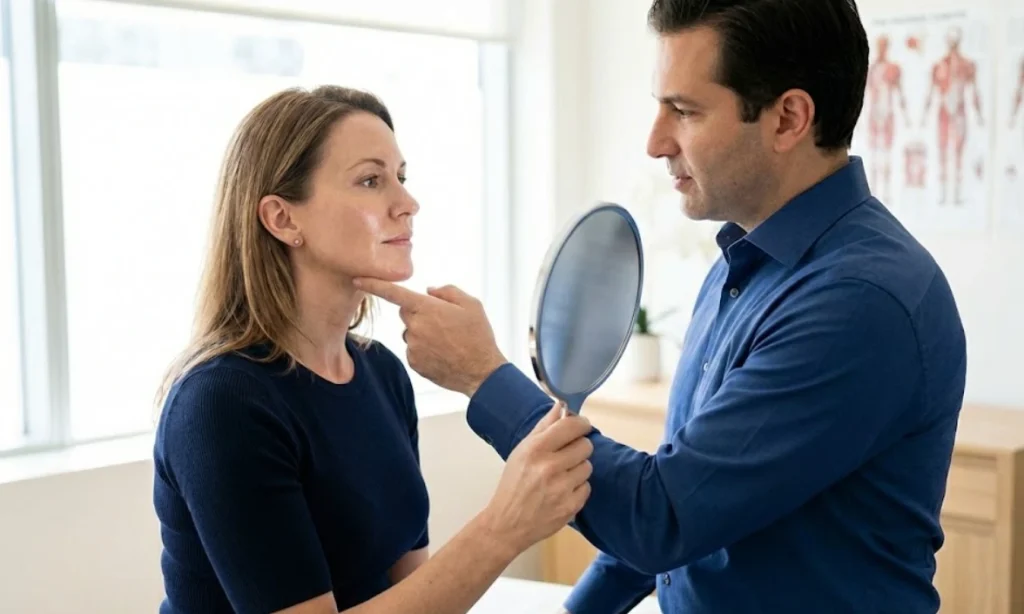
The major difference between a 60-year-old‘s and a 35-year-old’s facelift is the tissue level of treatment.
- Traditional Facelift (Cutaneous): Mainly Focus on removing the excess skin of a patient’s face.
- Young Facelift (Endoscopic/SMAS): Repositions the underlying muscles and fat focus without really removing skin.
For our young patients at Lin Europe Clinic, we mainly apply Endoscopic Facelift methods. We make small incisions (less than 2cm) that are completely hidden within the hairline at the temples. To help us see and at the same time conduct the surgery on the area beneath the skin, we use a camera (endoscope). We release the ligaments that are attached to the brow and cheek that we only very gently lift at the same time bringing up the muscle layer (SMAS) and fat pads vertically and securing them in a higher position.
- As a result: The mid-face is plumped, the eyebrows are raised, and the lines from the nose to the mouth are less visible. Due to skin not being cut out in front of the ear, therefore no facial scars are visible.
Filler Fatigue: The Tipping Point
The desire for a “Young Facelift” has been largely driven by the lifestyle fad called “Filler Fatigue.” Typically, women experiment with dermal fillers for the first time in their 20s. By their mid-30s, they will have been injecting hyaluronic acid into their faces for over ten years.
On the one hand, fillers work and are convenient for those small corrections that do not require a scalpel, but on the other hand, they distract from the problem of volume loss over time because they take up space. Besides, filler can change its location, get accumulated and absorb water causing facial swelling which leads to a puffy and distorted look or a so-called “pillow face.” What happens is that the face loses its lift, but gains this heavy and bloated look instead.
Patients come to the realization that the operation is in principle a better option because it is more natural afterwards. Instead of pumping the face up with 10 syringes of gel to give the illusion of lifting, surgery actually lifts the sagging tissue and brings it to its former position giving a sharp and even contour which fillers cannot achieve.
The Mindset of “Maintenance”
Some say that one should initiate treatment early enough in order to prevent larger interventions in the future, such is the idea of “maintenance surgery” or “banking youth.”
You may describe the aging process as gravity defeating your ligaments in a protracted battle. When in your late 30s or 40s you get your deep facial structures (SMAS) tightened, it is more or less like you are resetting the tension and thus the aging clock stop. Moreover, when you become old you will do so from a “higher” level. A person undergoing Mini Facelift or Temporal Lift at 42 will probably still look great at 60. This way the facelift can be a drastic overhaul or a subtle, undetectable refresh.
Full Recovery Time: Back to Work Quicker

One advantage of operating on young, healthy tissues is the quick recovery time. Younger patients not only get better circulation but also have more elastic skin resulting in the resolution of edema to be faster.
- Downtime: Majority of the patients having “Ponytail Lift” or endoscopic surgeries look presentable 7 to 10 days post-operation.
- Bruising: Since the incisions are deep (under the muscle) and not superficial, the resulting discolored sections of skin are often few and light in color.
- Scars: The hair hides the wounds, so you can put your hair up without any anxiety regarding the surgical marks.
Leading the Way in Advanced Endoscopy: Turkey
Facelifting for young people is even more demanding in terms of surgical skill because there is hardly any room for error. The beauty of the natural result becomes the “mask” for a perfect facial surgery. Thus a 35-year-old person should not look operated.
Turkey has become a prominent global player in the field of Endoscopic FaceLift surgery. Our surgeons at Lin Europe Clinic, Istanbul are not only prepared for, but they also excel at these scarless, ultra high-def techniques. We know all about the younger generations’ liking for the “cat eye” and the “snatched jawline” esthetic. No longer will you be faced with the never-ending circle of fillers and threads if you choose us to give you the solution which is permanent in every way and style-wise, structurally, and fit for decades of that fierce, fresh look!
Frequently Asked Questions About Young Facelifts
Not at all. You probably won’t need a full traditional facelift, but you could be an ideal candidate for an Endoscopic Mid-Face Lift or Temporal Lift to get the “snatched” look or fix early sagging with no visible scars.
A “Ponytail Lift” is a trendy term for an endoscopic facelift. It is a lift of the brows, cheeks, and eyes that is done through hairline incisions that are invisible. The result is a pulled-back, tight look that one gets when wearing a tight high ponytail.
It definitely does. Fillers only provide a temporary lift that surgery does permanently. A lot of patients choose to dissolve their fillers before surgery so that they can start fresh and avoid the “puffy” look as a result of the accumulation of years of injections.
It cannot be reversed or undone; however, the reality of the matter is that you keep getting older. The majority of the patients would say that they have enjoyed the best effects of the facelift for 10 to 15 years before deciding on a touch-up.
A mini face-lift, sometimes called a mini lift, focuses mainly on the lower face and the jawline. It is done through small incisions and is perfect if you want to remove early jowls. A full face-lift or full facelift works on your neck, mid-face, and brow. It is generally a treatment option for people with more advanced signs of aging.
Jacono, A. A. (2021). The Park Avenue Face: Secrets and Tips from a Top Facial Plastic Surgeon.
Marten, T., & Elyassnia, D. (2018). Short scar facelift: Neck lift and facial resurfacing. Clinics in Plastic Surgery.
Ramirez, O. M. (1994). Endoscopic techniques in facial rejuvenation. Aesthetic Plastic Surgery.