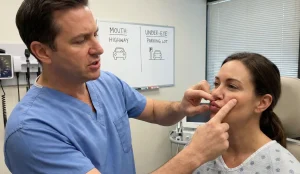
Yes, rhinoplasty can be performed on thick skin.
In cosmetic surgery, the nose is frequently likened to a tent in terms of its structural complexity. The cartilage and bone serve as the poles and frame, which is the skin, the fabric draped over them. When a person with thin, almost see-through skin has a rhino, the surgeon’s every action is revealed; like a thin silk sheet over a wire frame, even the tiniest change shows through. However, for thick skin patients, it is a completely different story.
During consultations at the Lin Europe Clinic we come across many patients who have lost their hope. Most of the time, they have already been informed by the other doctors that their nose is “too difficult” or that they can’t have the chic, petite, “Instagram-ready” tip that they want. Usually, these patients have thick, sebaceous (oily) skin that is hiding the cartilage, so the nose looks featureless. To those of you wondering if it is possible to perform a rhinoplasty on thick skin, the answer is a definite yes. But this kind of operation needs a surgical approach that is very different. Working on thick skin is not only about removal; rather, it is about redesigning and providing strong support.
The “Velvet vs. Silk” Analogy
To grasp the difficulty of thick skin rhinoplasty fully, consider the difference between placing a silk tablecloth on a sharp-edged table and putting a heavy, plush velvet blanket or a thick comforter on that table. The first case would allow seeing the corners, the edges, and the exact shape of the table clearly. The second case would, on the other hand, cause the sharp edges of the table to disappear. The corners looked rounded, soft, and blunted.
This is the way thick skin works. It doesn’t matter how pointed, sharp, or defined the cartilaginous tip underneath is; thick dermis always behaves as a layer of cushioning that dulls the visual effect.
- The Look: The main concern of people with thick skin is that their nasal tip looks bulbous, shapeless, or is “meaty”. Usually, they have big pores and an oily T-zone.
- The Weight: Thick skin has weight. Due to its heaviness, the skin envelope is progressively pulled downward by gravity, thus causing the tip to droop (ptosis), especially when smiling. The tip’s weight gives the foundation a need to be more robust than that of a thin nose.
The Mistake of Reduction: Why Smaller Isn’t Better
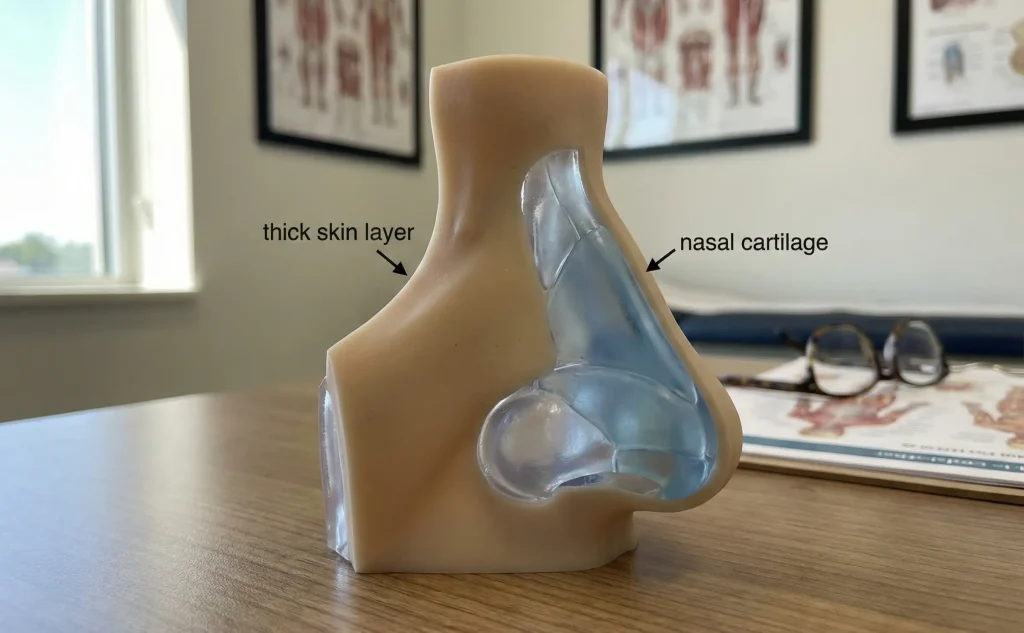
One of the most common mistakes that patients make is to think that a surgeon should take away more cartilage and bone in order to make a thick nose look less bulky. Some inexperienced surgeons fall into this trap.
Previously, a reductive rhinoplasty, i.e. forcibly shrinking the nose by cutting away the cartilage, was the usual practice. This is a disaster in an individual with thick skin. Under a heavy blanket (thick skin), if support (tent poles) is taken away, the blanket will not shrink-wrap tightly; it will collapse.
- Dead Space: When the skeleton is over-shrunk, a space appears between the cartilage and the thick skin. This space is known as “dead space”. Since the body hates empty space, it fills it with scar tissue.
- The Result: This scar tissue makes the nose even thicker, which can result in a shapeless mass or the dreaded “pollybeak deformity” where the area above the tip becomes bulging and swollen just like a parrot’s beak.
The Solution: Structural Rhinoplasty
Lin Europe Clinic doctors recommend Structural Rhinoplasty to their thick-skinned patients. We don’t reduce the size of the skeleton, instead, we make it stronger and more projected. We require a framework which is so strong that it cannot be pushed over by the heavy skin but instead, it forces the skin to reveal its definition.
- Planting a new graft is like planting a reinforced tent pole in a place where the ground is very soft and likely to slip. In order to find the base of the pole, the pole itself has to be very strong. Similarly, as the nasal structure is a very demanding area for a growth, a strong cartilage graft is necessary when dealing with thick skin type. Thus, to provide a firm central septal joining, in that exact location, the dorsum of the nasal tip cartilage is connected to a rib cartilage graft or a deep part of the septum by the surgeon.
- By pushing the tip out slightly (protruding it), a stretch is created in the thick skin. Just as a thick fabric that is stretched looks thinner and more taut, nasal tip projection reduces the thickness of the skin envelope, thereby uncovering the definition beneath.
- The clinical term for this is “de-roofing” which literally means thinning out the roof of the nasal tip skin. It is usually done in combination with other techniques such as onlay and shield tip grafts for achieving more structural support and better tip definition and projection. Mainly the change is visible to a person who seriously looks at the eyes and tip of the nose after surgery.
- There will be a shadow created above the nasal tip (supratip) which is where the cosmetic surgeon will do this. The optical illusion of a tip that is more refined and distinct is given by this sulcus, even though the thickness of the skin remains unchanged.
The Recovery Marathon: The “Waiting Game”

The procedure with thick skin skin requires a marathon rather than a sprint for the recovery phase. Due to the abundant blood supply and the extensive lymphatic system of thick skin, it is more likely that the edema (swelling) will persist for a longer time when compared to thin skin.
A thin-skinned patient may get around 90% of their result in 6 months, whereas a thick-skinned patient may require 18 to 24 months for the tip to be completely “wrap shrink” and become well defined.
- One day you may look in the mirror and see the definition that you were after, but after eating a meal with salt, on the following day the mirror may show you a swollen appearance. These types of changes in the condition of the facial skin are normal.
- In order to keep the swelling down, away from the tip of the nose, we sometimes do a series of cortisone injections directly into the nasal tip leading up the follow-up visits which effectively and rapidly reduce the nasal tip edema and the internal scar tissue that accompanies the inflammation.
- We usually recommend thick-skinned patients to wear nose tapes at night for a few months. This helps push the edema out by applying gentle pressure and at the same time, the skin is encouraged to adhere to the cartilage.
Why Turkey is the Hub for Thick Skin
Turkey is located at the crossroads of the populations where thick, sebaceous nasal skin becomes a genetic trait that is most common. Thus, Turkish surgeons probably have the greatest experience in the world of handling this particular tissue type. The volume of such cases is in the thousands and it is only going to grow.
At Lin Europe Clinic in Istanbul, we look at thick skin not as a hindrance to beauty but as a special kind of medium that demands exceptional expertise. Since we are very aware that “cookie-cutter” noses are not meant to be found here; therefore, advanced grafting techniques and aggressive post-operative care specifically targeting the fight against the skin’s heaviness are what we rely on to bring out the best from them. We also guide our patients through the psychological preparation for the long healing process ahead, so that they understand that the lack of definition they witness around the third postoperative month is just an intermediate stage, a masterpiece hidden under the swelling.
Frequently Asked Questions About Thick Skin Rhinoplasty
Yes, it is possible but it is more challenging from a technical point of view. The surgery will be done by a structural rhinoplasty surgeon who focuses on adding structural support to the nose rather than just removing cartilage. Reduction alone is generally not effective with thick skin.
Large, visible pores and oily T-zone are signs of thick skin. Also, if you can squeeze oil (sebum) out of your nasal tip, you probably have thick skin. Furthermore, if your nasal tip feels fleshy, soft, and spongy instead of being bony or cartilaginous, it is likely that the skin is thick.
At first, yes. The swelling experienced by thick-skinned individuals is very intense and lasts quite a long time. One can expect the nose to appear swollen, wide, and without any distinct features for the first 6 to 8 months. The real contour typically becomes visible only after the one-year mark.
In most cases, yes. Open rhinoplasty allows the surgeon to have a complete view of the area, which is very important for the complex grafting, suturing, and defatting necessary to adequately handle the heavy skin envelope. Closed rhinoplasty is often inadequate for major structural changes in thick noses.
Yes, it is one of the main factors. If the skin is not going to shrink over the nose bridge, there is the risk of scar tissue forming in the “dead space” above the tip, which results in a bird-beak shape. Without strong structural support and steroid injections, this can happen.
Guyuron, B., et al. (2010). Management of the thick-skinned nose. Plastic and Reconstructive Surgery.
Rohrich, R. J., & Gunter, J. P. (2002). The importance of the supratip break in rhinoplasty. Plastic and Reconstructive Surgery.
Toriumi, D. M. (2000). Structure approach in rhinoplasty. Facial Plastic Surgery Clinics of North America.