

Yes, light desk work is usually possible after 3 days.
In the present world where everything moves fast, it seems as if we cannot even think of a medical recovery as a time for rest. We are so connected with the world around us and, thus, for a lot of women dedicated to their careers, even a couple of weeks off are unthinkable. Therefore, one of the first questions that are asked in consultations is about the time schedule rather than the operation itself: “Can I get back to work only 3 days after breast augmentation?“
At Lin Europe Clinic, we don’t just get it—we feel that pressure very deeply. Surely, the idea of having your operation done on Friday and being able to work on Zoom again on Tuesday without even a little break in between is really tempting. Basically, the response is “probably”—however, there are several crucial limitations. Three days post-surgery, you may physically be able to sit in a chair; nevertheless, the question is whether you should do that, and even more, whether you will be able to get things done. It is extremely important to clarify what is meant by the word “work”; while the opening of a construction site after an injury is out of the question, even returning to a laptop implies a biological obstacle course which exactly on day three is the toughest one.
The “Day 3” Peak: The Elephant in the Room
To begin with, it’s good to realize that surgery leaves some inflammation and after the surgery goes down; that is your body healing. A lot of patients will wake up the day after surgery thinking that they feel good and are ready to do something because they still have a bit of an ability to numb the sensation and relief of adrenaline. Thus, they can think, “It’s okay; I can even work on Monday.”
Yet, the body doesn’t react by inflammation all at once, and it can take quite a while before you experience it fully. Three days after the surgery is the time when the swelling (and the situation with the edema) reaches its highest point. At the same time, if implants are under the pectoral muscles, the muscles themselves reach the most intense spasm. The patients refer to that feeling as if there is an “elephant on the chest.” Day three is when you will notice that the stiffness, soreness, and tiredness are much more pronounced than on the first day, even if one might assume the opposite would be the case. For your body, to do tasks that require a lot of concentration or to have to remain sitting for eight hours are especially unpleasant demands when it is in the state of peak physiology that corresponds to day three.
The “Brain Fog” Factor
Even in the case that you can keep your pain at a low level, it doesn’t mean that your brain is capable of doing calculations. Anesthesia in general leaves a sort of aftereffect known as “brain fog” which lasts up to 72 hours. You may notice that you go in and out of sleep, are absent-minded, or your mood is unsteady. Besides, narcotics can be required in the first days to ease the submuscular tightness and rawness that cause pain.
These types of medicines are pretty much the opposite of what you need if you want to be productive at work. They are rather the cause of sleepiness and distractedness. If part of your job is to drive, use a machine or make important financial or medical decisions then at that moment you being on medication is not only tough but also dangerous and illegal in most parts of the world. In case you’re set on day three as your return day, then you have to be ready for it without using more than regular dose of Tylenol, which probably will not be enough for a submuscular augmentation discomfort.
The “T-Rex” Arms and Typing
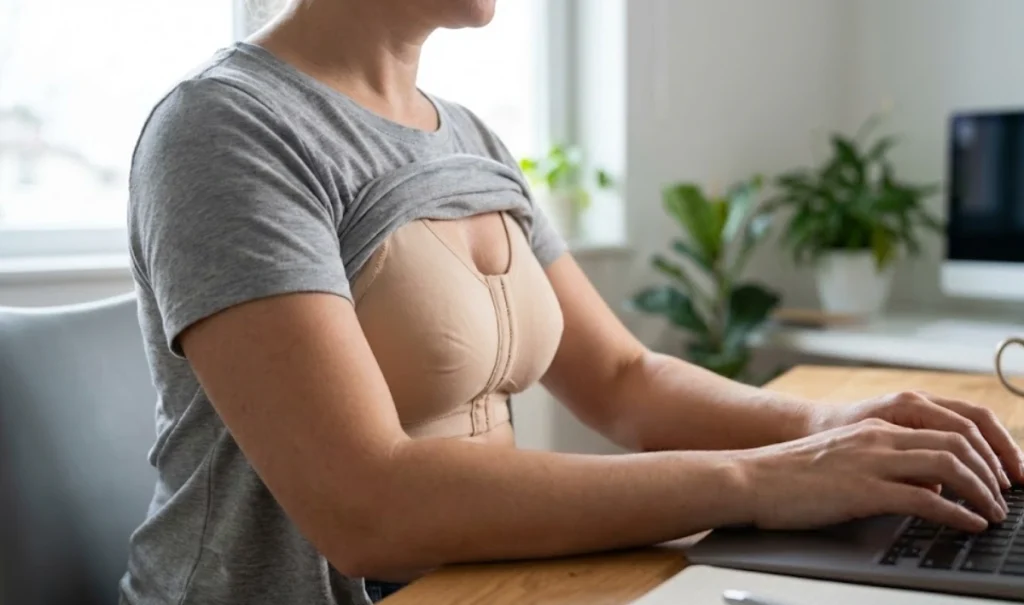
Choosing submuscular placement (implant under the muscle) is the standard between those aiming for the most natural look. With this method, one has almost zero freedom in terms of upper body movements. “T-Rex phase” is the name we came up with for this stage since you are going to keep your hands close to your body without extending them to avoid hurting your pectoral muscles.
Typing might be going on passively, but even you reaching the keyboard and clicking the mouse are activating the chest muscles. On the third day, this repeated and minor activity, in your opinion, leaves you not only miserable, but also causes inflammation and brings about a risk of bleeding (hematoma) in case you continue exerting yourself. If, as a desk worker, after typing for about 20 minutes your chest feels like it has been put through a fire, then that has to be your sign to stop.
The Hidden Benefit of Medical Tourism
To a certain extent, those who opt for medical tourism to get their operation done most often also end up benefiting from it as a result of them not being able to working right after the surgery. When your operation is booked in Istanbul, Turkey at Lin Europe Clinic, you, in fact, happen to be distant from your working place, housework, and the everyday stuff that all add up to stress.
Your itinerary serves as a natural cushion. Our patients do not have to deal with the fatigue of their first postoperative days while they are at the hotel; also, they recover with the help of the team and have no limitations in scheduling their time. This “forced” resting time after a surgery often turns out to be the deciding factor between a recovery that goes smoothly and a prolonged struggle. It is thus no wonder that our patients who come from far away and leave us usually about 5-7 days after their operation are already beyond the “Day 3 peak” and able to take on light work such as paper pushing or answering emails.
The Verdict: Give Yourself 5 to 7 Days
Is day three out of the question? No. Perhaps, if you have a subglandular augmentation, a great level of pain tolerance, and can work from the bed, you may make it. However, most women having a submuscular procedure should seriously get used to the idea of planning 5 to 7 days break.
Permit yourself to heal. How well you recover in the initial week greatly influences the end result. When you feel tired and think of replying to emails, just imagine! This might lead to an increase in your blood pressure, a worsening in the swelling, and an extension of the recovery time you are aiming to shorten.
Frequently Asked Questions
If work is a remote desk job it is physically possible, but definitely not a good idea. The peak of swelling and pain is generally the third post op day. Most patients feel that they are too exhausted or “‘drugged’ from medications” to get work done.
You are not allowed to drive if you take narcotic pain medication or muscle relaxants. Also, be able to pain-free turning the steering wheel. This normally happens in 5 to 7 days.
Certainly. The implant under the muscle leads to more tightness and the ‘T-Rex’ phase lasts longer than the over-the-muscle placement.
There is a danger of raising your blood pressure which may lead to bleeding (hematoma) or swelling. Also, you can wear yourself out and pain level will be higher because you have not rested enough.
For the first 4 to 6 weeks after the surgery, do not lift anything that weighs more than 5-10 lbs (like a gallon of milk). Therefore, if your work involves heavy lifting you will have to be on modified duties.
Adams, W. P. (2008). The process of breast augmentation: Four phases of care. Plastic and Reconstructive Surgery.
Cohen, J. B., et al. (2013). Return to work after breast augmentation. Aesthetic Surgery Journal.
Tebbetts, J. B. (2001). Dual plane breast augmentation. Plastic and Reconstructive Surgery.