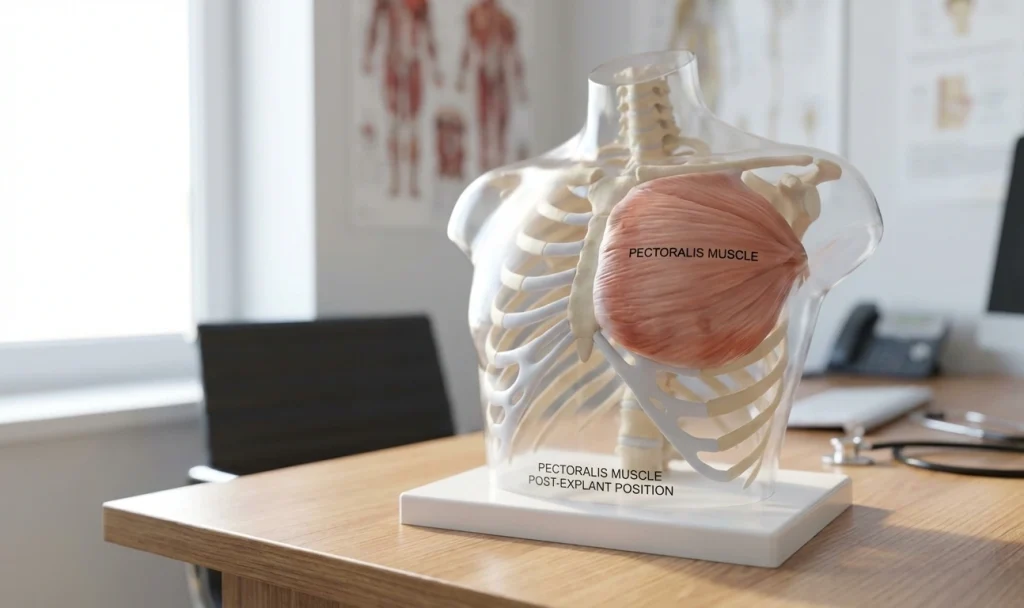
The chest muscle relaxes and returns to its natural position.
Women who get breast implants placed “submuscularly” (under the pectoral muscle) often come up with certain worries about their anatomy when they decide to get them removed. It is not unusual for patients to wonder, “What happens to the chest muscle after explant? Is it destroyed? Will it heal again?”
At Lin Europe Clinic we are able to give you a good news: the human body, especially muscle tissue, is very tough and can recover from a lot of damage. Although the pectoralis major muscle has become stretched and flattened due to the implant, the removal of the implant triggers a wonderful healing process. In the majority of cases, the muscle not only stays alive but also reverts to its old position and regains its function. Here we will talk about the biology of muscle regeneration after explant surgery.
The Immediate Release: The “Rubber Band” Effect
In order to understand the healing process, think about what happened to the muscle during your very first augmentation. Your muscle was raised and stretched over the implant just like a rubber band being stretched too far. After a few years the pressure from the implant made the muscle to get thinner and eventually it has been pushed against the device.
Removing the implant means the release of that tension immediately.
- Retraction: Muscle fibers shorten and retract as they are no longer pushed outward.
- Thickening: By not being constantly compressed, the muscle belly will slowly be able to reclaim its former thickness and soundness.
- Re-adherence: The most important stage is, definitely, re-adherence. The muscle settles down again on the chest wall (rib cage) and it starts to heal in its natural position.
Fixing “Animation Deformity”
“Animation deformity” is probably the most common problem women with submuscular implants talk about. This is the situation when you can see that implants jerk and change the shape of the breast when the chest muscles are flexed (for example when opening a door or doing a push-up).
Explant surgery is not only a good way of getting rid of the implants; it also helps to solve the problem.
- What Happens: By getting rid of the implant, the muscle no longer has to slide over a foreign object or be compressed.
- The Result: Your chest wall will contract normally after the healing. The weird distortions, the changes of the breast shape, the ripple and the jumping of the breast tissue usually disappear completely, so the chest movement looks natural again.
Does the Muscle Reattach to the Ribs?
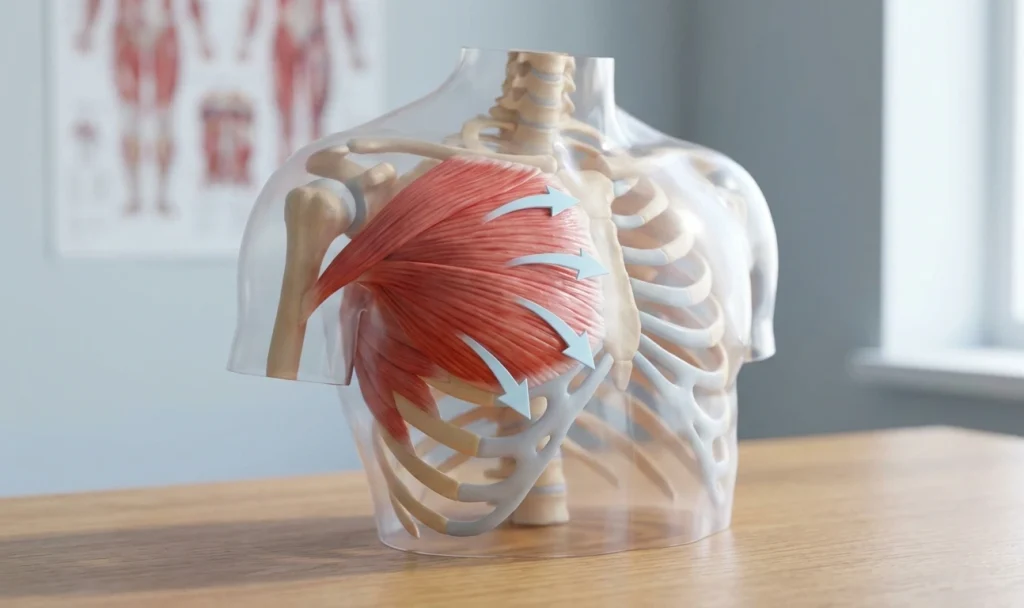
Usually during the first breast augmentation, the muscle’s lower attachment is cut or released to make enough space for the implant. Patients think it is a kind of permanent damage.
The scar tissue plays the role of a natural glue after explant. Even if the muscle does not biologically “grow” back into the bone just as before the surgery, the body makes a layer of scar tissue that practically sticks the muscle to the chest wall. This is how a stable and functional chest wall is created. You will not be able to feel the muscle “flopping around” inside; during the healing process it becomes firm and fixed.
Strength Recovery and Exercise
What a lot of people imagine wrongly is that explant surgery makes the patients weak. Most of the time, however patients say that they are stronger than before after they completely recover.
The implant had changed the function of the pectoral muscle and had put it at a mechanical disadvantage. The muscle was working under disadvantage because it was being constantly stretched. When the implant is taken out and the muscle heals (usually 6-8 weeks), the shoulder and chest biomechanics often get better. Upon the surgeon’s go-ahead, one will be able to do push-ups, weightlifting, and yoga with full force. Besides, the range of motion will be much better than it was with implants.
Capsule Removal and the Muscle
The muscle recovery depends on what happens to the scar capsule (the tissue that the body surrounds the implant with).
- If the Capsule is Left (or drains): Recovery goes faster and the muscle resettles quickly.
- If the Capsule is Removed (En Bloc/Total Capsulectomy): Removing the capsule that was adhered to the rib cage or muscle means you have to peel it off the muscle fibers. This causes a greater temporary soreness and bleeding. Nevertheless, it gives a “clean slate,” preciously allowing the raw muscle surface to directly heal against the chest wall.
Appearance of the Chest Wall

The upper chest will look different in a visual way. The loss of implant will lead to the loss of the upper fullness. At the same time, as the muscle gets stronger and bigger going along its normal healing process, the ribs’ bony look usually becomes less sharp.
Some women are scared of a “concave” or hollow look. Projection is gone but the muscle recovery initiates the smooth line from the collarbone to the breast tissue. If the hollowing really scares you, fat grafting is possible to mask the area.
Explant Surgery in Turkey
We know that a thorough understanding of the chest wall anatomy is an absolute must for submuscular explant procedures. At Lin Europe Clinic Istanbul, we are committed to using the most precise dissection methods to preserve integrity of the muscle especially when total capsulectomy is involved.
We are one of the few clinics in the world that provide the post-surgery physical therapy guidance under one roof with the personalized plan of your care. To make sure that you will be functional and comfortable, we work with you on gentle stretching exercises until your muscle re-adheres. Come to Turkey to regain your real strength with us where we value your functional recovery as much your aesthetic one.
Frequently Asked Questions About Muscle After Explant
It’s generally temporary and the reason is that your muscle was pressure flattened for quite some time with the implant. As the muscle heals and regains its volume without the heavy implant pressing down on it, the concavity normally disappears in around 6 to 12 months.
Six weeks is the approximate time period during which you should refrain from any activities that involve your chest muscles (such as pushing heavy doors or lifting). Although the initial pain goes away in a few weeks, the time needed for the muscle to be fully re-attached and to regain its strength is about 3 to 6 months.
You will notice an immediate decrease in volume and, most probably, some skin sagging as well. The skin will tighten up again to some extent. You will feel physically lighter, but it will take a few months for your natural breast tissue to “fluff” and settle into its final shape.
After the muscles have been stretched for years to accommodate the implant, they now go through the process of contraction and shortening which is the reason for muscle pain like after an intense workout. If your surgeon also separated the scar capsule from the muscle rib cage, then the raw surface from this procedure is another reason for the temporary pain.
During the muscle healing phase, one can experience soreness and tightness,almost like a very hard workout. The muscle fibers contract and shorten. It is a normal condition that can be regulated by medication.
Gabriel, A., et al. (2015). Outcomes of breast implant removal: A 10-year review. Aesthetic Surgery Journal, 35(7), 785-791.
Maxwell, G. P., & Gabriel, A. (2014). Bio-dimensional planning in revision breast augmentation. Clinics in Plastic Surgery.
Spear, S. L. (2010). Surgery of the Breast: Principles and Art. Lippincott Williams & Wilkins.
Swanson, E. (2014). Evaluation of symptoms in patients with silicone breast implants and the effect of explantation. Annals of Plastic Surgery.