
Yes, a hard fall can damage a breast implant.
Collapsing onto a rug, slipping on icy pavement, or falling down in the gym can be scary enough for anyone, but for women who have had breast implants, the concern doubles. The immediate reaction is usually: “Did I pop it?“
At Lin Europe Clinic we get distressed phone calls from patients who, after a fall, suspect their surgery has been compromised. The very short answer to the concern if you can break a breast implant by falling is indeed yes, but it is way harder than you think. Nowadays breast implants are very durable and breast implants in the US are made to withstand a lot of pressure. However, while the implant might be ok after the trauma, the area around it might be injured. This article goes through the genuine threat of trauma to the chest and the way to identify the problem.
Just How Tough Are Implants Nowadays?
In order to truly calm down your anxiety, you must be informed that today’s silicone implants (which are often described as “gummy bear” implants) undergo extensive testing. In their research, they are able to take hundreds of pounds of pressure without breaking. There are even viral videos of a car running over the implant without the implant rupturing.
If you compare it to a water balloon that would just burst, a cohesive gel implant is a solid and tough material. Therefore, a normal occasional fall such as tripping on the street or a toddler jumping on your chest will not inflict enough force to break an implant shell of a high-end brand. Only a high-velocity trauma such as a car accident where a seatbelt is tightly pressed against the chest with the extreme force or falling from a great height will the chance of rupture be very high.
The Safety of Cohesive Gel
Besides that, it is necessary to clarify the issue of “leakage“. Patients often imagine the liquid silicone flowing through their body as some poisonous substance if the implant is broken. The truth is, the shell releases a medical-grade “cohesive gel”, which chemically is closer to a gummy bear than a syrup.
Thus, even if the shell is torn or ruptured in the fall, the gel is predictable to keep its shape and stay together. It won’t “bleed” or run into the surrounding tissues in any significant way. Thus even the worst case of rupture, though damaging the appearance, is not done by the implant alone, but rather a matter of aesthetics that can be treated professionally.
The Real Risk: Hematoma and Displacement
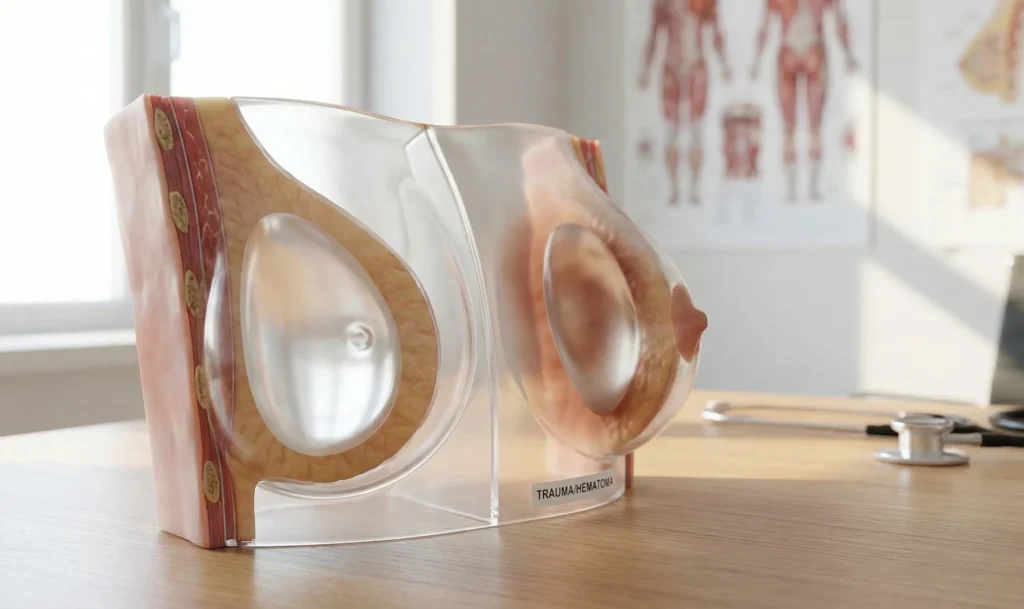
Even though the implant is very durable, the body is vulnerable. The fall can bring to light a variety of problems, but the breast tissue or the surgical pocket are the ones that are frequently affected by the trauma and this is the most likely situation.
- Hematoma (Internal Bleeding): Severe impact mechanically ruptures small blood vessels in the formation of scarred tissue around the implant. Blood collects in the pocket (hematoma). Symptom: rapid swelling, one breast significantly larger than the other, hardness, the presence of a severe purple bruise, and the skin having a deep, blue color.
- Displacement: Sudden and aggressive impact can cause the tearing of the inner scarring (capsule) that secures implant position. Consequently, the implant slips out of its pocket—going down too low or moving too far to the sides.Symptoms: abrupt imbalance or nipple position change.
Saline vs. Silicone: Detecting a Rupture
What happens depends completely on what type of breast implant you have if the fall was so severe as to break the shell of the implant.
- Saline Implants: The saline water will leak out and be absorbed by the body if the shell breaks. You will be aware right away (within hours or days) as the breast will visibly deflate and be flat.
- Silicone Implants: It is quite difficult in this case. Usually, gel is contained inside the shell or within the scar capsule, ‘Silent Rupture’, when the shell ruptures but the gel does not leak. It might take years before you notice the change which is why it is essential to keep track.
Signs You Might Have Damaged Your Implant
If you have fallen, it is wise to watch your chest for two weeks at least. Check these symptoms with care:
- Long-time Pain: After any injury, you can expect pain and discomfort; however, if your pain gets worse or is of a burning nature, or if the character of the pain changes to something similar to getting an electric shock, then the cause may be nerve damage or muscle tearing.
- Shape Change: Gaze at the mirror. Is one breast higher or lower than the other? Is there a bump or something different?
- Capsular Contracture: In some instances, the trauma activates inflammation and the body’s reaction is tension of the implant. If you find your breast becoming hard and getting bigger a few weeks after the fall, it might be a sign of injury reaction.
- Swelling: Is one breast visibly swollen or hotter than the other one?
What to Do Immediately After a Fall
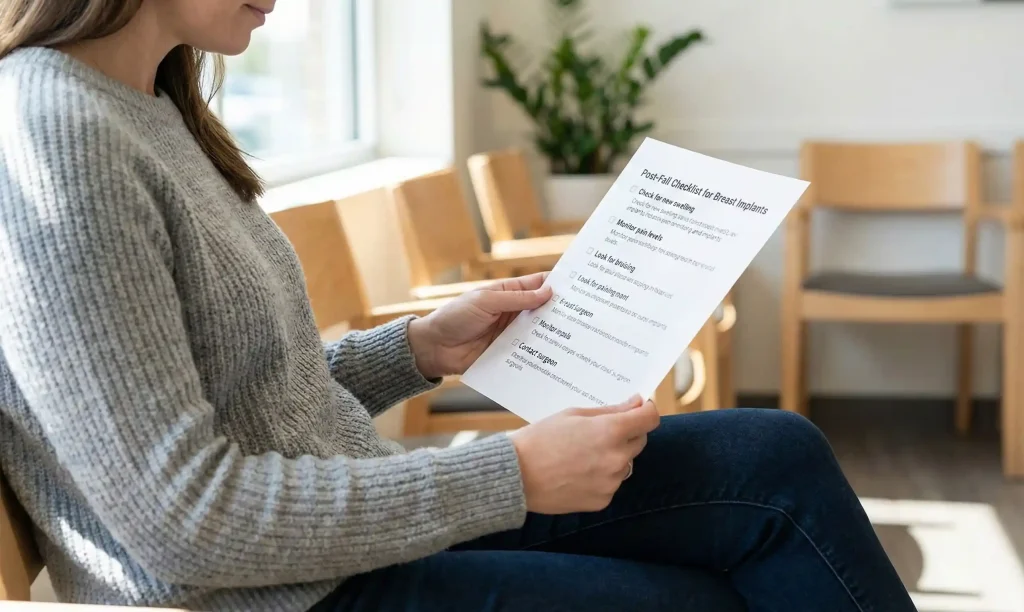
- Don’t Panic: Remember, the implants are strong.
- Visual Check: Look at yourself in the mirror for any bruises or change in the shape.
- Contact Your Surgeon: In case there is nothing noticeable, it is better to inform the clinic for the record.
- Imaging: If you have silicon implants and the impact was very hard, then in order to exclude a silent rupture, only imaging is the way. An Ultrasound is a good first step, but an MRI is the gold standard for checking silicone implant integrity.
Breast Implant Safety in Turkey
We, at Lin Europe Clinic, Istanbul use only FDA-approved, very high-grade cohesive gel implants that are known for their extreme durability. However, we understand that sometimes accidents do happen. Our patients are strongly encouraged to come to us immediately in case they get any chest trauma.
We have “all under one roof” facilities, thus we can offer our patients quick diagnostic imaging in case of any suspicion of rupture or displacement. We are experienced in revision surgery for the renewal of the implant, pocket repair, and thus your silhouette is restored in a safe way.
Frequently Asked Questions About Implant Trauma
Of course, you can, but it is very difficult. The shells of implants nowadays are highly durable. From a fall, it is more likely for bleeding (hematoma) to occur or for the implant to get displaced than for the shell to be ruptured.
The rupture of a saline implant will make you feel as if it deflated suddenly. The rupture of a silicone implant is usually “silent” and you may not feel anything initially, but it may result in the breast feeling hard or lumpy (knots) over time.
Absolutely. When the force of a locking seatbelt is excessive in a high-speed car accident and it goes across the chest, it can cause the implant to rupture. Any car accident is a reason to get medical help without fail.
That is very unlikely. Specialist personnel use special methods (displacement views) so that implants do not get compressed too hard. Always inform your technician that you have implants.
Yes. After the surgery site has totally healed (typically 3 to 6 months), sleeping on your stomach won’t hurt the implants. They are made to bear the pressure of your body weight.
Food and Drug Administration. (2020). Breast Implants: Risks and Complications.
Hölmich, L. R., et al. (2003). Untreated silicone breast implant rupture. Plastic and Reconstructive Surgery, 114(1), 204-214.
Maxwell, G. P., & Gabriel, A. (2012). The evolution of breast implants. Plastic and Reconstructive Surgery.
Spear, S. L. (2010). Surgery of the Breast: Principles and Art. Lippincott Williams & Wilkins.