Restrictions include avoiding heavy exercise and chest strain early on.
Breast augmentation is a thrilling step to a new figure; however, it rules out certain activities. Usually, patients inquire, “What are the restrictions for breast implants?” because they want to look after their investment without disrupting their lives. At Lin Europe Clinic, we think that one can only have a successful recovery if there is full comprehension. Being aware of the exact dos and don’ts not only keeps you safe but also helps prevent complications such as bleeding, implant displacement, and poor scarring.
The great news is that most, if not all, of these limitations are only temporary. They are meant to help your body heal the skin incisions and form a stable capsule around the implants. You are free to go back to almost all of your pre-surgery activities once this recovery time is over. Below we discuss the restriction timeline, from the very early recovery’s rigid “red light” stage to the minor lifestyle changes you may have to make for the long run.
Red Light Phase Weeks 1 and 2
The initial two weeks present you with the most severe restrictions. During this time, the body goes through the inflammatory or healing phase. The main thing you have to do is get enough sleep and not let the incisions open.
- No heavy lifting: It is forbidden to lift heavy objects over 5 pounds (approx. 2.5 kg). This means no heavy handbags, grocery bags, pets, kids, etc. Overexerting the chest muscles leads to high blood pressure and thus a hematoma (internal bleeding).
- No driving: As long as you are on narcotic pain relievers, you should not drive. Once the medicine is out of your system, you still should not get behind the wheel until you can turn it around rapidly without any pain or hesitation.
- No raising your arms: Don’t stretch your arms high above your head (like shampooing your hair in a hurry or getting something off a top shelf). The reason is that this movement is causing the pectoralis muscle to be stretched which can lead to the implant’s displacement or the pocket getting irritated if it’s still healing.
Sleeping Posture: Back Stays Your Choice

During the first one to one and a half months post-op, you won’t have the liberty to choose your sleeping posture. You have to sleep on your back, and it’s best if you’re slightly propped up on an angled pillow or a few piled-up pillows.
- No Stomach Sleeping: Before a scar capsule is formed lying on your stomach exerts direct pressure on the implants. It may let the pocket get squashed or push the implants to the sides.
- No Side Sleeping: Lying on your side too soon after surgery is prone to lead the implants to slide towards the armpit (lateral displacement). Besides, it can make the implants press together (symmastia).
At about the sixth week, most patients get the go-ahead to sleep on their sides and at the third month on the stomach. This law is critical for symmetry though some natural stomach sleepers may find it hard to obey.
Workouts and Sports
Returning to the sports hall or gym is a step-by-step process.
- Don’t run after the surgery, just walk: To help the blood circulate and thus, blood clot formation is prevented, you are encouraged to take very easy walks from the day of surgery. Nevertheless, running, jumping, or anything that can be classified as high-impact cardio is still prohibited for at least six weeks since the skin and ligaments are being stressed with every bump in these fast movements.
- No chest exercises: If your implants are underneath the muscle, you shouldn’t be turning on the chest muscles (push-ups, bench press, pull-ups) for around six to eight weeks. You can be pretty sure that engaging the muscle at such an early stage will not only garments but squeeze the implant out of position.
- Swimming restrictions: Until the healing wounds are confirmed by the surgeon as fully closed and even scabs have fallen off, it is prohibited to get the incisions wet (in pools, hot tubs, seas). This usually takes about 4 weeks to keep bacterial infection out.
Lifestyle Habits: Smoking and Drinking

In order to achieve the best scar formation and to lower the risk of the healing process being complicated, some habits have to be discontinued temporarily.
- No Smoking: Because nicotine causes blood vessels to constrict and thus, it reduces the delivery of oxygen to tissues, the tissue under repair eventually become extremely damaged. Smoking should be stopped at least for four weeks before and after the operation. Besides, the two-sided effect of smoking is nipple necrosis and capsular contracture.
- Limit Alcohol: As long as you are on painkillers and for the initial week, it is best to refrain from consuming alcohol. Drinking alcohol has the effect of thinning the blood and so, bruising and swelling may be more severe. Besides, alcohol dehydrates the body which means the healing process may be slower.
Considerations for Life on the Long Run
Once all wounds are healed (usually within 3-6 months), the “can’t dos” will mainly be gone. Besides, a handful of permanent considerations remain.
- Mammograms: Mammograms are still possible cases, but the technician must be notified that you have implants. A special method called the “displacement technique” will be used to see breast tissue after the implant has been compressed.
- Heavy Chest Training: Quite a few ladies with submuscular implants choose to make permanent changes in their chest workouts. The reason is that heavy pec training may cause the implants to shift very visibly (animation deformity). You may decide to switch to isolation exercises or use lighter weights to keep your good looks.
Breast Implants in Turkey
Which of these limitations will become non-limitations depends on the support system one has. At Lin Europe Clinic in Istanbul, your medical tourism experience is designed in such a way that the “heavy lifting” is done for you. Through our VIP transfer service you will never have to drive or carry your luggage during the entire period of your stay by hospital. Our nursing staff will be at your attendance to do the hair washing and help with the dressing so that you won’t have to overwork your arms.
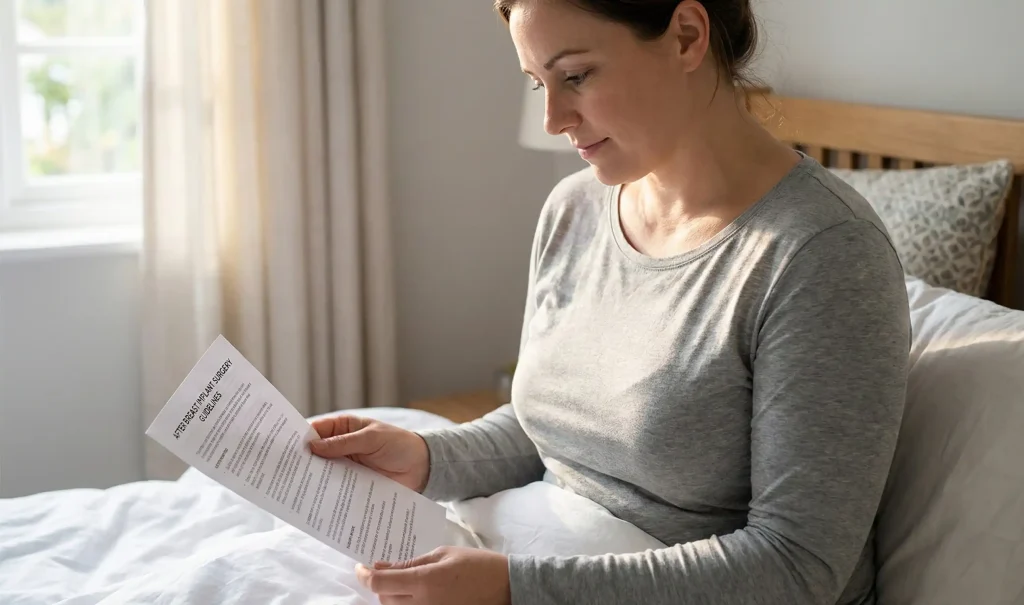
We prepare a printed copy of the detailed “Do’s and Don’ts” list that is surgery-specific. Your surgeon is always available for consultations and with our “all under one roof” system, you can come to ask questions such as, “Is it okay for me to get my cat now?” or “Is this stretch alright?” Consider letting us take care of a stress-free recovery in Istanbul while we put your safety first and you reap the benefits of your results for a lifetime.
Frequently Asked Questions About Implant Restrictions
You can’t lift over 5 lb, drive while taking pain meds, or raise your arms above your head for the first two weeks.
Usually, you can start sleeping on the side after six weeks. You should sleep on the back until your surgeon clears you to prevent displacement.
You are not allowed to lift a baby or child for at least 3 to 4 weeks. You should sit down and have someone give you the child to avoid overexertion.
As soon as you are not taking narcotics for pain and can turn the steering wheel without pain, you will be able to drive, which is usually 5 to 10 days.
Yes, it is safe to fly after a few days, but you should walk around the plane cabin at intervals to avoid blood clots. Your implants won’t explode in a plane.
American Society of Plastic Surgeons. (2024). Recovery after breast augmentation. Plastic Surgery Outcomes.
Adams, W. P. (2008). The process of breast augmentation: Four phases of care. Plastic and Reconstructive Surgery, 122(6), 1892-1900.
Bengtson, B. P. (2011). Complications, adverse events, and reoperations in breast augmentation. Clinics in Plastic Surgery, 38(3), 321-334.
Spear, S. L. (2010). Surgery of the Breast: Principles and Art. Lippincott Williams & Wilkins.
Tebbetts, J. B. (2006). Run-of-the-mill recovery or re-engineering the process? Plastic and Reconstructive Surgery, 117(7), 2450-2453.