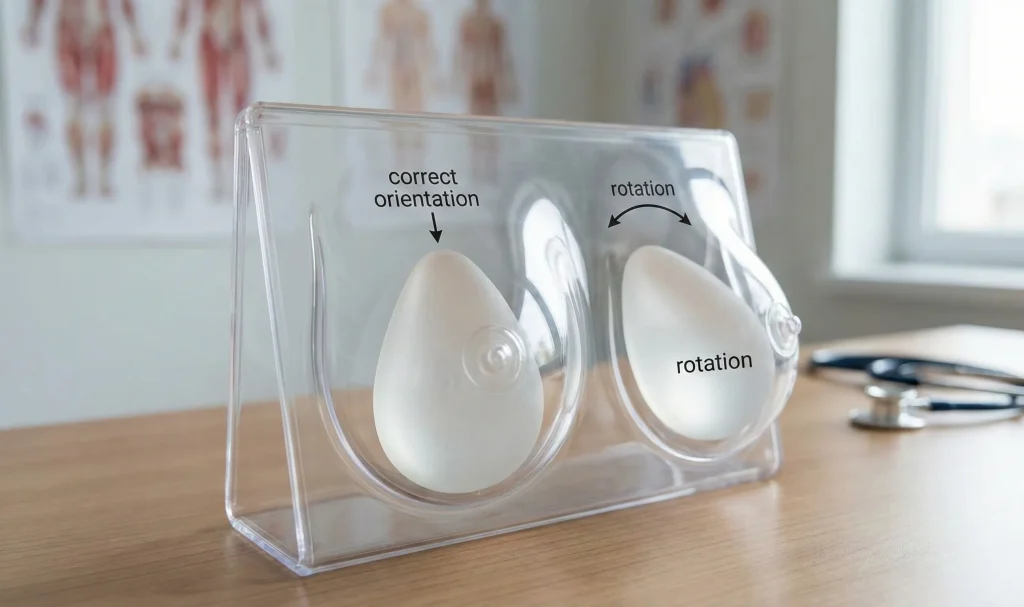
The risk is low but can affect breast shape.
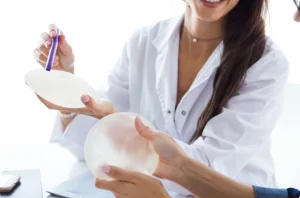
Patients who want their breast augmentation to look as natural as possible often lean towards “teardrop” or anatomical implants. These implants are narrower at the top and fuller at the bottom, which is a very similar shape to a natural breast. The only drawback of such a shape is that it is prone to a complication that does not occur with round implants: the risk of rotation. If you’ve come across stories of breasts looking distorted or “upside down” when the implant moves, fear not because here at Lin Europe Clinic, we reckon that getting to grips with the working of your medical device is the best way of dispelling your worries.
The question: “Is teardrop implant rotation a real risk?” can be answered in a simple way – Yes, it is a potential complication but it is a statistically remote event when the procedure is done by a skilled surgeon. What’s more, round implants don’t have a specific orientation since they look the same from all sides, whereas a teardrop implant has a clear top and bottom. So, if the implant turns around, the result will not be harmonious. By applying certain surgical methods and using the latest implant surfaces, we are able to “lock” the device in place thus, your results will stay stable and lovely for many years to come.
The Geometry of Distortion
You will not be acquainted with the risk if you don’t understand the geometry first. Round implants are symmetrical; even if they rotate 90 or 180 degrees inside the breast pocket, the external appearance of the breast does not change. It is a sphere, so orientation doesn’t matter. This tolerance makes round implants a “lower maintenance” option for certain patients.
However, a teardrop implant is likened to a pear in shape. The effect of the implant depends on the accurate positioning to achieve a natural-looking slope. If the implant rotates 90 degrees to the side, the breast will appear broad and distorted. If it turns 180 degrees (upside down), then the upper chest will be the area of fullness while the bottom will be empty, thus creating a distinct deformity. The shape is constant, thus the pocket that holds it has to be perfect. That’s why anatomical implants need a higher level of surgical skill compared to round implants; there is no room for error in the creation of the pocket.
The “Velcro” Effect of Texture

To stop this rotation from happening, the producers make teardrop implants with a textured surface. The shell of an anatomical implant, contrary to the smooth surface of a typical round implant, gives you a roughness sensation similar to that of sandpaper or velvet. The texture is not for decoration; it is meant to generate friction with the inside of the body.
Imagine the texture as “Velcro.” The rough surface stimulates the breast tissue to grow into the unevenness of the shell thus, the implant is essentially “glued” to the chest wall. The adherence keeps the device from spinning or sliding out of place. Although the recent talks about BIA-ALCL have resulted in less usage of “macro-textured” (very rough) implants, current “micro-textured” surfaces still offer enough friction to maintain stability without giving rise to an aggressive inflammatory response as old implants did.
The Importance of the “Glove-Fit” Pocket
Ultimately, the most effective way of skyrocketing your chances of success is your surgeon’s skill in creating the internal pocket. Normally, the surgeon makes a slightly bigger pocket to give room for movement and to get a soft feel when using a round implant. However, if a teardrop implant is being fitted, the surgeon needs to make a pocket that fits like a glove or precisely matching the implant’s dimensions -no bigger and no smaller.
An implant will have a lot of freedom to float and consequently spin if the pocket is excessively loose, especially in the first few weeks before the capsule is formed. On the other hand, the implant might not lie properly and it seems to be crumpled if the pocket is too tight. The surgeons at our clinic very carefully and meticulously cauterize the edges of the pocket so that the implant fits perfectly at the time of insertion. Also, we limit your upper body movement and forbid you from doing high-impact activities for the initial few weeks so that the “Velcro” effect can establish itself before you expose the implants to the force of gravity.
Treatment and Redress
An implant that has rotated can be diagnosed quite easily simply through visual inspection. You will recognize the deformation of the breast such as hanging the lower pole suddenly or bulging on the side. There are times when the rotation can be corrected by you manually if it’s still fresh and the capsule hasn’t hardened yet, which is called “external manipulation.“
On the other hand, if the rotation continues or happens repeatedly, a surgical revision is necessary. In that procedure, the surgeon re-enters the pocket, positions the implant again, and uses internal sutures (capsulorrhaphy) to close the pocket tightly, thus, it won’t move anymore. Sometimes, it may occur that if a patient’s tissues are simply unable to keep the teardrop shape stable (maybe because seroma fluid works as a lubricant), then switching to a round implant will be the desirable option to get rid of the risk completely while a “moderate plus” profile is used to keep the look somewhat natural.
Breast Augmentation in Turkey

One of the reasons why you choose Lin Europe Clinic for your breast augmentation in Turkey is because we specialize in the peculiarities of anatomical implants. We do not force teardrop implants on every patient; only when the patient’s body and the quality of tissue are adequate for stabilizing the implant do we choose them. Our Istanbul surgeons rely on top-notch, cohesive gel implants from the most reputable brands such as Mentor and Polytech, which have a prolonged record of stability and safety.
Your trip to Istanbul will be a precision and long-lasting satisfaction oriented. We give you detailed postoperative instructions regarding the proper ways of moving and sleeping during the adhesion phase which is the most crucial. Our VIP transfer service and luxury accommodation are there to make sure you don’t have to drag your luggage or expose yourself to stress as those are the things that can compromise your internal pocket during the first few vital days. At Lin Europe Clinic, we unite an artistic approach with strict surgical mechanics in order to give you a natural slope that comes with the stability you require.
Frequently Asked Questions About Teardrop Rotation
The main issue is the risk of rotation, which can lead to a distorted breast appearance if the implant changes its position. Also, because they use a thicker, form-stable gel to keep their precise shape, they are generally a bit firmer to the touch compared to round implants.
Teardrop implants, also known as anatomical implants, are breast prosthetics shaped somewhat like a pear with less volume on the top and more fullness on the bottom. They are designed to replicate the natural curve and outline of a breast rather than giving a round, overly lifted appearance.
Teardrop implants probably feel a bit firmer than round implants because of the very cohesive gel that is necessary to maintain the shape. Still, if they are implanted under the chest muscle, they are typically not felt and will look natural as if they are your own tissue.
Teardrop implants are perfect for women who lack sufficient natural breast tissue and therefore, depend on the implant for the overall breast shape definition. Also, they are a smart choice if you want to correct tuberous breast deformity or if you desire a gentle, natural outline rather than a very full upper-pole.
Just like any other breast prosthetics, teardrop implants are not permanent and usually, their lifespan is between 10 to 20 years. Nevertheless, you should have regular check-ups with your surgeon. Many patients, however, keep them for a longer time without experiencing any issues.
Maxwell, G. P., & Gabriel, A. (2013). The evolution of the “teardrop” implant: The 5th generation. Plastic and Reconstructive Surgery.
Adams, W. P., Jr. (2008). The process of breast augmentation: four sequential steps for optimizing outcomes for patients. Plastic and Reconstructive Surgery.
Hammond, D. C. (2013). Textured breast implants. Clinics in Plastic Surgery.