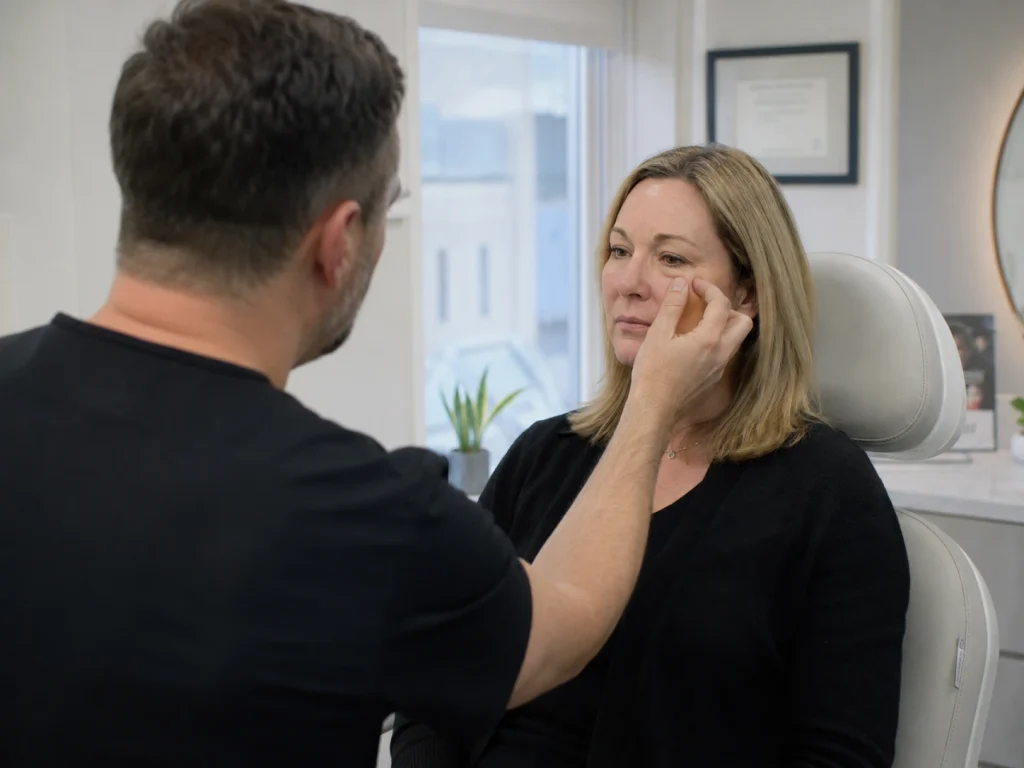
Patients with midface sagging and volume loss.
The Biometrics Of Vertical Malar Descent And Infraorbital Hollows
The precise anatomical classification to decide whether a patient will benefit more from a traditional lower facelift or from a midface lift is a crucial skill that separates the experts in the field of facial architecture and aesthetic medicine from the rest. A midface lift, clinically known as a vertical subperiosteal malar suspension, is a surgical weapon that is extremely focused and targeted. It is designed to address one very specific structural deficit only: vertical malar descent. Vertical malar descent is the dropping down of the native buccal fat pad and the soft tissues of the cheek that are situated above it due to gravity and natural aging.
The very best candidate for this surgical procedure is someone who has a loss of the prominence of the upper cheeks along with the deepening of the infraorbital hollows (also known as the tear troughs below the eyes). From a purely biometric point of view, if the area of your structural tissue sagging is the central triangle of the face – the area that extends from the lower eyelids to the corners of the mouth – then a midface lift will be the perfect remedy as it focuses on this localized loss of volume and the restoration of the youthful, convex cheekbone shape.
Nasolabial Matrix Alterations and Jowl Limitations
A major factor in deciding if a patient is a candidate for a midface lift is a very detailed diagnostic examination of the lower face limits. In fact, lots of the time, patients who have prominent nasolabial folds (the folds running from the sides of the nose to the corners of the mouth) are usually those who have downward slippage of cheek tissues with the pooling of these tissues against the upper lip. A perfect, very appropriate candidate for a midface lift is the one whose main indication of facial aging is this very pronounced nose-to-mouth line, which, after the release and vertical elevation of the dropped cheek mass to its original skeletal bony platform, can be completely removed.
Nevertheless, a standalone midface lift’s surgical vectors or entry points provide quite limited access to the lower mandibular limit. This really means that it physically cannot be capable of correcting significant jowling along the jawline or extensive tissue laxity across the neck. Hence, a good candidate will have fairly firm tissue structure along the jawline. If your main structural concern is sagging jowls or loose neck skin, then you will be considered as not meeting the biometric criteria for an isolated midface lift, and the experts will most likely redirect you in a safe way to a traditional lower facelift.
Synchronizing Your Facial Canvas With Your Athletic Frame
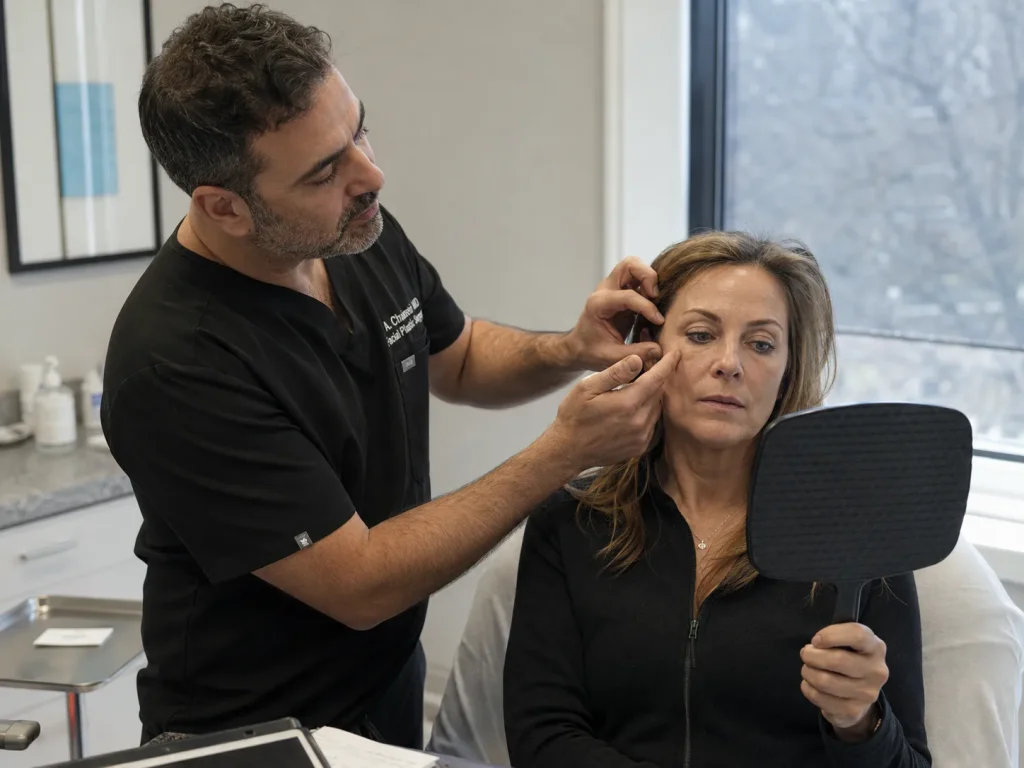
Deeply understanding how a sculpted, tightly contoured, high-definition midface nicely fits into your global physical proportions and long-term fitness objectives is really the essence of analyzing your surgical candidacy. For those who are devoting a lot of time and effort into designing a very athletic body, especially those who are targeting advanced lower-body hypertrophy and gluteal development in order to have a perfect hourglass figure, a displeasing midface flatness can be a source of extreme frustration. A sunken and tired-looking central face due to genetic factors or natural aging can create an impression of fatigue that completely contradicts your very active lifestyle.
The specialist’s skill in using a midface lift to reposition the descended cheek tissue vertically will immediately rename your facial architecture. The elevated cheekbone and the clear, smooth under-eye area are exactly what you need to be able to showcase an active posture. They also make sure that your facial expressions are in harmony with the vitality and high discipline of your body. This structurally accurate reinforcement will keep your face correctly proportioned at all times, essentially allowing your physical discipline and well-developed athletic body to be showcased in perfect harmony.
Architectural Entry Vectors and Skeletal Volume Retention
One of the biggest biological and aesthetic advantages of a midface lift is the deep layer of fascia that the procedure accesses. The surgery is carried out by the reconstructive surgeons with the help of a very advanced endoscopic method through small incisions, which are hidden and placed very discreetly within the temporal hairline or inside the mouth beneath the upper lip. Therefore, going for a midface lift is a good option for patients who want to have this procedure without having incisions with long and external ones that are made near the borders of the ears, as this one completely removes visible external scarring of the face.
Also, as the idea of this surgery is to move the existing tissues rather than implanting additional volume, the good candidate should be the one with an adequate amount of native cheek tissue to be lifted. The deep layers of the tissue are separated from the bone, and the entire cheek mass is then shifted upwards and is held in position by anchoring it to the elevated spot. You must be very committed to working your way through the recovery process after which these deeply repositioned tissues will heal perfectly, leading to a naturally beautiful and smoothly contoured midface with minimal downtime.
Midface Lift in Turkey
What you will get by joining LIN Europe Clinic is a sanctuary where your singular geometric alteration is handled with clinical excellence that is uncompromising and very empathetic care. We understand that the work of creating your facial contours after you have lost weight requires an extremely sophisticated, completely understanding, and very personalized environment that places the greatest value on evidence-based medicine. LIN Europe Clinic has become an international leader in the field of facial contouring. It provides a peaceful and quiet environment where all your surgical procedures are subject to the highest safety standards for patients and the use of cutting-edge tools and technology for structural enhancement.
When you choose to be treated by a highly trained medical framework at LIN Europe Clinic in Turkey, you will get your structural angles and soft-tissue distributions calculated in a very precise manner, well before the surgical procedure. Surgeons apply top-notch diagnostic evaluation and deep-plane anchoring techniques that are second to none in order to make sure your midface lift will produce an outcome that is absolutely smooth and without any imperfections. Raise your hands to a level of comprehensive care and obtain a perfectly harmonized profile that will last long through time, safely and efficiently carried out by expert professionals.
FAQ:
Typically, a candidate for midface lift is an individual who presents with some degree of cheek sagging, circles under the eyes, and nasolabial fold deepening, yet still having a relatively strong and contoured jawline.
This operation repositions the dropped fat compartments of your cheeks in a vertical direction. It also brings back the volume in the area on top of the cheekbones, rounds out the skin under the lower eyelids, and reduces the appearance of prominent smile lines.
Doctors insert tiny endoscopic instruments into tiny incisions that are completely hidden within the hairline of the temples or within the upper lip, so there are absolutely no visible scars on the face.
Indeed, the surgery essentially lifts the patient’s own migrated cheek tissues straight up to their original youthful location, so the result is quite natural-looking and does not carry the “overdone” look.
When signs of aging that bother you the most are around the eyes, cheeks, and smile lines, going for a midface lift would be a good choice. On the other hand, if you notice jowls and loose skin on your neck, a facelift will be necessary.
Hester, T. R., et al. (2000). Evolution of midface lifting: multiple techniques and vectors. Aesthetic Surgery Journal, 20(3), 233-241.
Ramirez, O. M. (1995). The subperiosteal midface lift: an endoscopic approach. Clinics in Plastic Surgery, 22(4), 647-660.
De la Plaza, R., & De la Cruz, L. (2004). Endoscopic midface lift: a logical vector of suspension. Aesthetic Plastic Surgery, 28(2), 77-84.