Yes, after full scalp healing.
Biometrics of the Two Levels of Hair Restoration
Achieving the ultimate level of density in hair restoration sometimes calls for a combination of different methods. To put it simply from a biometric point of view, a hair transplant produces the 3D texture and terminal hair strands; on the other hand, Scalp Micropigmentation (SMP) creates a 2D “shadow” or the illusion of depth. Pairing these two methods is a must clinically for those with limited donor hair who want a high-definition, “full” look.
At Lin Health Europe Clinic, we say that SMP is like a high-end concealer. It deposits medical-grade pigments into the dermal layer, which then looks like hair follicles. This works together in such a way that the structural harmony of the scalp is kept, as the pigment lessens the difference between the skin and hair. In this way of merging these biometrics, we come to a state of biological balance where the transplanted grafts and the fake follicles unite in creating a sharp, lively figure.
Donor Site Scar Concealment and Structural Harmony
Getting surgical brilliance in a hair transplant basically involves dealing with both the recipient and donor areas. Biometrically speaking, regardless of whether you get FUT (strip) or FUE (individual grafts), tiny marks of the surgery may still be present in the donor area. SMP is a major medical innovation that can mask such marks, almost making donor scars invisible even with very short hair.
The structural harmony at the back of the head is what really matters when it comes to a definition-rich end result. At Lin Health Europe Clinic, we take advantage of SMP to conceal any signs of “over-harvesting” or linear scarring in the donor area to make them blend with the natural hair. Such a careful professional approach makes sure that your new look is flawless from all angles, and you can confidently wear your hair while the health of your scalp is continuously supported and fortified.
Full Maturation of Follicles – a Must
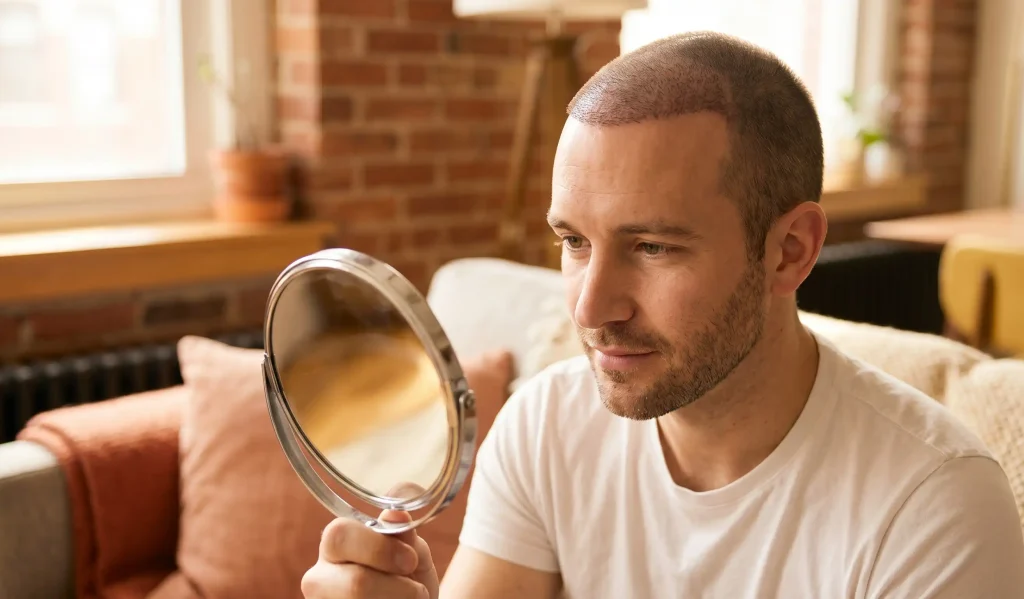
The timing of SMP following a hair transplant needs to be really professional. Biometrically, the scalp must be fully healed, and the transplanted follicles must be at their maximum point of stability. If the pigments are added too soon, that might disturb the biological balance of the healing grafts and possibly cause localized inflammation or poor pigment retention.
Usually, we recommend a clinical waiting period of about 6 to 12 months after the transplant before starting SMP. During this time, all post-operative swelling will have completely disappeared, and the “shock loss” stage that generally takes place after hair transplantation is also out of the way. When the terminal hair has matured, our clinical mastery team in Turkey will be able to accurately position the pigments in between the hairs so that a state of high-definition symmetry and structural harmony, which will last for years, is achieved.
Professional Rigor: Pigment Selection and Dermal Integration
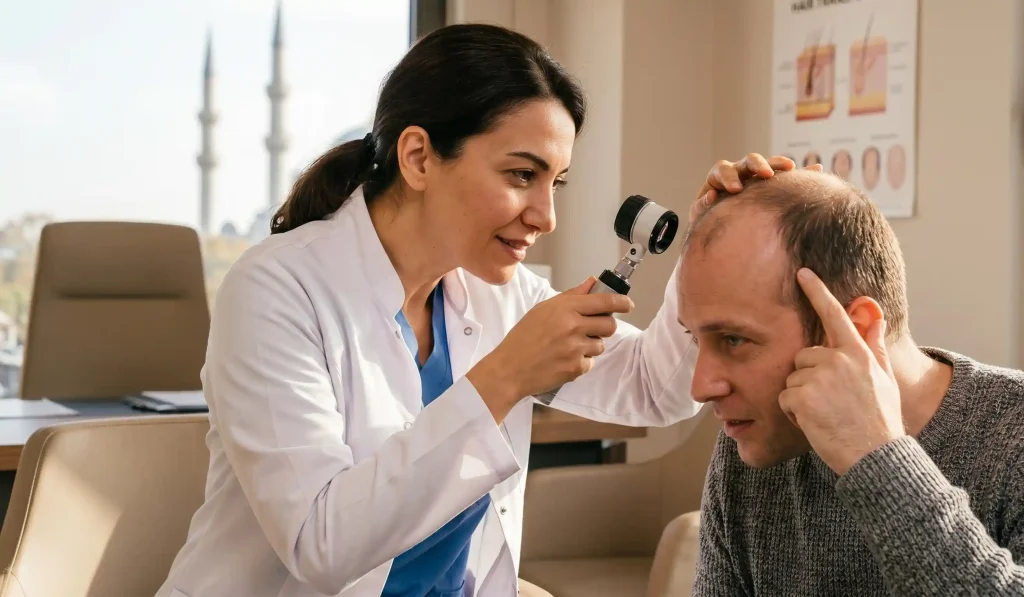
To get the absolute best natural look, a thorough understanding of dermal biometrics is required. SMP needles and pigments are specifically designed and planned not to change color, unlike a regular tattoo. The professional rigor that is involved in determining the shade to be matched to your natural hair color, as well as your skin undertones, is also done so as to prevent a “bluish” or “unnatural” tint that is often associated with low-quality treatments.
| Restoration Phase | Primary Goal | Biometric Outcome |
| Hair Transplant | Restoration of 3D terminal hair. | Natural texture and growth. |
| Micropigmentation | Camouflage and 2D density. | Reduced scalp visibility. |
| Combined Therapy | High-definition synergy. | Absolute pinnacle of fullness. |
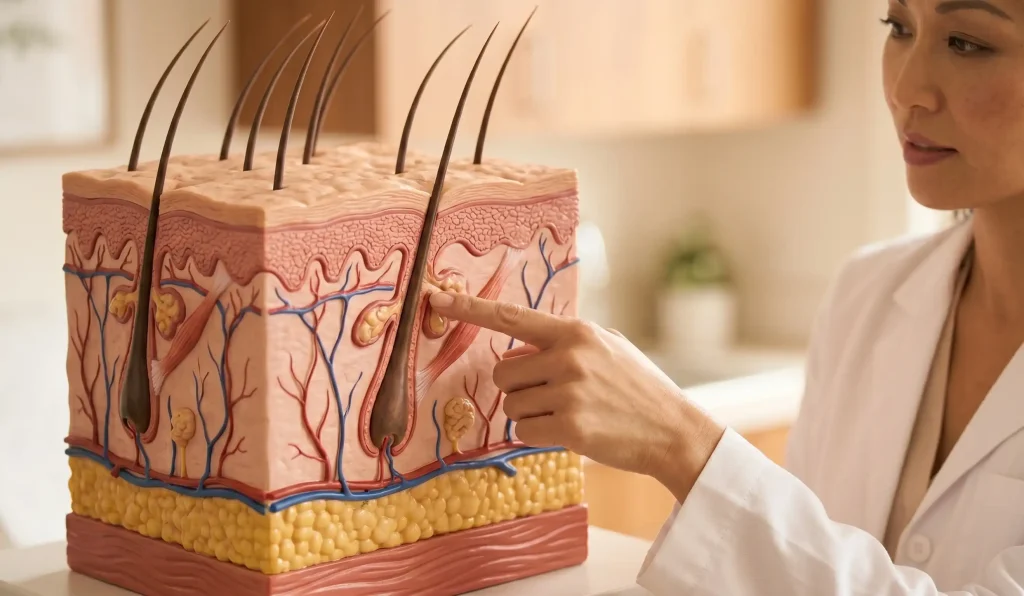
At Lin Health Europe Clinic, we focus our medical innovation to make sure that the depth of the pigment is absolutely in step with the anatomy of your skin. By this means, professional care is elevated to another level and pigment “migration” is prevented. What this means is that the structural harmony of the scalp is not only supported but also enhanced with a stable, vibrant, and permanent solution from an aesthetic standpoint.
Hair Transplant in Turkey
By selecting Lin Health Europe Clinic, you become a part of a worldwide sanctuary where your hair restoration journey will be taken care of by people with elite clinical mastery. We understand that a hair transplant is just one step in the overall achievement of your ultimate aesthetic goals. Our center in Turkey is a front-runner in surgical brilliance, along with the high-definition enhancements of SMP that complement the world’s best follicular procedures.
Trusting Lin Health Europe Clinic means that you have placed your confidence in a medical setting that is top-notch when it comes to anatomic science and patient-centered safety. We take care of your transition to a fuller profile with professional rigor, and guarantee that your outcomes will be symmetric, stable, and in perfect structural harmony. Get to know the superior care of Lin Health Europe Clinic and obtain results that are a true reflection of the top level of biological balance. Your route to a permanent and chiseled profile is held with thoroughness at the very center of Turkey.
FAQ:
Yes, micropigmentation is a great clinical option to make a hair transplant look denser. Apart from the hair you’ve transplanted, it also works by visually adding more hair and looking like a natural, dense head of hair by cleverly covering the scalp.
Medically, this is not just a suggestion but a requirement to wait 6 to 12 months minimum after the hair transplant before commencing SMP. This period gives time to the transplanted hair to mature fully and also helps in restoring the biological environment of the scalp.
If SMP is done with adherence to professional standards and clinical knowledge, it does not harm transplanted hair. The ink is injected into a dermal layer that is more superficial than the hair bulbs keeping the grafts’ systemic vitality intact.
SMP is a semi-permanent medical procedure. The ink used in SMP is long-lasting but it is recommended to get a touch-up once every 3-5 years in order to maintain supreme color and structural harmony.
Indeed, the main benefit of SMP is that it can effectively conceal FUE “dot” scars and FUT linear scars. Thanks to this surgical technique, your donor area can be made to look just as well-defined and healthy as your new hairline.
Tebbetts, J. B. (2002). Systemic Vitality and Surgical Precision in Restoration Procedures. Saunders Elsevier.
Unger, W. P., et al. (2011). Hair Transplantation: Clinical Mastery and Biometric Anchorage. CRC Press.
Janis, J. E., et al. (2005). Scalp Anatomy and Biometrics: Implications for Dermal Pigmentation. Plastic and Reconstructive Surgery.
Rassman, W. R., et al. (2013). Scalp Micropigmentation: A Useful Tool for Hair Restoration and Structural Harmony. Dermatologic Surgery.
Nahai, F. (2011). The Art of Aesthetic Surgery: Principles and Professional Rigor in Hair Restoration. Quality Medical Publishing.