A deep plane facelift often provides the most natural results.
Facial Rejuvenation’s Shift
The field of facial plastic surgery and structural rejuvenation is a cutting-edge area where a superb result depends on moving beyond traditional surgical mindsets. For the past several decades, classic facelifts primarily consisted of just the surgeon pulling and tightening skin. This “skin only” method often ended up creating the much-feared “windblown,” artificial, or stretched look, as it was essentially horizontally squeezing the tender skin surface and making the skin tight.
At the very minimum, clinicians would say that the Deep-Plane Facelift is the benchmark for obtaining the most natural-looking facelift results. Rather than pulling the skin, a deep-plane facelift goes below the layer of muscles and targets the actual underlying tissues that have been causing aging. It’s through the cutting of the tethering ligaments and through the vertical repositioning of the deep layers of facial tissues that your surgeon is able to bring back the high cheekbones, define your jawline nicely, and have your neck be smooth, all in such a way that you look like you have merely gone through a nice facelift but not looked altered or surgically modified.
Anatomy Differences: Deep-Plane vs Traditional
A better understanding of why the deep-plane method results in the best and most natural-looking outcome is quite necessary. To see the contrast clearly, a review of how the two different kinds of operation approaches handle facial anatomy is useful:
- Traditional Skin-Only Facelift: These types of techniques peel the skin off the other layers and then pull it tight. Because skin has no real structural strength, this results in the skin being stretched horizontally, leading to the mouth being stretched, distorting earlobes, causing a flattening of the natural cheek curves, and overall an artificial, surgically altered look.
- SMAS (Superficial Musculoaponeurotic System): The sheet-like framework of skin that is located just under the skin surface by way of either a plication (stitching without removing the tissue) or an ectomy (surgical excision).
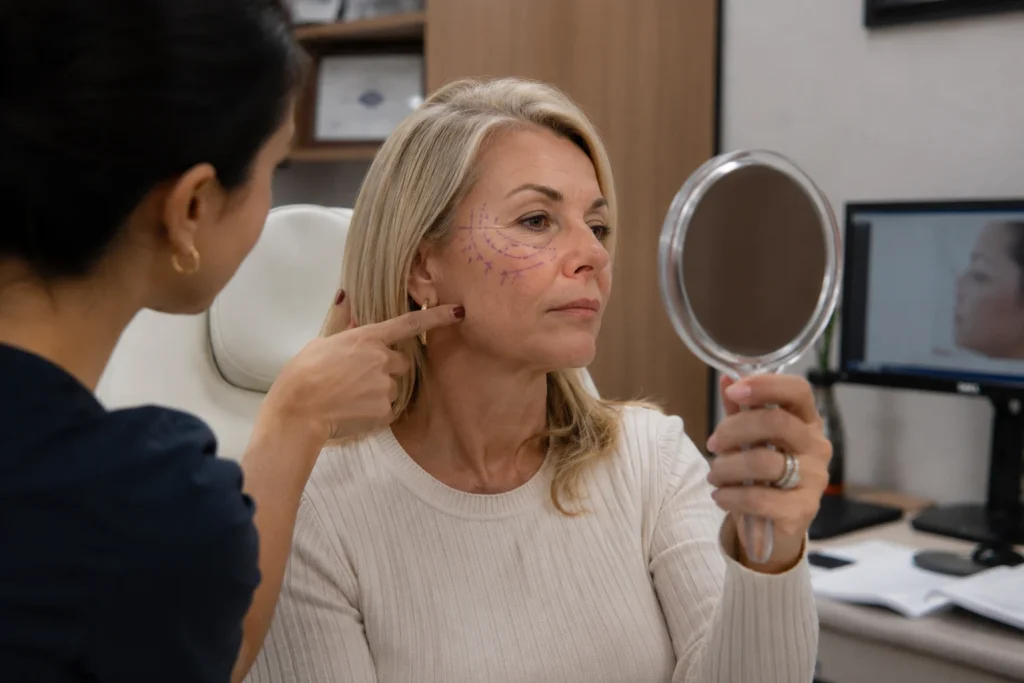
- Deep-Plane Facelift: The surgeon makes an incision and reaches the area below the skin’s surface level and, in fact, directly beneath the SMAS layer. Then they cut and free up the ligaments that are responsible for the tethering of facial tissues. The result is that the entire deep fat pad and underlying muscle layer can be lifted straight up without having to separate skin from muscle. Because the deep tissues now take the whole strain and the skin just naturally lies over and is sewn together without tension, one can still make the usual facial expressions.
The Face Hallmarks of a Real Natural Face
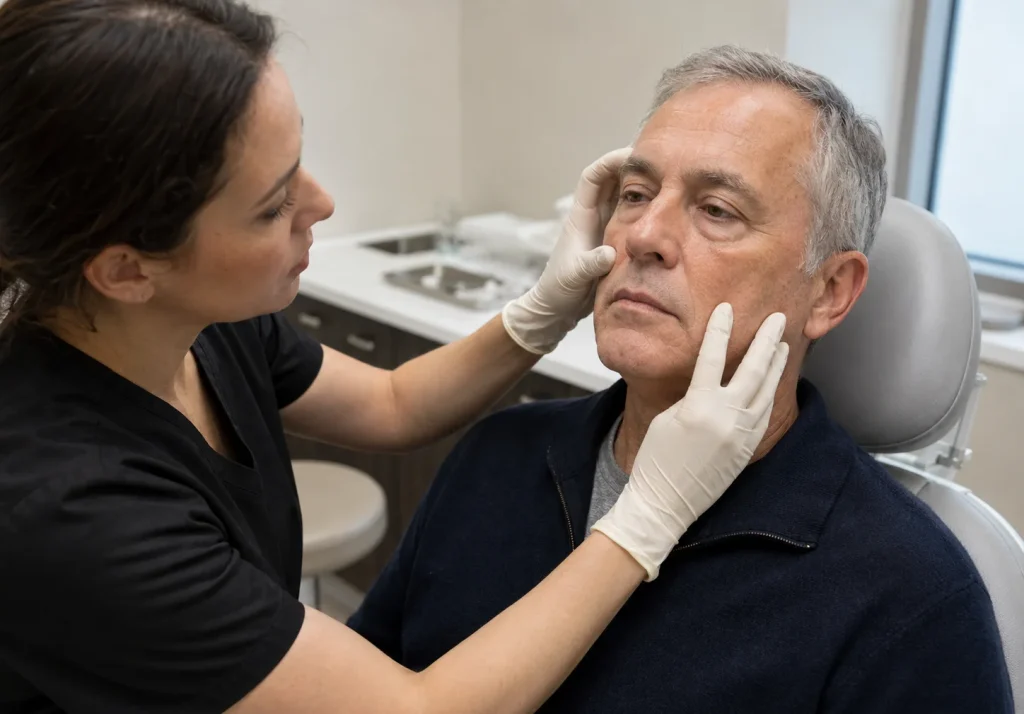
The perfect deep-plane facelift is capable of restoring and maintaining those facial signs that are typical of a young, unoperated-on face:
- The Deep-Plane Facelift restores the cheeks to their natural fullness when cheek fat that had hung is lifted vertically and replaced on the cheekbone without the use of synthetic fillers. This results in a heart-shaped facial appearance very similar to youth.
- Corners of the mouth that are smooth without a surgical mark. When deep tissues are raised vertically instead of dragged out laterally back towards the ears, the shape of the mouth remains the same, so the corner of the mouth is just smooth skin and nothing pulled unnaturally at all.
- Ears and the hairlines are perfectly untouched. No pulling of the skin means no pixie ear deformation. Also, the natural hairline and hairlines at the ear sides remain as they are. As the stitches of the incisions are placed carefully with almost no tension, the skin around the surgical wound does not change its appearance.
- When you elevate the facial structure of the cheek, you automatically close the gap around the lower part of the eye, which was formed by the sagging, and hence you not only brighten up the whole dark circles and tear troughs but also get them completely smoothed out. The area becomes very clean and clear, and there is absolutely no trace of the problem.
Maintaining the Structural Firmness and Post-Operative Boundaries
As a person who has a demanding standard for his or her appearance, you would not want to let your recovery be interfered with by any of those external or self-inflicted factors. The deep-plane facelift is a very delicate surgical procedure that results in a new and youthful look, and in order to preserve that, certain lifestyle changes must be maintained, and a good follow-up with the doctor must continue after discharge. These guidelines will be explained by your surgeon before and after surgery, and they will be given to you as a written copy as instructions to follow.
For the first weeks following a deep-plane facelift surgery, the main issue is deep tissue swelling. A good idea is to sleep on two or three pillows elevated on the back side, avoiding the stomach or the sides at night. It will be very difficult for you to do so, but sleep on your back and avoid pressure on the incision lines as much as you can to avoid uneven pressure, so that your healing will not be affected and the results will not be distorted if the pressure on them is too uneven.
Turkey Facial Lift
Opting for LIN Europe Clinic in Turkey is not merely a step but a jump to an exclusive world-class medical destination that gives your face surgery, facial reshaping, and other plastic procedures a high degree of care while you receive your surgical treatments. We acknowledge that deep-plane elevations, the SMAS handling, and the tissue adaptations that result in an excellent facelift call for an exceptionally well-equipped and well-organized environment of a medical facility that, on the one hand, supports all the advanced technologies and, on the other, makes the surgical process safe and easy for the patient, as the latter feels that he or she is treated like family.
The place has been chosen where the patient receives the necessary post-operation care and is provided with an environment where their health and safety are not compromised and where the level of service is world-renowned. As LIN Europe Clinic in Turkey, we have an elite medical team, and they are committed to safeguarding your cosmetic investment without in any way sacrificing your health. The fact that you have placed your trust with us at LIN Europe Clinic, Istanbul, means that your face’s structure has been analyzed with an extremely high-accuracy diagnostic machine that gives minute details.
FAQ:
Deep-Plane Facelift is by far the facelift that looks the most natural. It is so called because it allows release of facial deep ligaments and the repositioning of the muscle layer (SMAS) vertically that brings youthfulness to the cheeks and jawlines. All this is done without tension on the skin or horizontal pulling.
A fake or stretched look arises when instead surgeons just pull the skin tightly all over the face (conventional skin-only lift). Natural-lifting facetimes shift all structural stress onto the muscle layer beneath, which leaves the skin looking smooth and tension-free.
Absolutely. Deep-plane facelifts are very safe to perform even for people who are of varying ages and in excellent health as long as surgery is done by a certified facial plastic surgeon. The preservation of skin flap blood supply is actually better since the skin is not detached from the muscle layer in a deep and extensive way compared with what was done on older techniques.
Since a deep-plane facelift frees the structural ligaments and re-affixes the deep musculature of the face, these types of facelists usually give results that are very long-lasting; one can even expect the effects to last between ten to fifteen years or longer.
In general, most patients go through an extremely swollen period with mild bruising around 7 to 10 days. Sutures are normally removed at about 7 to 10 days and people are usually comfortable enough to go back to work and engage in social activities by weeks 2 to 3.
Hamra, S. T. (1990). The deep-plane facelift. Plastic and Reconstructive Surgery, 86(1), 53-61.
Jacono, A. A., et al. (2011). A technical comparison of deep-plane and superficial SMAS facelifts: Evaluating ligamentous release, vertical vectors, and aesthetic longevity. Aesthetic Surgery Journal, 31(8), 887-896.
Rohrich, R. J., et al. (2014). Advanced postoperative care, deep-plane tissue elevation, and structural stability in primary facial contouring. Aesthetic Surgery Journal, 34(5), 587-595.