A cat eye lift typically lasts several years.
The cat eye, fox eye, or simply the upturned corner of the eyes with that sleek underlying almond shape, has been made one of the most popular aesthetics of the decade. Influenced by supermodels Bella Hadid, Kendall Jenner, and endless social media filters, the crowd is rushing the clinics to get parasitic, exotic, ‘snatched’ and lifted-looking eyes. The aesthetic shift from the traditionally ‘wide-eyed, innocent’ look has gone towards a fiercer, more seductive one.
Nonetheless, the internet is loaded with quite conflicting pieces of information about its duration, and as a result, patients get totally mixed up. On one hand, some social media personalities claim their lift only lasted a couple of weeks, whereas others have been reveling in their outcomes for several years. This discrepancy is because the “Cat Eye Lift” is a marketing umbrella term rather than a single kind of medical procedure. Therefore, it can be anything from a simple Botox nip to a major eyelid tendon surgical reconstruction. So, the answer to the “how long does it last?” question is not a simple number, it depends absolutely on the biomechanics of the chosen technique.
What Is the Truth About PDO Threads and Surgical Permanence?
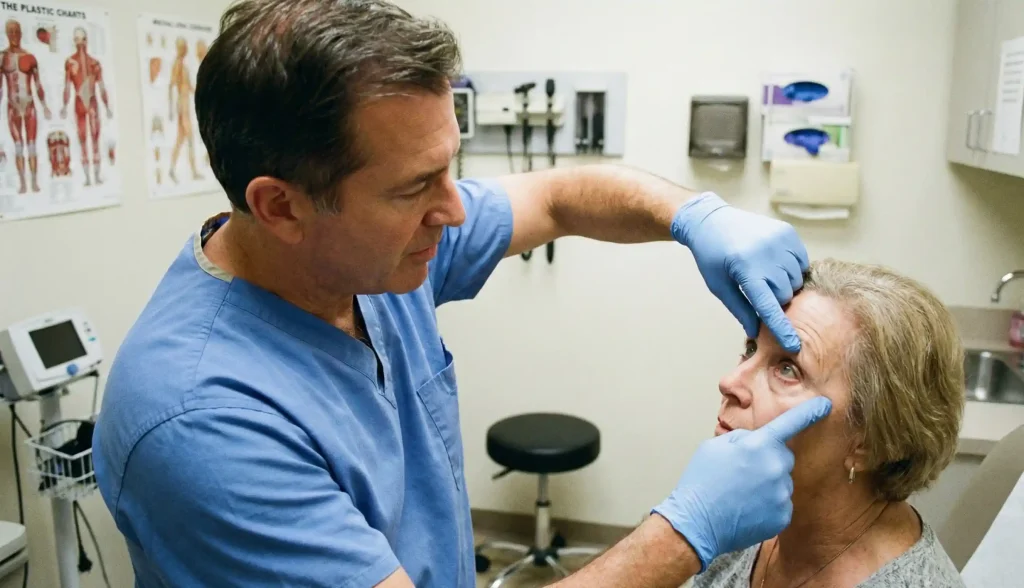
The majority of “Fox Eye” procedures that flood the social media are actually PDO Thread Lifts, aka ‘lunchtime lift‘ in the marketing jargon. In this non-invasive technique, barb-free threads are injected under the skin to physically hold the skin up by pulling the eyebrow and eye corner. The results of this type of procedure usually last only 3 to 9 months even though the after picture shows a drastic change. The essential reason is that the skin around the eyes is heavy, dynamic, and extremely mobile. Also, these threads are not fixed to the bone but are suspended in the soft tissue. Every tick, each smile, and every word that you say will wear out the microscopic barbs on the threads, or the threads themselves will dissolve. Many patients find that the “snatched” look begins to fade within weeks as the tissue relaxes, which means that threads are just a temporary look rather than a solution.
If you want to have a result that would last for years and not for months, the only option is surgery. The surgical Cat Eye Lift, also known as a Canthoplasty or Canthopexy, changes the eye’s architecture for good. Instead of threads that depend on friction, this surgical method involves going to the Lateral Canthal Tendon—the single fibrous cable that tethers your lower eyelid to the eye socket rim. So the surgeon can tighten this tendon, possibly shorten it, and reattach it firmly (periosteum) to the bone. Since we physically alter the anatomy by making the tendon shorter and the new, secure attachment point created is to the skeleton, the eye shape is structurally changed and will not simply “dissolve” away like a sugar thread.
The “Settle” Effect and Necessity of Over-Correction
Even if with the permanence of surgery, patients should learn about the biological notion of “settling” in order to stay realistic, which is why it is also essential. Gravity always pulls our face down; however, the eye itself is surrounded by orbicularis oculi, a strong sphincter muscle that is in a state of constant contraction to close the eye. So, the muscle is working against the lift. On top of that, the surgically lifted eye will still, become, by around 10-20%, less elevated within the first six months due to the natural process of tissues healing, swelling going down, and the skin stretched to the new tension.
To deal with such a natural drop, experienced surgeons purposely over-correct the lift in the operation. And this is what makes the period of recovery not only physical but also psychological. Initially, you may be too slanted, slightly resembling an alien, or you may even feel that the eyes are pulled too tight. That is the extreme look that has been planned and is necessary. It is the final natural position that is hit, which is how the settling and gravity will make the eye land perfectly in the almond shape, provided that you do not look at the over-corrected eye at the beginning. You see, if on day one the eye was placed in the “perfect” position, by month six it would have settled too low, and you would have lost the exotic shape your money bought.
Choosing and Performing the Lift: Canthoplasty, Canthopexy, and Temporal Synergy
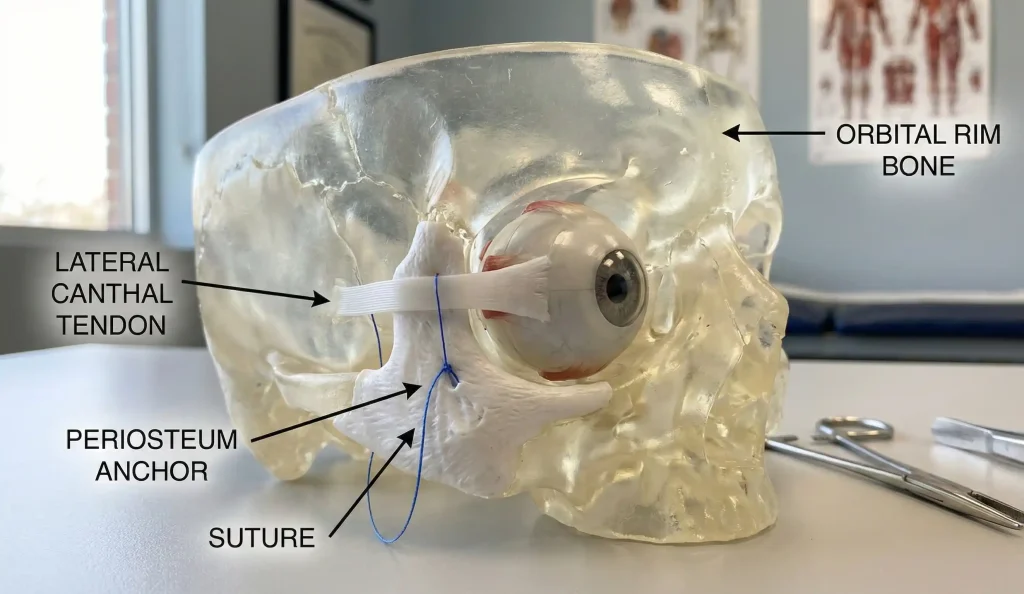
The type of surgery also affects the results’ duration. Depending on which method a Canthopexy or a Canthoplasty was chosen. In Canthopexy, the surgeon uses stitches to pull the tendon without cutting it, thus preserving the natural shape. The downside is that the thread can break or stretch over time, and the results are expected to last from 5 to 10 years depending on the tissue quality. Conversely, a Canthoplasty requires the surgeon to first cut the tendon and then reconstruct the corner of the eye. It is the strongest and most permanent procedure which is usually selected for patients who have very round eyes or a lot of scleral show and thus need maximum, permanent support.
Moreover, trying to lift just the corner of the eye without thinking about the heavy skin above it will probably give you running results for which you won’t even need to run. In case the temple and brow are heavy, they will inevitably push the newly lifted eye down, which will soon cause it to drop again. To get an effect that will last the longest time, both the Cat Eye surgery and a Temporal Brow Lift (commonly referred to as the Ponytail Lift) are combined by us almost always. When we pull the heavy forehead skin, we basically remove the pressing weight. The eye is thus supported from both sides, as if a suspension bridge is holding the aesthetic in place for the long term.
Discover the “Exotic Balance” with Lin Europe
Lin Europe Clinic doctors craft a look that is not only “Exotic Eye” but also conscious of your eye’s health and function. A very aggressive lift carried out by a careless surgeon can potentially have a patient suffer from “lagophthalmos,” a condition where a patient cannot close their eyes fully while sleeping. As a result, the patient experiences dry eye, eye redness, eye itching, and corneal damage. To respect the limits of your anatomy, our surgeons utilize a specialized deep-fixation technique which includes non-absorbable or long-lasting sutures. We do more than just stitch the skin; we attach the tendon firmly to the periosteum of the orbital rim. Such a result is ensured to have survived the dynamic forces of blinking and smiling, thus, a look that is biological, functional as well as sharp and alluring is the one you will be getting for years to come.
Frequently Asked Questions About Cat Eye Lifts
The Canthoplasty involves a small incision (5-8mm) which is placed within a natural crow’s feet wrinkle at the corner of the eye. After healing, it will be hardly noticeable to the naked eye.
It has the potential to visually change the shape of the eyes quite dramatically. By adjusting the tilt (canthal tilt) and the eye opening, it can resemble certain characteristics of almond-shaped or Asian eyes. We cover this in detail in the consultation to make sure the result fits with your personal identity goals.
Indeed, it is a symptom that everyone experiences. For about 2-3 weeks, you will experience the corners of your eyes being pulled or tight and due to swelling or protective ointment use, your vision might also be a bit blurred.
Both terms have been frequently found to be synonymous in pop culture, however, “Fox Eye” is usually associated more with the trend of uplifting the brow tail and eye corner (by threads) whereas “Cat Eye” refers only to the surgical reshaping of the eye corner.
You will not be able to wear contact lenses for at least 2 to 3 weeks. You will put the lenses in by pulling the eyelid which can be fussy and this action can disrupt the delicate internal stitches before they have fully secured the tendon.
Kantor, J. (2016). Lateral canthoplasty: Techniques and indications. Facial Plastic Surgery Clinics.
Taban, M., et al. (2010). Aesthetic lateral canthoplasty. Ophthalmic Plastic and Reconstructive Surgery.
McCord, C. D., & Boswell, C. B. (2009). The lateral canthal anchor. Plastic and Reconstructive Surgery.