
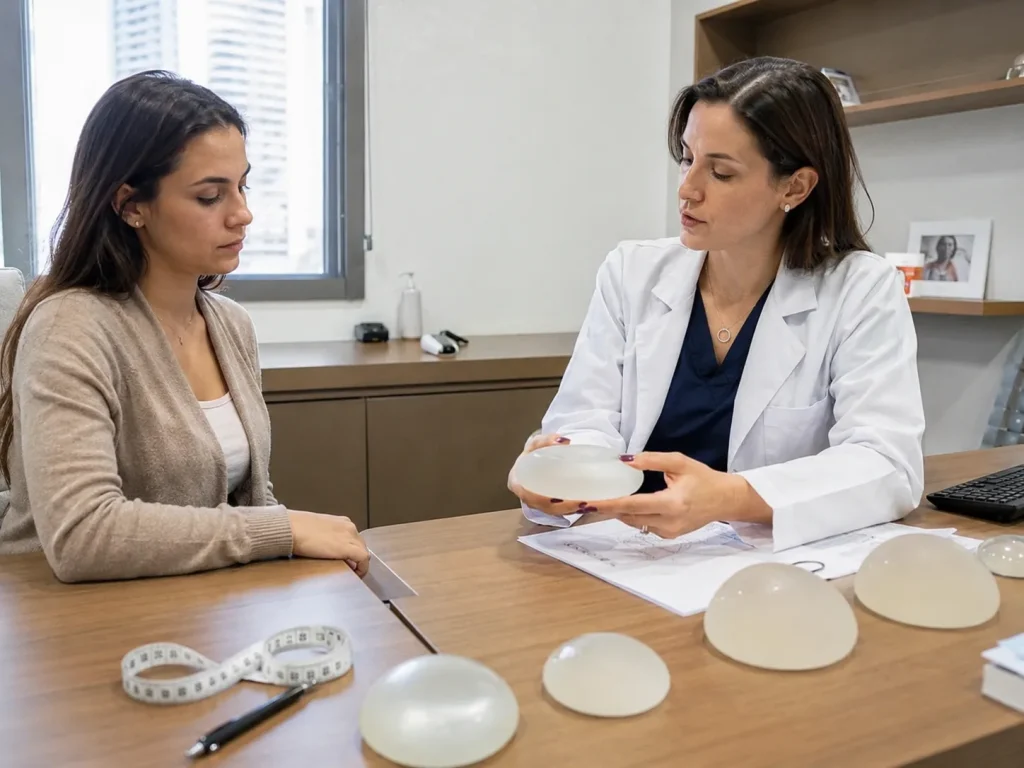
A guide for choosing implant size and shape.
The Clinical Function of an Implant Sizing Guide
Choosing an ideal implant size is among the most significant decisions a patient can make when it comes to plastic surgery, and to that end, board-certified plastic surgeons use an implant sizing guide – a detailed clinical tool to convert a patient’s desired bra size (subjectively expressed) into a very precise scientific measurement for use in surgery. Considering that commercial bra sizing varies greatly across different brands, subjective labels like a “C” or “D” should not be regarded as surgical references.
In a clinically defined setting, the breast implant sizing guide is standardized by using the cubic centimeter (cc) as the unit of measure alongside the patient’s exact chest wall anatomical measurements of the patient. By matching the patient’s original breast base width, skin elasticity, and desired forward projection against the dimensions of the implant, the sizing guide will guide us into the perfect implant without unnecessary estimation. The mathematical method guarantees compatibility and harmony without risking surgical complications such as lateral displacement, symmastia (a condition where the implants touch in the middle), and natural or unintended stretching of the skin cover that wraps the implant.
Essential Dimensional Measures and Sizing Strategy
Figuring out how the sizing guide works is all in the specific dimension metrics that play a significant role in the implant choice. The most important one is breast base width (BBW), which limits the biggest diameter of the implant that your frame can safely support without overflowing into the armpit. Given the limit of maximum allowed width, the surgeon uses the sizing guide to select the implant “profile,” or the one that gives the most projection. The profile controls how far the implant is situated forward off the chest wall such that ladies with little width can get the same fullness (high-profile implant) without busting their safety limits of base width.
In addition, skin stretch capability and the amount of current breast tissue are factored into the sizing calculation. A woman who is very tight-skinned, typically a nulliparous woman who has not been pregnant previously, has limited stretching ability, and therefore, the sizing guide will cap off the starting volumes to prevent vascular compromise or excessive tension on incision lines. Through careful math of existing tissue amount, skin looseness, and base width, the sizing guide can be utilized to give a safe range of visually appealing implant sizes perfectly suited to the patient’s body anatomy rather than a standardized cup size.
In-Clinic Sizing Sessions and 3D Imaging Technology
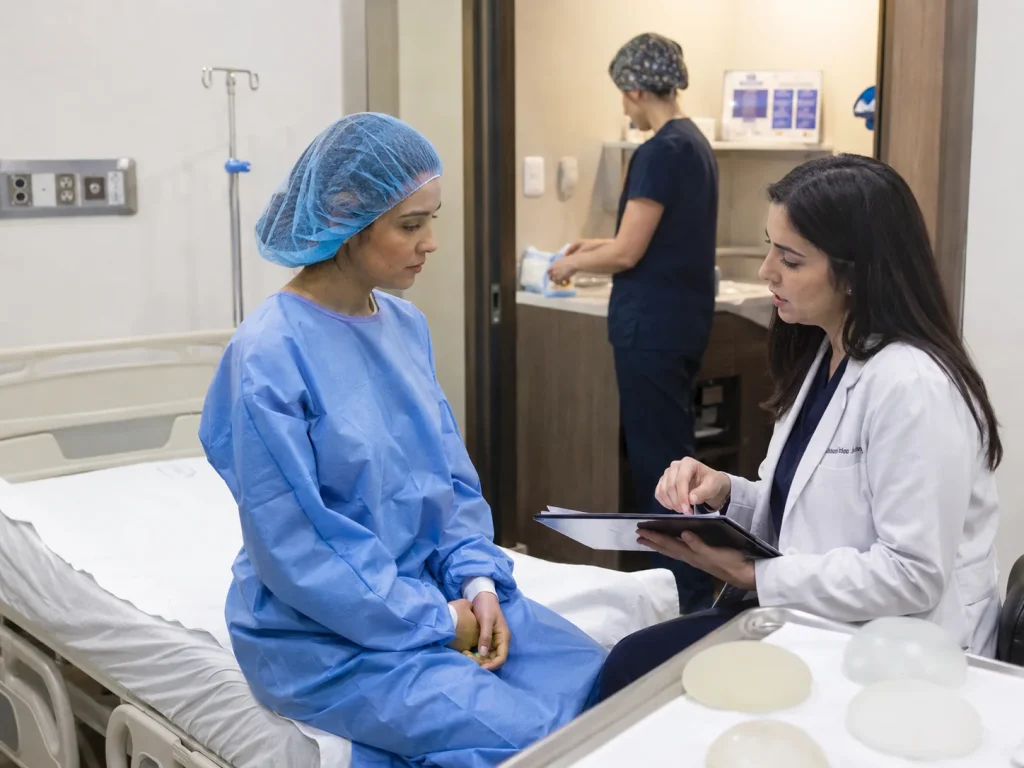
The physical sizing experience in consultation with the patient helps visualize and understand dimensions suggested by a sizing guide. It’s very likely that during such a meeting, patients are provided with a special sizing bra without padding and have a chance to try on different-sized “sizers” – physical mockups of silicone pieces of certain volumes such as 300cc, 350cc, and 400cc. The tactile approach not only lets clients judge the proportion and silhouette of different implants on them but also feel the weight and how they are affected physically. This interaction with a client bridges the gap between purely scientific numbers and real-world aesthetic desires; thus, the client is able to confirm her expectations are compatible with the surgeon’s surgical advice.
3D imaging is a cutting-edge method adopted by progressive breast augmentation surgery consultations to further enrich physical sizing with a more immersive technology. By using high-accuracy scanners, the surgical team records the exact replica of the patient’s torso in digital form. Afterwards, sophisticated software is capable of demonstrating how different implant sizes and profiles or implant levels (subglandular vs. submuscular) could potentially appear on the patient’s virtual self in real life. This kind of 3D sizing guide is predictive as well as extremely accurate, so it gives a multi-angle preview of the operation result, which is very accurate and therefore helps patients choose the volumetric size confidently and without doubt.
Protecting Your Body and Post Surgery Boundaries
During your rehabilitation period, it is critical for you to stick to your surgeon’s instructions with great care. You must understand that it is necessary to protect your newly formed breast pocket with its perfectly aligned implants as well as incision lines to facilitate the production of tough collagen and fibrin bonds that result in the healing process within the first 6 to 8 weeks of the operation. If you are careless about your care regimen for this vulnerable time, even with a well-selected implant size as advised by your size guide, you risk compromising structural placement and ending up with displacement or asymmetry.
If you would like your new shape to be locked in as firmly as possible with maximum structural accuracy without losing it you would certainly agree that you must refrain yourself at least temporarily from any heavy upper-body activities, running, or high intensity work-outs after recovery begins you have to stay on the bed only on your back with your upper torso raised to avoid pressing the areas around healing tissues which minimizes deep post-operative swelling at the same time. Moreover, you should wear a medical-grade surgical support bra continuously without missing for the first 4 to 6 weeks. With such a piece of clothing, you will get rid of mechanical drag from one area to another; you will assist the healing incision lines and make all tissue come together as smoothly as possible; you will also strictly stay away from nicotinic compounds.
Breast Implants in Turkey
Opting for LIN Europe Clinic means you have found a world-recognized oasis of medicine that provides excellence in medical care for your face and figure without a single compromise and at the same time with genuine love and understanding. We know very well that carrying out the intricate dissection for pockets, implant positioning, and making skin adapt so beautifully to the implant requires a very high level, well-thought-out, trustworthy, and encouraging setup centered on medical facts.
By placing your complete faith in the professional team at LIN Europe Clinic in Istanbul, you give us the chance to closely monitor your body’s parameters using the most advanced diagnostic tools. Your personal pre-operative assessment will consist of high-definition tissue mapping, personalized planning sessions with your surgeon, and tailored healing support plans that will guide you smoothly through each period of your tissues’ evolution and lifestyle reintegration. Our highly qualified medical staff is committed to the protection of your cosmetic investment as well as your systemic health, so that you will be comfortable and confident with the most balanced and striking version of you without a worry.
FAQ:
Breast implant sizing guide represents a thorough clinical assessment that takes your accurate body parameters such as chest base width and skin elasticity to determine the safest and most beautiful volume in cubic centimeters (cc) of implants for your body.
Physicians will measure the width of your chest wall (also known as breast base width) and evaluate the amount of natural tissue that you have. Using those precise measurements, they will suggest a size and profile of the implant that you can fit comfortably into your body.
Indeed. Trying on physical silicone sizers with a special sports bra during your consultation provides an excellent idea of the weight, the scale of the implant and also how you will look in your casual clothes.
A 3D scan of your torso will create a digital model of the body that your plastic surgeon can use to “simulate” various implant sizes and profiles on your body. This gives you a very accurate view of how you will look after surgery and helps you to visualize the final aesthetic.
Bra cup sizes are very subjective as each manufacturer of bras may use their own system for defining cup sizes. To avoid such uncertainties, plastic surgeons use millimeters measurement and implant volume in cc as these values provide the most reliable and accurate surgical planning method.
Tebbetts, J. B. (2002). High-definition breast augmentation: Tissue dimensional planning and sizing guide applications for optimal outcomes. Plastic and Reconstructive Surgery, 110(2), 566-577.
Spear, S. L. (2006). Surgical planning in breast augmentation: Managing base widths, volumetric sizers, and 3D imaging in clinical practice. Clinics in Plastic Surgery, 33(4), 543-552.
Rohrich, R. J., et al. (2014). Advanced postoperative care, deep pocket dissection stability, and risk mitigation protocols in breast augmentation. Aesthetic Surgery Journal, 34(5), 587-595.