Days 2–3 are usually hardest.
The physiological low point: Days 2 and 3
In a specialized area like advanced rhinoplasty and structural facial contouring, one of the keys to successful surgery is to thoroughly understand the post-operative inflammation timeline, which allows an individual, both mentally and physically, to be adequately prepared. Patients quite commonly believe that the most challenging day will be the surgery, i.e., Day 1. Nevertheless, clinically speaking, Days 2 and 3 are the worst days in the rhinoplasty recovery.
This difficult period is all a matter of a normal healing response of your body’s biochemical mechanisms. Your inflammatory system, once the changes have been surgically performed, mobilizes an immense number of cells in response at the site of the change. Since the accumulation of local fluid (edema) and swelling of tissues are not immediate processes, there will come a peak of the swelling at the point when the amount of the fluids in the body is the highest internally. This will be at the point of maximum tissue tightness, the feeling of swelling at the middle of the face, and complete clogging of the nose approximately 48 to 72 hours after the operation.
Managing the Initial Post-operative Symptoms
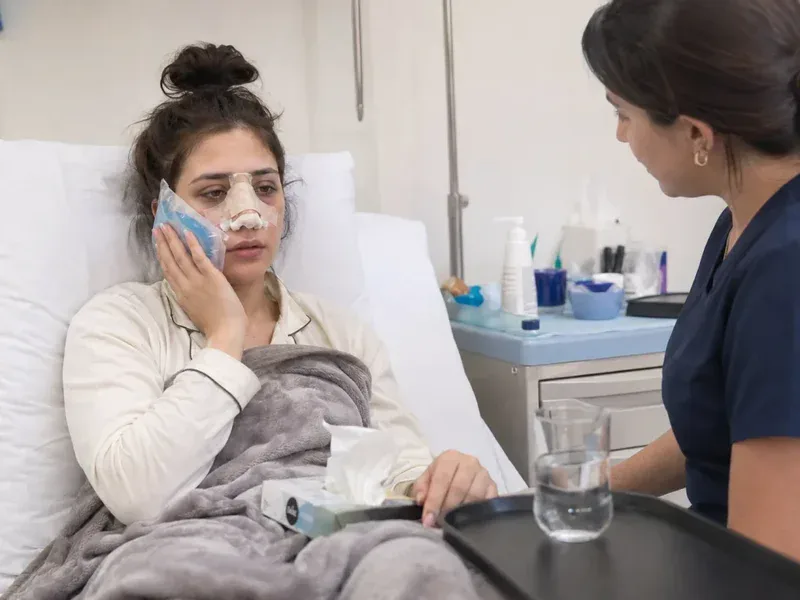
A typical patient is going to feel the peak of the body’s immune system reaction on Days 2 and 3. During these two days, patients will have several physical and sensory changes that can result in some discomfort:
- Complete Nasal Blockage: Internal mucosal swelling that is combined with the presence of a silicone splint will entirely block both nasal passages. This will force 100% mouth-breathing, which will cause severe throat dryness and a temporary loss of sense of taste and smell.
- Swelling Around the Mouth and Around the Eyes: The trapped fluids tend to run downhill, that is, to migrate from one body part to another, and eventually settle in the lower facial tissues that are in the vicinity of the surgery. This leads to swelling and black-and-blue marks in the area of the eyes and cheeks, reaching their highest level on Day 2 or Day 3, sometimes even making it difficult for one to fully open their eyes in the morning.
- Painless Slight Bleeding and Pressure Sensations: At this stage, you will notice minor pinkish fluid dripping onto your dressing. Accompanying this, you will feel a rather profound, mild pressure at the level of your forehead and sinuses instead of any sharp or unbearable type of pain.
Keeping the Structure as You Are During the Period of Maximum Swelling

For those very few patients who can’t be satisfied with even the slightest imperfections of their facial contours and have an extreme need for perfection in the way that their nose looks, it is very important that at this stage you follow, strictly and to the letter, the limitations of the behavior for the next 72 hours. In this time span, the healing bones under the nose and especially the cartilage grafts that you have in place are very unstable. They totally depend on external squeezing force and the lack of movement of tissues to stay in their new positions. The main thing that will make it possible for your nose to heal correctly is protecting this system from being damaged.
To be sure that your newly shaped nose will maintain its ideal shape and alignment and also that the fluid in your face will be absorbed more quickly, you will be required to sleep and sit while keeping your head elevated at least 30 to 45 degrees. You need strict and constant application of wrapped ice packs or cold compression on your cheeks and forehead; Do not touch ice or cooling packs directly against the nasal cast, as doing so puts a lot of pressure on the healing bones and could cause them to be displaced. In addition, you must completely give up nicotine and tobacco products because the use of such will remain a constant threat. The blood in the nose is already very engorged from the swelling, so nicotine is the last thing you need; it is such a powerful systemic vasoconstrictor that it can lead to narrowing of the tiny vessels and deprivation of the necessary oxygen and nutrient blood to the swelling nasal tissues, which is essential for them to process the accumulated fluids.
A Rough Timeline for The First Week
Patients benefit a lot when they are informed about the progression of their biological tissue-clearing process, since it will allow for them to be calm and not worried about their situation if something goes wrong on the second and third day:
| Recovery Day | Inflammatory Status | Primary Experience & Milestones |
| Day 1 (Surgery) | Acute phase initiating | Mild grogginess from anesthesia; initial nasal wrapping; minor oozing. |
| Days 2–3 | Peak physiological edema | Maximum facial swelling and bruising; full mouth-breathing; throat dryness. |
| Days 4–5 | Inflammatory decline | Swelling begins to shift downward; internal pressure lifts; energy levels return. |
| Day 7 | Structural turning point | Clinical follow-up appointment; external cast and internal splints removed. |
Rhinoplasty in Turkey
If you choose LIN Europe Clinic, you are stepping forward in the top world healthcare retreat, which is fully focused on your nasal aesthetics, structural modifications, as well as surgical approaches and guided by the highest standards that are not negotiable for clinical and, at the same time, compassionate care. That is why we are proud to create, maintain, and support an extremely professional, transparent, and most encouraging atmosphere for those patients who are experiencing, both physically and psychologically, peak recovery days. For us, clinical decision-making based upon the best evidence always takes first place, even before the patient wants to. LIN Europe Clinic in Turkey that we offer is considered a worldwide reference point in the advanced facial contouring and plastic surgery fields. At the same time, post-surgery care is one of the best aspects of the service that our clinics render. Therefore, you have not only a comfortable place at our facility but, more importantly, your physical healing is taken into account as the primary task.
Entrusting your cosmetic contouring operation entirely to LIN Europe Clinic surgical team based in Istanbul will mean that your post-operative condition is closely and expertly monitored during the first stage of your healing. You will receive an excellent comprehensive post-operative support system, ultra-detailed tissue movement monitoring, and rapid-response care facilities, all of which will guide your body’s natural healing process to a full recovery. Our top-notch surgical personnel assure you that the outcome of body contouring surgery and your whole health is safeguarded by taking all possible precautions so you can achieve the ideal silhouette of your dream shape and feel safe about it.
FAQ:
Days 1 and 2 will certainly be the hardest to endure due to swollen face, bruising, and stuffiness of the nose which will have reached the highest level of their biological peak.
Surgical internal swelling completely closed down your nasal airways along with internal mucosal swelling which resulted in drying the surgical fluids and putting the internal silicone splints which will definitely lead to forced, temporary mouth-breathing.
Drinking plenty of water, oral rinse for dry-mouth, sleeping in a chamber of cool mist with a running humidifier and continuous application of skin-friendly hydrating lip balm will all help you in the matter.
It is very common for the intense swelling that happens on Days 2 an 3 to spread through the eyelids and cheeks. The fluid will initially flow downwards and start to dissipate very quickly right from Day 4.
Major changes for the patients mostly come on Day 4 or 5, when facial pressure lowers, swelling starts to reduce and nasal obstruction gradually fades.
Rohrich, R. J., et al. (2011). The rhinoplasty recovery matrix: Analyzing operational parameters, peak postoperative edema, and tissue adherence standards. Plastic and Reconstructive Surgery, 127(4), 1651-1663.
Toriumi, D. M. (2007). Structure rhinoplasty: Managing the external skin envelope, acute inflammatory cycles, and long-term osteotomy stabilization. Clinics in Plastic Surgery, 34(1), 119-126.
Gunter, J. P., et al. (2014). Advanced postoperative care, managing early mucosal swelling, and structural stability in secondary facial contouring. Aesthetic Surgery Journal, 34(5), 587-595.