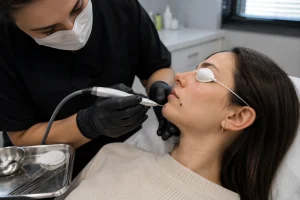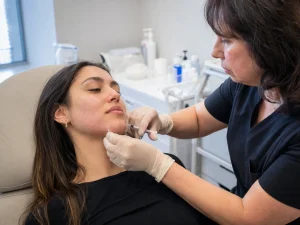
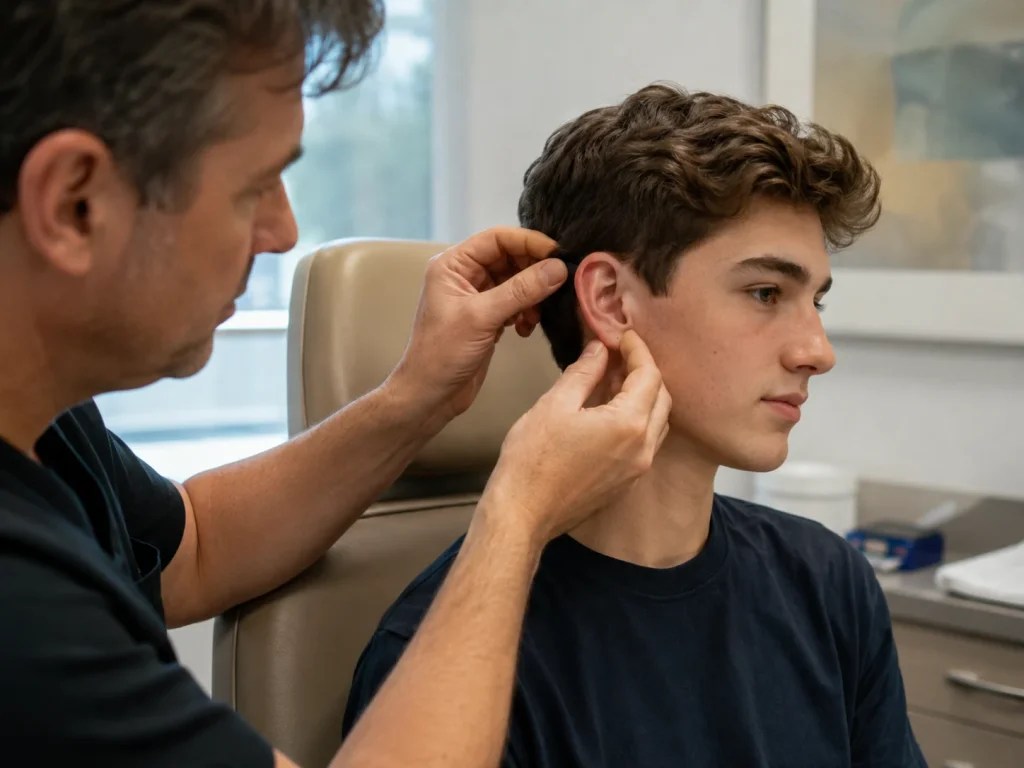
Otoplasty surgery usually takes one to two hours.
The Surgical Window: Changing Cartilage Shape with Great Precision
In the field of correcting ear pain and facial bone restructuring, changing how far the lip of the ear stands out needs exact knowledge of human anatomy. When people ask how long it takes to have an otoplasty (ear pinning surgery), the duration is thought about by two totally different phases: the exact time spent inside the surgical room and the long biological time needed for the tissues to heal fully.
Intraoperatively, a classic bilateral otoplasty is an exceptionally time-saving, outpatient surgery that, on average, needs 1 to 2 hours to be done perfectly. The exact amount of time spent under either local or general anesthesia is determined by how complicated the deformity of the ear cartilage is. Should the ear protrusion only be due to the antihelical fold being less prominent, the surgeon can efficiently recreate the natural fold by means of permanent internal stitches only. On the other hand, if the patient has an excessively developed deep conchal bowl, the expert will have to carefully remove the small crescent of the extra cartilage and then fix the ear structure to be closer to the head; hence, the surgical time.
Post-operative Inflammation Period and New Matrix Enclosure
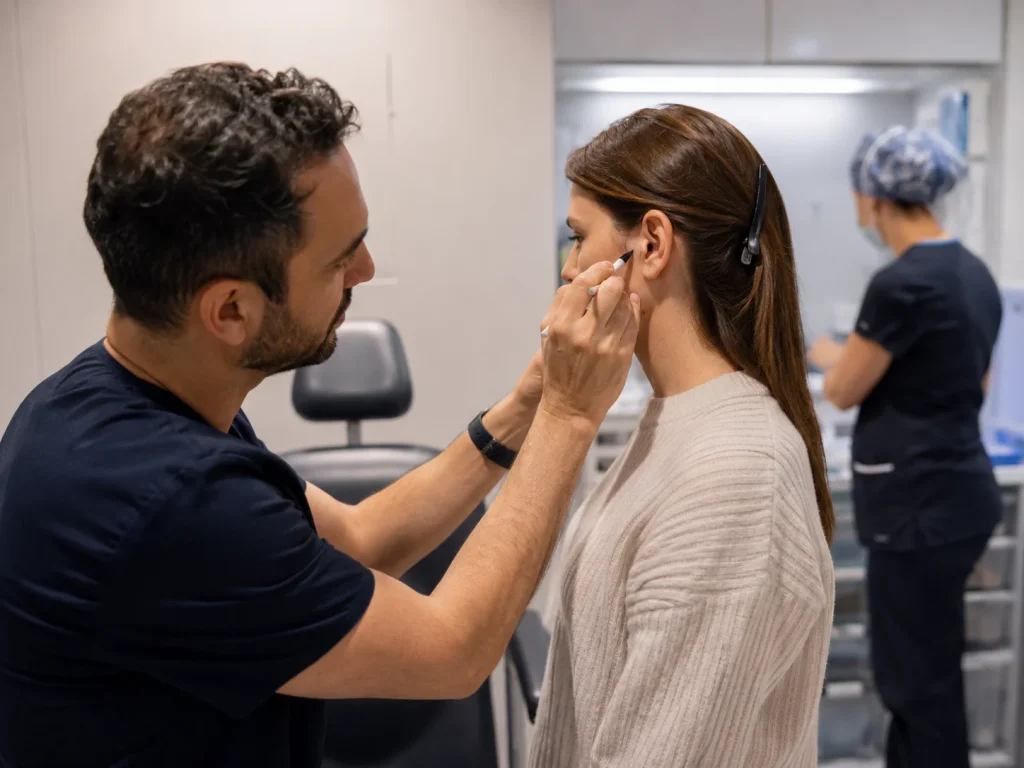
After the mechanical modeling of the cartilage, your healing path enters the acute post-operative phase, and the newly made ear cartilage is in need of a special time period to get firmly fixed in its new, low-profile positioning. Immediately after the surgery, your head will be wrapped for the first three days with a thick, heavy medical plaster to exert even and continuous pressure that not only limits localized swelling but also completely eliminates the formation of a hematoma. Around day seven to ten, you go back to the clinic for the removal of the external micro-sutures, and from that moment, you will be changing the heavy medical dressing with a light elastic sports headband to assist the early cellular fusion.
For the next three weeks, the use of this protective headband for a minimum of twenty-four hours/day is a critical factor as it serves as a major external barrier, stopping the ears from being bent or pulled forward accidentally during regular activities, while concurrently safeguarding the vulnerable internal permanent knots. At the beginning of the third month, the ear framework will have consolidated sufficiently for the patient to be allowed to remove the headband only during the day. However, the patient must still wear the headband during bedtime for another 4 weeks to prevent folding the ear to the pillow during night movements, which will ensure that the tissue has been locked seamlessly in its permanent location.
High-Level Biomechanical Forces and Long-Lasting Internal Anchoring
For fully appreciating the extent of structural stability that is reached through this transformation, it is important to analyze the underlying advanced biomechanical forces inside the ear anatomy, newly arranged. The human ear cartilage is endowed with a natural “cartilage memory,” a kind of natural elasticity that results in a continuous outward force, causing the tissue to resist the new position and attempt to revert to the original, protruding one. To overcome this continuous mechanical opposition, top surgeons resort to internal anchoring techniques that involve placing non-absorbable monofilament sutures deep within the innermost layers of the perichondrium. These special threads serve the function of an internal splint as well as maintaining the newly formed antihelical fold and conchal cartilage being attached to the mastoid fascia with absolute geometric precision.
During the first three months, a major biological event called fibrovascular consolidation takes place in the tissues around these internal sutures. The body reacts by activating a wound-healing process that will produce a dense network of type I and type III collagen fibers precisely at the levels of the incision lines and suture tracts. This newly made collagen network will progressively mature, become cross-linked, and replace the initial, relatively fragile scar tissue with a strong, permanent fascial bond. After this, the biological integration is fully complete, and the structural dependence will be transferred from the artificial fibers to your own natural connective tissue. This will make sure that your ears remain perfectly aligned with your skull, and they will be completely resistant to any future changes, keeping the profile harmony at its best for a lifetime.
Perfecting Cranial Balance to Accentuate Your Physique
Being well acquainted with the rigid limits of otoplasty aftercare will enable you to get your body transformation done without any fear of structural failure. For those who work very hard on their physical fitness and have reached the elite level of performance, especially if they have concentrated a lot on lower body muscle hypertrophy and gluteal development to give themselves an hourglass figure, the attention to detail for the global symmetry of the body is paramount. Sticking-out or large ears can be a major source of distraction, visually breaking the elegant and well-toned lines of the shoulders and slim waist.
By having a very precise and highly effective otoplasty to permanently bring your ears in line with your head shape, the specialist successfully purifies your overall silhouette. Aligning your facial proportions in perfect geometric harmony will be the means to portray the same level of disciplined living, inner strength, and athletic grace as your body does. This mathematically engineered balance eliminates any unwanted visual disharmony so that your well-developed lower curves and your sophisticated physical proportions can remain beautifully highlighted from every single angle.
Otoplasty in Turkey
If you decide on LIN Europe Clinic, it means you are choosing a top-notch medical facility where your unique physical remodeling journey will be accompanied by no compromises in professional skills and heartfelt concern. We totally understand that the decision to restore one’s ears entails the highest level of complexity, requires openness and support, and most important of all, it is grounded in evidence-based medicine. LIN Europe Clinic in Turkey is one of the world leaders in advanced facial contouring, and it is also a calm place where your surgical roadmap is entirely guided by the highest global patient safety standards.
When you entrust your highest hopes to our committed, board-certified plastic surgery team at LIN Europe Clinic in Istanbul, your otoplasty will be done perfectly and mathematically correct. We have at our disposal the most modern techniques for diagnostic evaluation, hidden posterior incision vectors, and advanced non-absorbable internal anchoring sutures that help us to ensure your operation results in a perfectly balanced, natural-looking face with no visible external marks. Our team of top-notch medical staff offers you complete single-person medical supervision to assist you safely throughout your healing process and protect your surgical achievement over a lifetime. Get the sophisticated, personalized service of LIN Europe Clinic and enjoy a beautifully harmonized profile, safely and expertly carried out in the heart of Turkey.
FAQ:
The surgery itself is a really fast operation, usually taking around 1-2 hours to finish the process for both the ears. Since it’s an outpatient procedure, you can go straight home or your luxury hotel that same day.
The majority of patients report a very minor pain, like a dull throb or localized tightness, which is easily controlled by standard prescription or over-the-counter painkillers during the first three days. After the first week, the pain level dramatically decreases.
If you don’t wear the headband within the first month, there is a very high risk of the structure failing. The headband acts like a shield for the permanent internal sutures against getting overstretched or snapped off; wearing it too soon can make the cartilage come forward.
In order to achieve total cosmetic invisibility, incisions are so well hidden that they cannot be seen at all. Surgeons even manage to place the thin incision line inside the natural anatomical fold right behind the ear, which means there are absolutely no visible traces on the front of your face.
Indeed, otoplasty results are meant to be permanent and last a lifetime. After the cartilage inside the ear has healed and fixed itself in the new position against the skull during the first eight weeks, the ears will always have their balanced and low-profile shape.
Furnas, D. W. (1968). Correction of prominent ears by conchal-mastoid sutures. Plastic and Reconstructive Surgery, 42(3), 189-193.
Mustardé, J. C. (1963). The correction of prominent ears using simple buried sutures. British Journal of Plastic Surgery, 16, 170-178.
Singer, A. J., & Clark, R. A. (1999). Cutaneous wound healing and tissue remodeling dynamics. New England Journal of Medicine, 341(10), 738-746.