Residual skin laxity or aging changes.
The Optical Illusion Of Post-Operative Tissue Edema
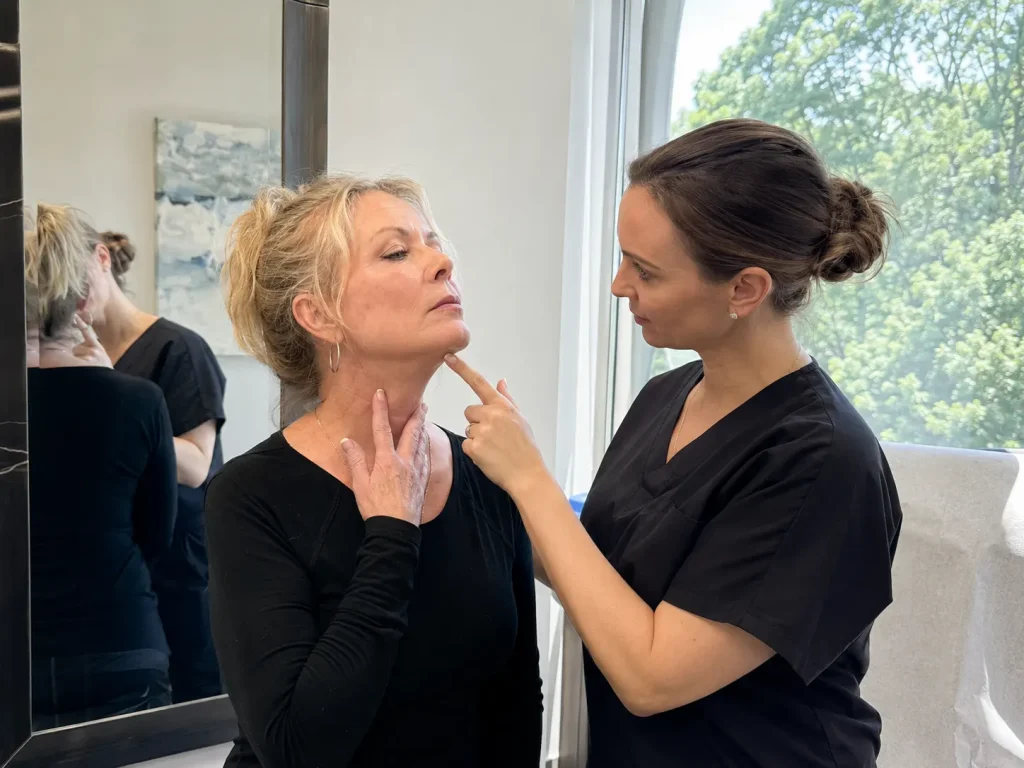
Very tightly controlled neck profile analysis during recovery is extremely important in the highly specialized area of facial architecture and aesthetic medicine. Often, when patients are concerned that their neck still looks loose or saggy a few days after a neck lift, the foremost clinical reason could be a known biological phenomenon: localized fluid retention and deep micro-edema. The violent disruption of the deep cervical fascial networks and platysma muscle layers leads to a powerful immune response, temporarily filling the surgical pocket with stagnant lymphatic fluid.
It is important to know that this swelling may not be in the form of a firm, tight puffiness; often, gravity causes the fluid to settle in the lower submental zone underneath the chin. This fluid pocket can be soft, doughy, or pliable, and it can easily fool you into thinking that there is still fat or loose skin. This is actually a normal stage in the acute healing process and one that requires patient discipline, as your very own lymphatic channels will gradually clear the fluid over the initial six to twelve weeks.
Dermal Elasticity Thresholds and Draping Dynamics
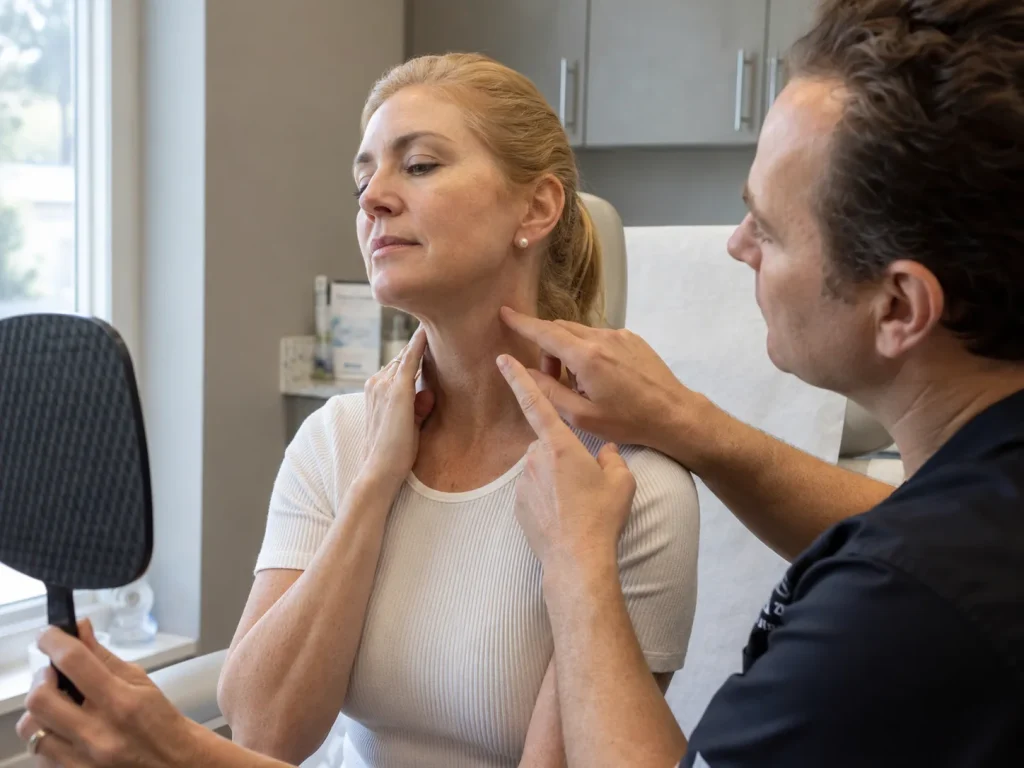
The resiliency and youthful aspects of your neckline will, in fact, be determined to a great extent by the basic biological quality of your skin. At the time of the neck lift, the surgeon will tighten and reposition the muscle and remove the excess skin. Nonetheless, a patient with severely impaired skin elasticity—dermatological elasticity that has been damaged as a consequence of, e.g., genetic reasons, severe sun damage, or major weight fluctuations prior to the surgery—may find that the skin will not be able to stretch and change the new minimal framework adequately.
The skin, when it loses its elastin and collagen fibers that maintain its structure, no longer has the internal memory required to shrink-wrap tightly over the newly sculpted contours. Instead, the tissue becomes loose and this may cause a slightly softened or saggy look along the transition zones. A deeply accurate clinical evaluation will tell you that this dermal settling is not a breakdown of the internal muscular suspension, but rather a sign of the skin texture limitations. Usually, this can be improved with the use of non-invasive energy devices to stimulate new dermal contraction, especially during the tissue maturation phase.
Structural Boundaries and the Platysmaplasty Limit
In order to properly evaluate your neck contouring results, you must first understand the exact anatomical boundaries of the procedure you underwent. Usually, a standard or isolated neck lift focuses only on the reconstruction of the muscle and skin of the neck that are below the mandibular border. The vector of force or the direction of pull is highly focused, and it is designed to move the loose neck tissues back and up towards the hidden anchor points located behind the ears.
Should a patient’s tissues be affected by significant jowling, falling cheek mass, or late tissue displacement across the lower third of the face, then trying to correct these with a neck lift only will not be possible. The loose tissues of the lower face will naturally fall down and pile up just above the neck. What this continuous downward movement of facial tissues can do is create an illusion of a loose, incomplete neck correction. To avoid this discrepancy in the structure, good surgeons check your overall proportions thoroughly beforehand, and most of the time, they will suggest a combined lower facelift to achieve a perfectly smooth jawline.
Platysmal Separation and Deep Visceral Fat Factors
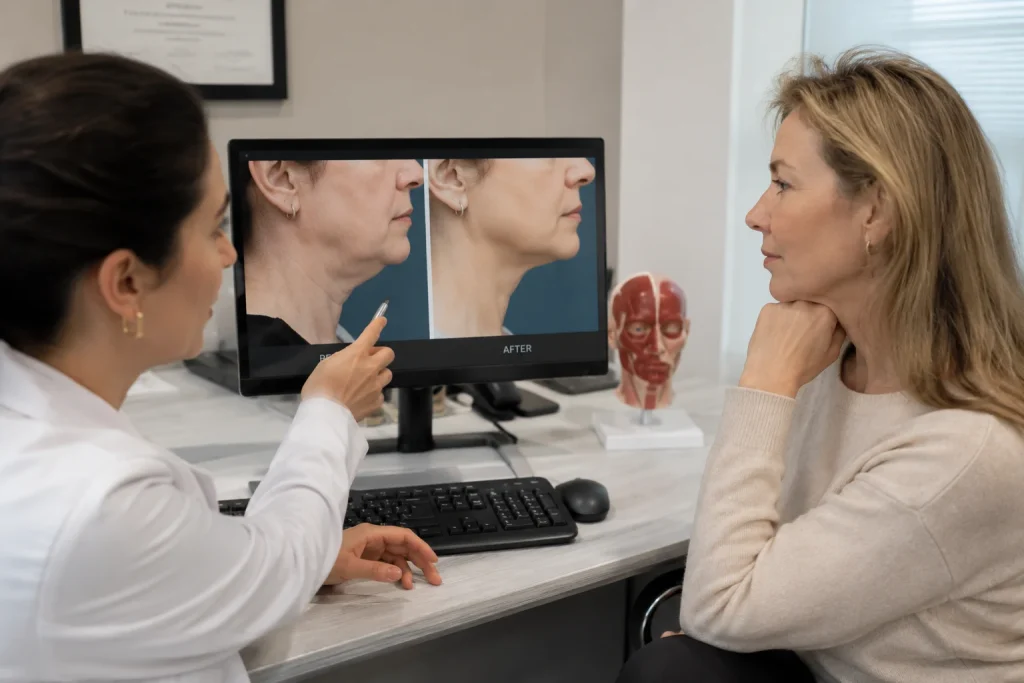
Very occasionally, a saggy neck appearance that does not go away or comes back during the first months can be due to structural issues under the skin. The platysma muscle corset is secured with permanent, internal sutures that have a great tensile strength. If during the early healing stage a patient forces himself too hard mechanically, e.g., by harsh coughing, lifting weights, or aggressive neck twisting, then these sutures can loosen, and the muscle borders can subtly come apart again.
Also, a bulky neck can be due to a large amount of fat located below the platysma or to enlarged submandibular glands, which are entirely underneath the muscle layer. A neck lift is, primarily, a surgery that modifies the layer of subcutaneous fat that is right under the skin. If, for safety reasons, the operation was limited to this layer and the deeper visceral structures were left unnoticed, these can continue to push outward against the tightened muscle sheet, and so, the patient still cannot get a razor-thin, ultra-sharp angle under the chin.
Neck Lift in Turkey
If you decide to have your surgery at the LIN Europe Clinic, you will be entering a high-class medical environment in which your facial transformation will be handled with impeccable clinical skills and great compassionate care. We know that a thorough evaluation of persistent post-operative tissue changes sets a requirement for that only a very sophisticated, transparent, and highly personalized environment can meet, and that such an environment is one that puts evidence-based medicine as the foremost priority. Our luxurious medical facility in Turkey is at the forefront of the world in cervical contouring and is a quiet place where your tissue maturation is supervised and directed by expert reconstructive specialists.
By developing great trust in the expert team of LIN Europe Clinic in Istanbul, your post-operative healing process will be under complete diagnostic control. Besides using top-notch diagnostic images, we will provide you with personalized clinical compression protocols that will prevent your deep muscle systems from tearing and help them to settle optimally. Come to the refined, comprehensive service of LIN Europe Clinic and get a perfectly balanced profile that is timelessly beautiful, and which will be managed safely and skillfully in the heart of Turkey.
FAQ:
Almost always early on, sagging is a result of pretty localized, calm, kind of soft chin swelling that is the situation when the fluid tends to collect under your chin by gravity. The fluid even at that stage can quite easily get you to first think it’s loose skin since physically, it’s cold, soft, and it looks exactly like sustaining the loose skin.
The suction wrap around your skin will finish the repositioning of the muscle problem for about three to six months. Your definite, perfect outline with a drop of sharpness will have come out clearly in the earliest moments the swelling completely subsides.
Blocking one’s natural elastin production in the skin due to aging or damaging sun exposure is one factor that can make neck a little bit saggy and not shrink back tightly over the muscles. This kind of result is a loose appearance that, upon further visits and treatments, can be improved with skin-tightening treatments.
When the suture breaks it is almost as if, you know, the suture would be the last variable, (of course, first of all, implementation of the doctor assistant did matter). Sometimes, the focus on failure is even misplaced, other than complete lifting of navel retraction suture, more of the time the persistent sagging is very much seen to be caused by fluid retention or the furthest lower face jowling.
To a certain extent, the introduction of sagging cheeks and jowls could be just a matter of releasing the excess tissue of your face to naturally down slide over the jawline. This effect is the lessening of neck tightness which on the whole goes for lower face lifting to be able to get a complete fix in most cases.
Aston, S. J. (1998). Platysma-SMAS cervicofacial rhytidoplasty. Clinics in Plastic Surgery, 10(3), 507-520.
Feldman, J. J. (1990). Corset platysmaplasty. Plastic and Reconstructive Surgery, 85(3), 333-343.
Labbé, D., Franco, D., & Nicolas, J. (2006). Platysma suspension and platysmaplasty during neck lift: anatomical study and clinical applications. Plastic and Reconstructive Surgery, 117(6), 2001-2010.