Scars usually fade and flatten significantly.
The Biometrics of Dermal Maturation and Scar Remodeling
Scars in the context of body sculpting and post-operative tissue healing are not mere static marks, but living biological matrices actively changing over time. If an individual has an abdominoplasty (tummy tuck), the body reacts to the surgical cut by starting a dermal repair program which can last several years. Initially, from a purely biometric point of view, healing depends on fibroblasts quickly summoning large amounts of Type III collagen which is quite disorganized, to close the surgical gap as fast as possible.
At LIN Europe Clinic, we tell our visitors that this new collagen production is the reason for the fresh scar being raised, hard, and showing a strong color (red or purple) during the first year. Though the body’s switch to scar remodeling over the long term involves slowly breaking down and getting rid of the stiff tissue, while at the same time using organized, softer, and stronger Type I collagen to replace it. When a scar is 5 years old, such a drastic biological remodeling will have been completed through and through. The tissue now appears in its original state of biological balance, making it a definite, ever-lasting representation of the aesthetic result.
After 5 Years: Appearance and Surface Changes
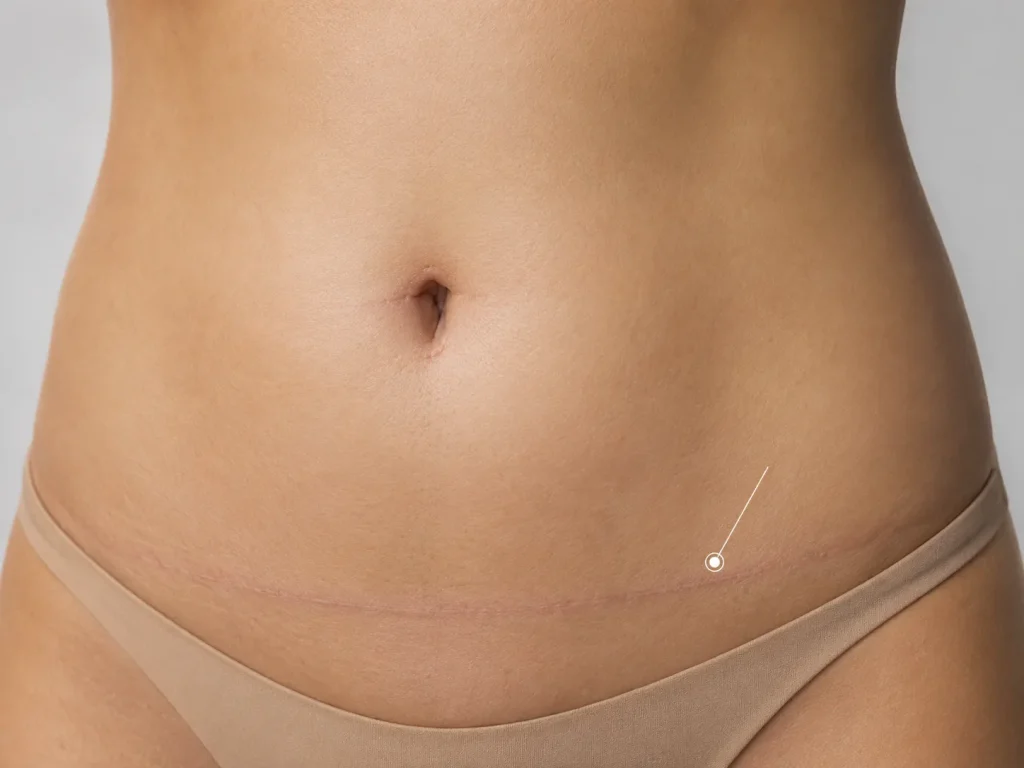
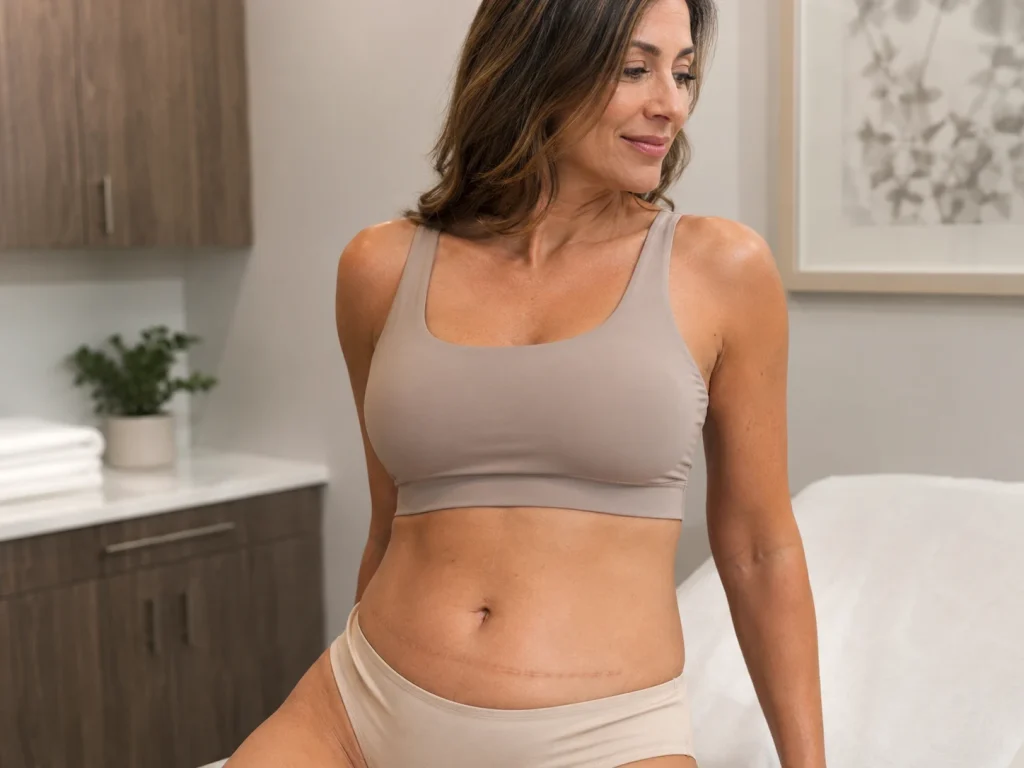
Tummy tuck scar at 5 years post-operation has reached the stage where the natural tissue fades almost completely. At this stage, the red and dark pigmentation-causing inflammatory responses will have stopped quite some time ago.
Comparing a healthy scar after 5 years of tummy tuck with the initial phase, the visual and tactile changes are significant:
- Color Reversion: The bright red, pink, or purple colors have completely changed. Usually, the scar appears as a pale, silvery, or skin-colored line that is very similar to the color of the skin around it.
- Leveling of the Surface: The stiffness, bumpiness or “rope-like” nature of the scar has been entirely removed. Five-year scar is completely flat with the neighboring skin, making it very difficult to detect even by touch.
- Elasticity Recovery: The skin runs along the scar line, regains most of its natural stretchiness and softness, it moves comfortably with the abdominal wall without feeling tight or limited.
Creative Surgery: Scars Location and Managing Internal Pressures
The final visual appeal of a 5-year scar is actually decided on the very first day in the operating room. For a scar to become an almost imperceptible hairline, a surgeon must manage dermal tension through clinical mastery. In case the surgeon depends solely on the outer skin to hold the tummy tightly together, the mechanical tension will eventually result in the scar stretching and becoming a thick, highly visible band over time. To stop this from happening, our experts at our Istanbul sanctuary use multi-layer internal suturing.
We take advantage of solid, absorbable sutures deep in the fascial layers to handle 100% of the physical force. When the outer skin is to be closed, there is no tension pulling on the surface incision at all. Besides that, the incision is carefully planned to be extremely low on the pelvic bone. This outstanding surgical brilliance ensures that even after 5 years, the very faint scar line is permanently hidden under the most daring bikini or the lowest-cut underwear.
Clinical Measures for Perfect Long-Term Scar Maturation
Despite a surgical technique being a deciding factor, structural harmony at the 5-year mark will also require the patient to show professional diligence during the first year. How well a scar is protected and cared for initially will have a great influence on how it looks 5 years later.
- Silicone Treatment: The best and most proven scar management approach is the uninterrupted use of medical-grade silicone gel sheets for 6 to 12 months. Silicone forms a hyper-hydrated environment that sends a signal to fibroblasts not to produce more collagen than necessary, so the scar is not raised or hypertrophic.
- Protection from Sunlight: If a fresh scar is exposed to direct sunlight, it will cause melanocytes in the area to permanently darken the already delicate tissue. Using a strong UV protection during the first year is the reason why a 5-year scar appears pale and well-blended instead of being permanently brown.
- Fractional Laser Treatment: If a patient desires an absolutely perfect look, non-ablative fractional laser treatments may be conducted after the first year in order to remove pigment residues and make the micro-texture of the scar match the natural skin.
Tummy Tuck in Turkey
Choosing LIN Europe Clinic represents a step into a world-class medical resort where highly complicated body contouring surgeries are done with an uncompromising focus on achieving excellent aesthetic results that will last a lifetime. We acknowledge that a tummy tuck is a lifelong physical investment, and your results should look just as elegant and natural in 10 years as on your first day. LIN Europe Clinic in Turkey is a world leader in advanced tissue management and offers a high-end environment where your structural integrity and aesthetic vision are our top priorities.
When you decide to LIN Europe Clinic with your care, you will gain access to an elite medical organization that greatly values professional care even beyond your surgical operation. We thoroughly plan your whole surgical and post-surgical journey, apply world-class tension-free closure methods, and provide complete scar management treatment plans. Get to know LIN Europe Clinic‘s sophisticated care and gain a stunningly balanced and exquisitely sculpted silhouette that represents the very peak of biological success, offered safely in the center of Turkey.
FAQ:
No, any time the full thickness of the human dermis is surgically incised, it will always result in a scar that lasts forever. Yet, through top-notch surgical methods and proper follow-up care, a 5-year-old scar is a barely visible, super thin and flat line of silver that one would find very difficult to notice.
If a scar keeps the dark color or hyper-pigmentation even after 5 years, this is most often a consequence of not protecting the scar from the sun (UV rays) during the very first year of healing. Once the pigment is set in the mature tissue, clinical laser treatments are required to break down the melanin and lighten the scar.
A scar will enlarge only if it has been stitched under high mechanical tension at the surface of the skin, or if the patient did not refrain from heavy lifting before the deep tissues have completely healed. By employing modern internal suturing techniques, which are tension-free, the surface scar will remain a thin line forever.
Definitely. An incision for tummy tuck purpose, which is planned with great precision, is situated very low on the pelvic bone so that it can be hidden well under the standard briefs and even string bikinis. Your well-toned flat stomach will be seen but the faded scar will still remain hidden.
After 5 years, if the scar is still thick, raised or “ropey” (hypertrophic), topical treatments like creams won’t be effective anymore. You will have to seek the help of a doctor who specializes in scars for steroid injections, laser treatment of the skin, or minor scar revision surgery to remove the bad tissue and close the wound in a perfect way.
Broughton, G., Janis, J. E., & Attinger, C. E. (2006). The basic science of wound healing. Plastic and Reconstructive Surgery, 117(7 Suppl), 12S-34S.
Mustoe, T. A., Cooter, R. D., Gold, M. H., et al. (2002). International clinical recommendations on scar management. Plastic and Reconstructive Surgery, 110(2), 560-571.
Gurtner, G. C., Werner, S., Barrandon, Y., & Longaker, M. T. (2008). Wound repair and regeneration. Nature, 453(7193), 314-321.
Shermak, M. A. (2020). Abdominoplasty with Circumferential Contouring. Clinics in Plastic Surgery, 47(3), 365-375.