Tissue tension and healing cause discomfort.
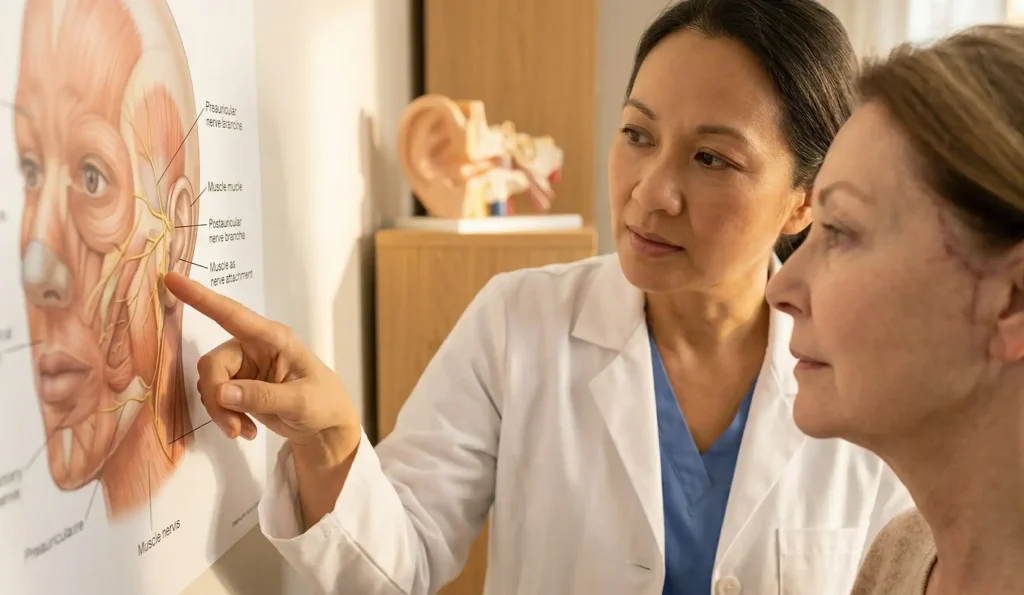
When it comes to deep-plane rhytidectomy and high-definition facial rejuvenation, the face-to-ear anatomy is the primary area that a surgeon pays attention to during a facelift. To reposition and secure the face and the area of the SMAS layer to create a facelift, the main incisions are usually drawn around the twists of the tragus and the back of the earlobe. As a first answer to the question of why ears hurt after a facelift, is a chief complaint of the patients when the ears hurt after a facelift, the clinical reply is that there are two main reasons: neural compression and mechanical tension. Both are sensory nerves supplying the ear.
Periauricular pain, a highly sensitive but clinical standard phase of “neurological resetting,” is what we at Lin Health Europe Clinic associate with ear pain after a facelift. For our travelling international patients to Turkey, we highlight the fact that ear pain is rarely an issue with the ear itself but rather it is a sign of the massive lifting of the facial tissues that are next to the ear. Our center is the leading one in the country for advanced facial sculpting and we are able to provide nerve-sparing techniques not only minimizing the duration of these sensations but also allowing the patients to enjoy a safe, comfortable journey to a younger, refined look.
The Great Auricular Nerve and Sensory “Stunning”

Most cases of ear pain associated with facelift surgery are due to the temporary disruption of the Great Auricular Nerve (GAN). Body map of areas where this nerve supplies sensation is lower two-thirds of the ear and the nearby skin. Elevation of the skin flap during the facelift operation at Lin Health Europe Clinic in Turkey will unavoidably stretch or “stun” the very small nerve fibers. “Stunning” or stretching the micro-fibers of the GAN is the norm. This does not imply nerve damage, but rather the nerve ends up in a condition called neuropraxia (loss of function for a while).
It is estimated that in the initial post-facelift weeks in Istanbul, as the nerve recovers, it can send the brain faulty signals resulting in sensations of sharp “electric” pains, itching or burning in the lobule of the ear. For us at the clinic, we view it as a “sensory transition,” and it is one of the clinical signs of the internal healing process.
Mechanical Tension and “Anchor” Point Pressure
In order for a facelift to be effective, the facial tissues must be firmly anchored to some fixed points near the ear. In order to produce a good results of a facelift lasting for several years, the operating surgeon must exert enough tension on the SMAS layer. This tension will be highest at the periauricular or ear area. When the tension is very high, it may cause press the ear side or the ear-to-cheek junction.
Likewise, the Lin Health Europe Clinic doctors in Turkey use a multi-layered anchoring technique to evenly spread the tension, which prevents a “pulled” look and lessens the localized pressure on the ear. But for the initial 14 days of post-surgical healing in Istanbul, the typical inflammatory reaction leading to increased tissue volume can make the feeling of “tightness” so intense temporarily and even give rise to a pain that is referred either to the ear canal or the ear rim.
Postoperative Edema and the “Fullness” Sensation
The ear comprises a complex architecture of cartilage and skin, making it very receptive to changes in local fluid dynamics. Swelling or postoperative edema commonly heads toward the ears following a facelift. If there is an accumulation of fluid in the periauricular space, this often results in a feeling of “fullness” or “clogged ears” just like one gets at a flight to a high altitude. Such internal pressure can close the ear canal, leading to dull, throbbing pain.
We at Lin Health Europe Clinic are constantly pointing out to our international visitors in Turkey the importance of keeping the head elevated during the entire 24 hours of the first week. This very simple thing, led by gravity significantly helps drain the fluid away from the fragile ear structures in Istanbul, thereby greatly diminishing the “heaviness” sensation and the associated discomfort as the inward collagen formation (neocollagenesis) begins to strengthen the internal tissues.
The “Pixie Ear” Myth vs. Suture Maturation
A common worry with patients undergoing facelift surgery is the dreaded “Pixie Ear” deformity—where the earlobe pulls downwards and appears stretched and unnatural. Sometimes, ear pain makes the patients suspect this phenomenon; however, in reality, it is only the feeling of suture maturation. Surgical cuts made around the ears are held together by very delicate and precise sutures. As these sutures “relax” and the body produces new collagen to strengthen the incision, the area may feel tight and uncomfortable.
At our center, deep-plane tension-relieving sutures are used which completely take the weight off the earlobe. This guarantees that even though you might feel some “tugging” sensations during your recovery in Turkey, the ear’s physical form remains intact. It is the extensive experience at Lin Health Europe Clinic to make sure that while the face is beautifully lifted, the earlobe remains naturally “free-hanging.”
Sensory Recovery: The 6-Month Timeline

The slowest-healing unit in the human body is the nerve. The facial skin can be so beautifully healed that even after two weeks in Istanbul, it looks, yet the sensory nerves around the ears may still necessitate a few months for full recalibration.
- Weeks 1–4: Patients typically report a mixture of numbness and occasional “zapping” sensations.
- Months 2–4: Sharp pain that is experienced during the early phases disappears, leaving a “tingling” feeling as nerves recover their protective coating.
- Month 6+: By the six-month mark sensory function is fully recovered and both the “natural” ear feeling and the disappearance of the localized tenderness are garments.
We at Lin Health Europe Clinic along with our international visitors in Turkey outline a continuous care program for post-lift patients. If pain or numbness persists for longer than the usual time frame, the therapies of targeted “desensitization” can be used to promote the final stage of neural integration by our experienced specialists in Istanbul. We think that any face-lift you undergo should be so perfect that after 6 months, “you no longer feel it”.
Facelift in Turkey
At Lin Health Europe Clinic, we see true surgical mastery as the very act of protecting the delicate nerve pathways that run through the face. Our clinic in Turkey is a place of medical excellence where advanced facial plastic surgery is combined with the highest standards of international patient care. We have JCI-accredited hospitals with state-of-the-art equipment that reassert our position as a global leader in medical tourism and high-definition facial rejuvenation.
Picking Lin Health Europe Clinic means the most experienced, safety-focused hands in Istanbul. All our internationally renowned specialists place the greatest emphasis on absolute symmetry and natural facial expressions for each of their international patients. From your first biometric scanning to the moment your perfectly matured profile is unveiled, you will go through the same level of professionalism and the highest hospitality standards that have placed us at the top of the aesthetic medicine world. With our help, you will achieve a more youthful, attentive, and self-assured appearance guided by the world’s leading precision standards.
FAQ:
Generally, ear pain stems from either temporary irritation of the Great Auricular Nerve or the tension put on the flesh around the ear while the face is being lifted. This kind of pain is a usual part of nerve recovery after a facelift in Turkey and normally goes away as the swelling decreases and the nerves adjust.
Acute soreness and sharp “zapping” sensations generally disappear after 4 to 6 weeks in most patients of Istanbul. Still, subtle tingling or numbness near the earlobes can last for roughly 6 months as the tender sensory nerves totally develop in Turkey.
Surgery to lift the face is rarely classified as “painful”; rather, patients mostly refer to their experience as a “very tight” or pressure feeling around the jawline and ears. Minimal localized discomfort can be effectively controlled with the use of mild analgesics and head elevation in the first few days post-surgery in Istanbul.
In order to reduce the risk of pressure on your ears and to help the fluid drainage, you need to sleep only on your back with your head propped up at a 45-degree angle for at least the first two weeks. In fact, the position mentioned above in Turkey will not only stave off the “throbbing” sensation which can be caused by edema but also ensure the healing of the incisions without tension.
Surgeons place incisions very carefully inside the natural ear folds and hairline, so healing scars usually stay practically undetectable. The phase of neocollagenesis gradually makes sure that the scars in Istanbul match the skin so well that they cannot be seen.
Marten, T. J. (1997). Facelift planning: common pitfalls and how to avoid them. Clinics in Plastic Surgery.
Stuzin, J. M., et al. (1992). The anatomy and clinical applications of the SMAS. Plastic and Reconstructive Surgery.
Mendelson, B. C. (1992). Surgery of the superficial musculoaponeurotic system: principles of selection and application. Aesthetic Surgery Journal.
Roostaeian, J., et al. (2015). Great auricular nerve injury in facelift surgery. Plastic and Reconstructive Surgery.
Jacono, A. A. (2018). The Art and Science of Extended Deep Plane Facelifting. Quality Medical Publishing.