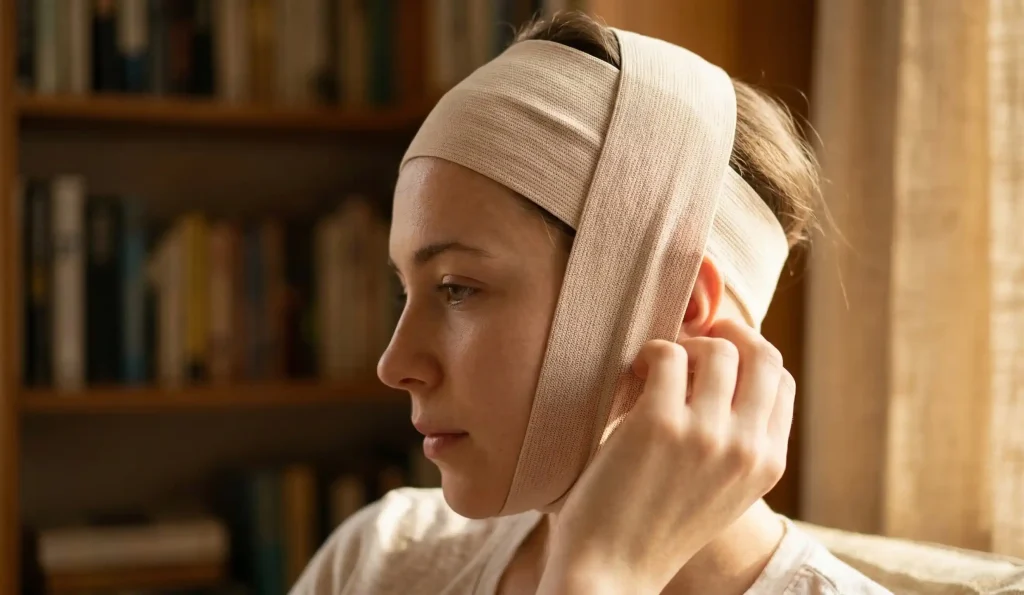
Band worn for two weeks.
Among all facial plastic surgery procedures, an otoplasty (ear pinning or reshaping) is a highly successful procedure that permanently alters the structural framework of the ear. However, the operation does not end when you leave the surgical suite. When patients ask how long they must wear the postoperative headband, the clinical answer is rooted in the biological properties of human cartilage. Cartilage possesses an innate “memory” and naturally attempts to spring back to its original shape. The medical headband is not merely a cosmetic accessory; it is a vital external splint required to hold your newly sculpted anatomy in place while the internal tissues heal.
At Lin Health Europe Clinic, it is one of the cornerstones of our philosophy regarding your post-surgical care that aftercare is the second, equally important half of your surgical intervention. To our international patients coming to Turkey, we strongly emphasize that the strict adherence to headband usage alone will ultimately decide the permanent success of your procedure. Medically, we are the leading centre for advanced auricular reconstruction, where this level of surgical discipline enables us to preserve your newly achieved facial harmony against the various unpredictable destructive forces of sleep, gravity and mechanical traumatisation.
The Acute Phase: 24/7 Compression (Days 1 to 7)

The ears are especially vulnerable right after your otoplasty. Cartilage is surgically manipulated and posterior incisions are made which lead to inflammation and swelling. To counteract this inflammatory response, you have to wear a heavy, medical-grade compression dressing or a specialized headband 24 hours a day, during at least the first few postoperative days (3 to 7 days, exact protocol will be given by your surgeon)
Besides alleviating the post-surgical edema (swelling) and the secondary hematoma (a blood collection within the skin and cartilage) formation, this persistent compression also provides a very firm and solid external support so that the internal sutures used to reshape your ears (the delicate Mustardé or Furnas sutures) are not torn before the tissue has had time to fuse. At Lin Health Europe Clinic, when you enter our doors in Turkey, we monitor this phase of intense healing and tissue remodeling very closely to make sure that your ears are healing tightly along these new aesthetic vectors that we have achieved.
Cartilage Memory and Nighttime Wear (Weeks 2 to 6)
Once the acute phase passes, the swelling gets better and the risk of a hematoma is almost at zero. In most cases, your surgeon will allow you to be without the headband during the day. But, this marks the beginning of neocollagenesis, i.e. the phase when your body produces new scar tissue to permanently fix the cartilage into its new shape. You will be basically highly advised to wear the headband every night, without exception, while you are asleep for the following duration of the healing phase – typically four to six weeks.
The Danger of Over-Compression
Lots of patients don’t really know the importance of wearing the headband, but at the same time, some of them make a very serious mistake by wearing it too tightly. It is a common superstition among the patients that the tighter they compress their ears with the band, the flatter their ears will become. But, clinically, this notion is the opposite of safety.
Very tight compression with band causes complete cutting off the micro-vascular blood supply to the skin of the ear. Such an ischemic environment may lead to serious tissue necrosis (death of skin) and permanent cartilage damage. In Turkey, our Lin Health Europe Clinic team gives comprehensive instructions about the precise amount of tension to be exerted on the band. The band should give you a sensation of being snug, supportive, and comfortable—it should never cause deep, throbbing pain or skin breakdown.
Protecting Against Daytime Accidental Trauma
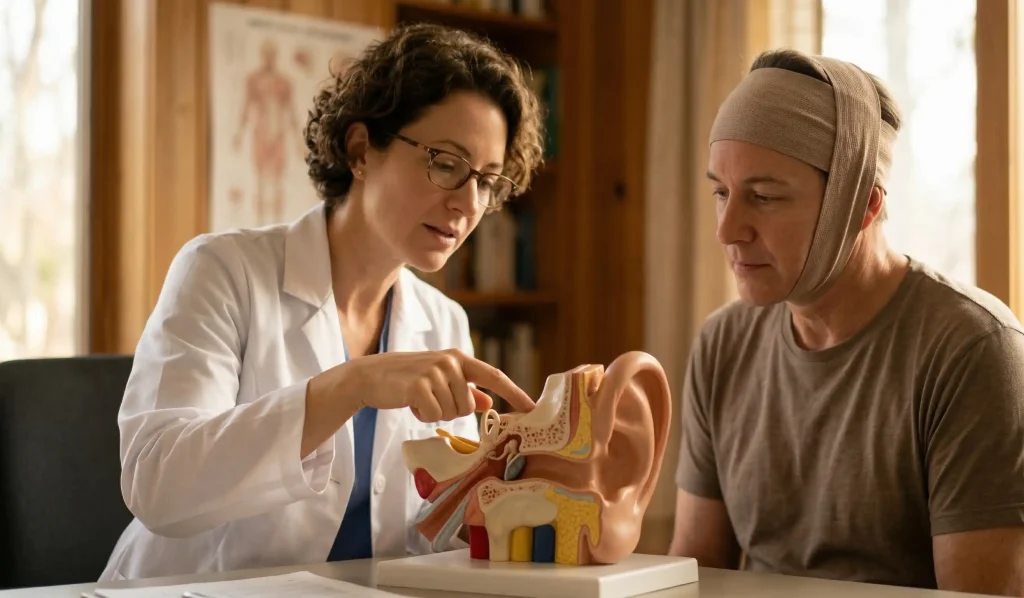
Even after you have been given the green light to take off the headband during the day, your ears still will remain highly susceptible to structural damage for months after the surgery. Also, the headband serves as a reminder that one should be careful with the head and new ears.
Even simple, everyday gestures like taking a t-shirt off your head, brushing your hair vigorously, or playing with the pet of your kids can lead to accidental grabbing of the top of your ear and pulling it forcefully forward. It is our practice at Lin Health Europe Clinic to remind our international visitors and patientsto stay hyper-vigilant during the very first post-surgery months. We are of the opinion that an elite aesthetic outcome can only be achieved through a tight surgical geometrical planning and meticulous, patient-led protection on a daily basis.
Otoplasty in Turkey
It is our conviction at Lin Health Europe Clinic that the best cosmetic surgery standards can only be reached through uncompromising patient education and by providing our patients with support after the surgery. Our Turkey centre is the perfect example of a perfectly equipped medical sanctuary, where advanced facial plastic surgery artwork is coupled with the luxury of personalized, individual patient care. We work in 5-star, JCI-accredited hospitals which serve both as an excellent working environment for our staff and a magnet for patients from all over the world who want to combine their medical journey with a touristic one in our beautiful country.
We are sure that choosing Lin Health Europe Clinic means that you are entrusting yourself to the most talented surgeons in Istanbul. Even for our international visitors, we implement techniques involving cartilage that are so durable that they are practically permanent. We also ensure that every patient, regardless of their country of origin, is treated with the highest degree of respect and equality. From your first biometric analysis and screening to your final reveal, fully healed, you will be greeted with a high level of professional experience, care and hospitality that has made our name synonymous with excellence in the world of aesthetic medicine. With our team, your entire journey to increased facial confidence will be under the guidance and management of world-class professionals.
FAQ:
You must wear the medical headband 24 hours a day for the first week to minimize swelling and protect the internal sutures. Following this acute phase, you are clinically required to wear it only at night for an additional four to six weeks to prevent folding the ear while sleeping.
Failing to wear the compression band drastically increases the risk of accidental trauma and dangerous hematoma formation. More severely, the cartilage may revert to its original protruding shape because the internal stitches can easily tear under mechanical stress.
You must strictly sleep on your back with your head elevated for the first few weeks to avoid putting direct pressure on your healing cartilage. Your surgical team in Istanbul will provide specific ergonomic guidance to ensure you do not crush your newly shaped ears during the night.
The band should fit snugly to provide gentle support, but it should never cause throbbing pain or cut off circulation. If the compression is too aggressive, it can lead to dangerous skin necrosis, so it is vital to follow the exact tension guidelines provided by our clinic in Turkey.
Most patients are cleared to gently wash their hair with a mild baby shampoo around the third or fourth day post-surgery once the initial dressings are removed. You must take extreme care not to bend the ears forward or scrub near the posterior incisions to protect the delicate structural repair.
Janis, J. E., et al. (2005). Anatomy of the ear. Plastic and Reconstructive Surgery.
Mustardé, J. C. (1963). The correction of prominent ears using simple mattress sutures. British Journal of Plastic Surgery.
Furnas, D. W. (1968). Correction of prominent ears by conchamastoid sutures. Plastic and Reconstructive Surgery.
Kelley, P., et al. (2003). Otoplasty: evaluation, technique, and review. Facial Plastic Surgery.