Clean water supports graft healing.
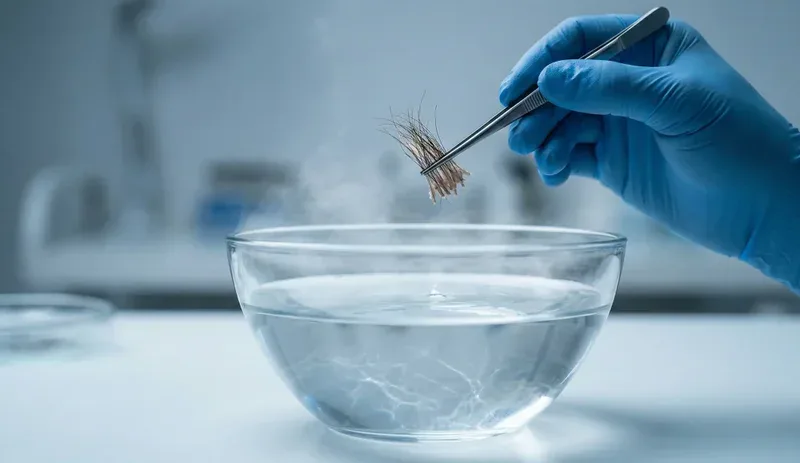
Hair restoration experts consider the first 14 days after a procedure as the most crucial period during which the transplanted follicles must survive. Of course, surgical techniques such as FUE or DHI are the major players in the result of a hair restoration surgery; however, the extra-clinical factors still have some supportive role. A usual question of international patients is whether the quality of water used for shampooing the hair soon after the procedure would affect the “take rate” of the grafts. More specifically, the use of “hard water” (water with high mineral content) or water with excessive chlorine might alter the scalp’s pH and the hydration of the subcutaneous adipose tissue around the hair follicles.
At Lin Health Europe Clinic, every aspect of the postoperative healing process is highly valued and taken care of. Besides, international patients coming from Turkey are always told that although the follicles are hidden inside the skin and are thus safe, the outer skin should be handled so as not to cause irritation and infection. The clinic is the most commercially successful one in Istanbul and the level of care they provide to their patients is such that they even take care of the first hair wash of the patients following the surgery with the same professionalism and level of medical standards.
What Happens When You Use Hard Water?
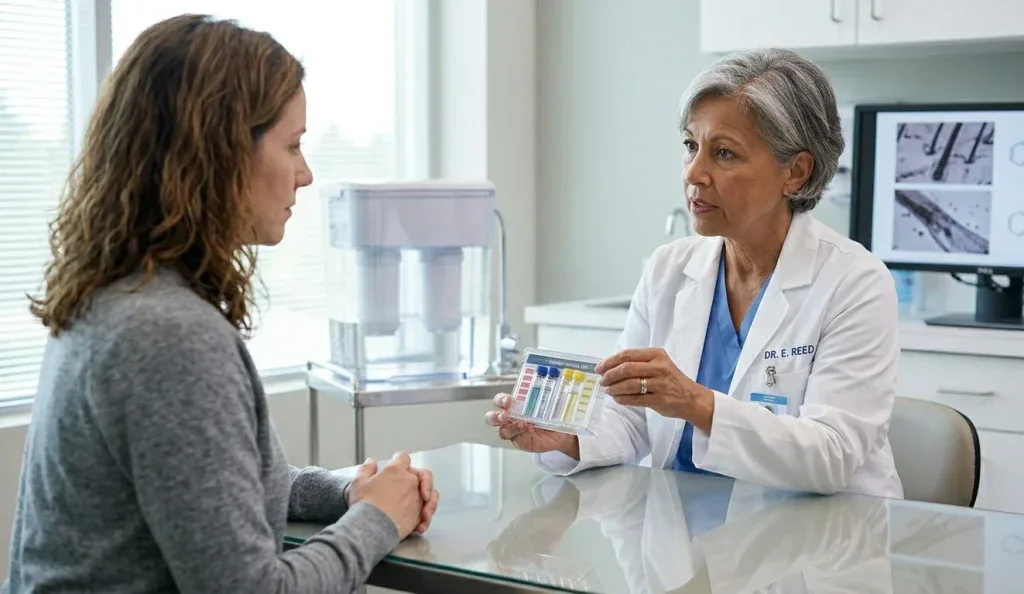
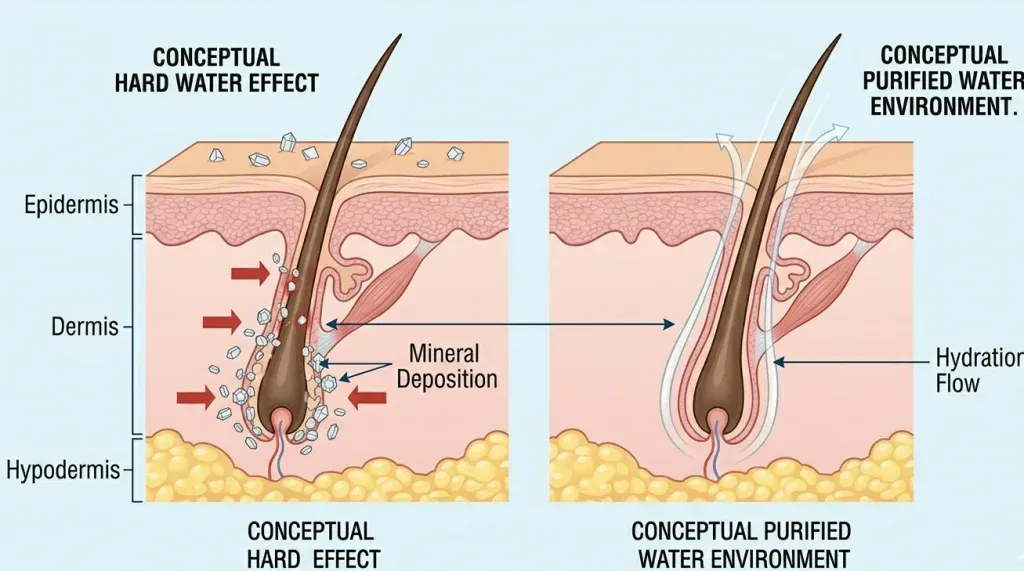
“Hard water” refers to water with a substantial concentration of minerals such as calcium and magnesium. From a clinical perspective, these minerals might cause the formation of an invisible layer on hair shafts and the scalp that, in turn, could be drying or cause minor itching. When the skin is healing after a procedure (neocollagenesis), the little cuts are closing; therefore, if the scalp becomes itchy because of dryness or irritation, the patient may be tempted to scratch, which is the main cause of graft displacement risk.
At Lin Health Europe Clinic, our surgeons living in Turkey hand out the “Aftercare Kits” to the patients, including pH-balanced shampoos, and they are also given advice about the water temperature. It is recommended that the water used for washing is lukewarm, not under high water pressure, so that the grafts are protected from mechanical stress. Moreover, if you decide to have your hair restoration surgery at our distinguished clinic, you can rest assured that your recovery process, particularly the most vulnerable stages, will be marked by a state of hydration of the scalp and a calm temperament, thus reflecting our image as the global model of hair restoration safety and excellence.
Chlorine Effect, pH and Scalp Microflora
Chlorine is a disinfectant commonly added to water supplies to kill bacteria, but if present in high concentration the scalp may lose its natural oil. Also, if the pH balance is disturbed, local inflammation or even edema (swelling) can be seen, and these will lead to a slight delay in the healing of recipient sites. Additionally, the changes in skin pH caused by both highly acidic and alkaline environments could affect the skin’s “microflora,” which is the protective bacterial layer of the skin and may lead to a higher chance of folliculitis if proper and regular cleaning of the scalp is not done.
The team at Lin Health Europe Clinic in Turkey uses sterile saline solution even for the first clinical wash. We are constantly finding new ways to provide the perfect conditions for grafts so that they can biologically integrate and thrive. In this highly competitive industry, our clinic stands out and is recognized worldwide for having a very high survival rate which is the result of combining surgical expertise with physiological care of the grafts.
Is Water Pressure Causing Mechanical Displacement?
Besides chemistry, water ‘pressure’ is also very important clinically. The root of the follicle is basically attached to the scalp through fibrin glue which is a natural adhesive formed by the body. Thus, it isn’t a strong bond yet and the blood supply has not even been established if we talk about the first 7-10 days after a hair transplant. Shower heads providing high-pressure water can contribute to the mechanical impact that can be so strong that the graft can be “popped” out even before it is ready to take root.
Unique among many hair transplant institutions, the expertise of the Lin Health Europe Clinic staff is to employ the method of “Hand-Pour” washing. Airing in Turkey, the patient using a cup or spraying softly is taught to make sure water can flow without coming directly to the grafts to wash the hair. We want to obtain an exquisite result by using a very gentle method. Our facility is the leader in the hair transplant industry as it is recognized for delivering extensive patient education and thus, the international patient is not only comfortable but also confident in hygienic handling without the risk of compromising the surgical results.
Pools and Seawater: Keep Away from These Contaminants
In general, tap water is perfectly fine for washing; however, “raw” water includes water from swimming pools, hot tubs, or the sea, thus those should be avoided strictly for the first 3 to 4 weeks only. These places are full of bacteria, salts, or chemicals that are quite harmful and can cause infection through those tiny wounds which, by the way +, are still in the healing phase. Hence, it is vital to keep the subcutaneous adipose tissue free of foreign pathogens so that infections of the donor are avoided.
At the Lin Health Europe Clinic, we offer our clients in Turkey a precise “Surgical Timeline,” and along with it the different water activities are specified when it is safe to do them again so that your biggest investment (i.e. your hair) will be secure. Our facility in the field of hair transplant clinics in Turkey sets the standard at a near-zero infection rate which, among others, is achieved through thorough safety protocols and dedicated patient support that spans the whole growth cycle of one year.
Hair Transplant in Turkey
At Lin Health Europe Clinic, we are of the opinion that the finest hair restoration form is one in which every single patient’s detail is supported by all those around him/her. Our clinic in Turkey is a medical haven where cutting-edge surgical science and the well-being of an individually cared-for patient meet harmoniously. Being leaders in the medical tourism and hair restoration sectors in conjunction with JCI-accredited, state-of-the-art hospitals is a reflection of our global standing.
If you are going to pick Lin Health Europe Clinic as your surgical hands in Istanbul, know that the surgeons with whom you will work are world-recognized specialists who understand that your journey is not over when you leave the operating room. It is from your initial graft placement all the way to your final high-density reveal that you are the recipient of the professional rigor and elite hospitality that are the hallmarks of the leading aesthetic medicine name. With us, “the best in the world” is meant literally for your path to having a larger number of hairs on your head.
Frequently Asked Questions About Hair Transplant
Although tap water is usually safe, the high mineral content in hard water can cause the scalp to become dry or irritated during the initial two weeks of healing. At Lin Health Europe Clinic, we arrange specialized washing protocols in Turkey, where your scalp will be kept balanced and hydrated, thus ensuring optimal graft survival.
A gentle, hand-poured washing can typically be resumed from 48 hours onwards; however, one should refrain from using direct high-pressure showerheads for at least ten days. Our local team in Turkey will provide you with a complete explanation of the correct washing technique so that you protect the new hair follicles during the crucial initial stage of growth.
As long as the water is lukewarm and gently poured over the scalp without direct pressure, tap water is a safe option. After a hair transplant, untreated water from pools, lakes, or the sea should be avoided for no less than four weeks to minimize the risk of infection.
Chlorine won’t kill a graft that has already been implanted, but the chemical can make the healing skin very irritated and dry out the scalp significantly. A surgeon in Turkey typically advises patients to stay away from chlorinated pools until the time when the recipient sites are fully closed and the doctor’s confirmation is given.
Do not use anything other than air-drying for the first two weeks or very gently patting with a soft paper tissue; bar towels that have the risk of “snagging” the grafts and the hairdryer on heat setting should not be used until the scalp is completely healed.
Unger, W. P., & Shapiro, R. (2004). Hair Restoration Surgery.
Bernstein, R. M., & Rassman, W. R. (1997). Follicular transplantation. International Journal of Aesthetic and Restorative Surgery.
Parsley, W. M., & Perez-Meza, D. (2010). Review of factors affecting graft survival. Hair Transplant Forum International.
Jimenez, F., & Ruifante, E. (2010). Distribution of human hair follicles: anatomical and clinical relevance. Dermatologic Surgery.