

Size, shape, and position asymmetry.
Among the challenges faced in the aesthetic and reconstructive surgery of the breast, the issue of breast asymmetry or clinically anisomastia is a condition complex enough to be the concern of a large percentage of the adult female population. Physiologically, it is noise and hence variation in size and/or shape of the breasts can be deemed as normal but when the degree is so high and the contrast is so marked, the condition could invariably be associated with both physical and emotional problems. Therefore, it is paramount that the surgeon figures out from what kind of tissue the problem resulted and which anatomical structures, if any, have an impact before planning the surgical correction.
At Lin Health Europe Clinic, we think that every patient with asymmetry represents a whole new puzzle and thus needs a unique operative plan. Whether the issue between the two breasts lies with development, pregnancy, or the several cycles of weight loss and gain, it is our intention at Lin Health Europe Clinic to help the patient regain the silhouette that is both natural and pleasing. To our patients coming to Turkey for treatment, it might be quite helpful, first of all, to understand these three fundamental categories so that they can judge for themselves if an isolated breast lift, breast augmentation or a combination of procedures would give them an ideal correction.
Type I: Volume Disparity (Simple Anisomastia)

The major deviation between breasts is that of the volume of the two boobs of which one is bigger and the other smaller. Such volume asymmetry is basically the consequence of a developmental process, and the differences start surfacing during puberty. In a clinical setting, the discrepancy may extend from half a cup to a few cups of volume. In such cases, the placement of the nipple and the skin covering both breasts is usually identical, but the composition of glandular and subcutaneous adipose tissue varies.
At Lin Health Europe Clinic, if we are to help a patient with a volume discrepancy change his/her breasts to symmetric ones by an operation, then one of the comfortable options we have is simply to utilize different implant sizes. In such a case, the doctor inserting a bigger implant in the smaller breast (or vice versa) makes the projection of the two breasts equal. Sometimes, the addition of the autologous fat grafting (injection of one’s own fat tissue) is a “touch up” step to the operation that brings the final result by providing volume to special parts which in this situation could be the upper cleavage.
Type II: Positional and Ptotic Asymmetry
In the case of the type II variant, emphasis is placed on the relative position of the breasts on the chest wall as well as the degree of ptosis (sagging). It is quite possible that the volumes of the breasts might be almost the same but with one hanging lower than the other, or the nipple-areola complex (NAC) of one side is closer to the bottom. The main reason for this is probably that on one side, the skin has lost its elasticity and the height of the inframammary fold (the fold beneath the breast) is different.
Type II positional asymmetry correction is a more complex operation than the one requiring only volume adjustment. Generally, it is a breast lift (mastopexy) by itself or in conjunction with other procedures that repositions the nipple and gets rid of excess loose skin after lifting the breast in the case of the lower side. At Lin Health Europe Clinic, our surgeons in Turkey master the art of “leveling” the breasts from the knuckle to the elbow, so to say, making certain that the nipples are horizontal rods and the breast peaks are all pointing to the same anatomical height which reprises the visual effect of the facade being balanced.
Type III: Combined and Complex Asymmetry
The most complex are the Type III asymmetry cases that can be categorized as multifactorial ones. A typical case in such a situation could be one breast which is not only larger but is also sagging heavily, whereas the other, with which it is paired, is smaller and has no traces of droop, though their respective breasts are different in ternary features such as the diameter of the areola and the base width. Because a diagnosis of Type III calls for the recognition of many factors, the surgical plan at Lin Health Europe Klinik is often ‘asymmetrical’ itself.
This means for instance that augmenting the smaller breast, on one hand, while simultaneously performing an augmentation-mastopexy, on the other hand, is a quite possible scenario. In Turkey, we employ 3D Imaging technology in such a way that these maps not only differences in skin, fat, and muscle but also the extraordinary points of these two breasts’ unique sets of dynamics which can be treated with only one complete transformation.
Skeletal and Thoracic Influences on Asymmetry
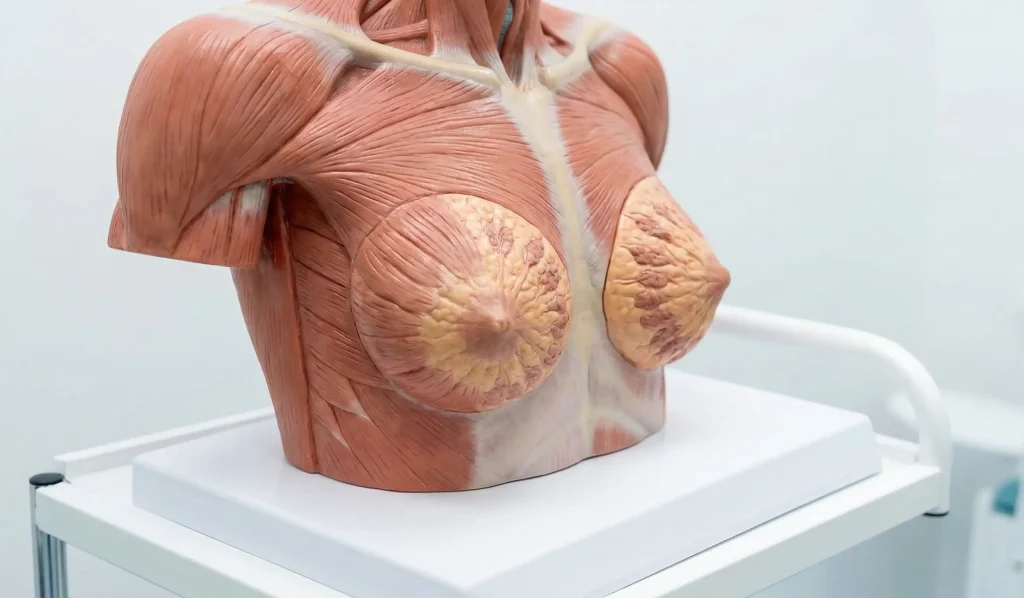
Breast asymmetry, to a certain extent, may be due to a discrepancy in the female framework. In fact, pectus excavatum (sunken chest) and scoliosis are, in one way or another, to blame as they often result in asymmetry of the rib cage and hence imbalance in breast volume may be more apparent even if the breasts are in complete symmetry. Under such circumstances, the surgeon will have to take the thoracic contour into consideration when deciding on the implant to be used.
At Lin Health Europe Clinic, the breast is no different than the chest wall in regard to its aesthetic potential. >Our surgeons in Turkey may use different implant shapes—such as a “high profile” on a “recessed” side and a “moderate profile” on a “protruding” side—to compensate for skeletal imbalances. By focusing on both the reddish and the connective tissue of the breast and the core wood underlying them, we provide our patients from all over the world with a result that looks naturally balanced from every angle.
Breast Asymmetry in Turkey
At Lin Health Europe Clinic, we are of the opinion that symmetry correction is an artist’s palette of beauty that requires highly medical intervention. Our Istanbul facility, Turkey is prepared to extend a great gesture of reconstructive kindness to any anisomastia-suffering woman. We only use implants made of the highest quality, most compatible materials and also continually update ourselves with the latest surgical techniques to yield a safe and lasting result.
Our total care method starts with a very detailed analysis of skin laxity, glandular volume, and nipple position, measuring each breast independently before the operation. Through our surgical expertise and the excellent medical facilities of Turkey, the team at Lin Health Europe Clinic provides each patient with the support and professionalism she deserves, along with the possibility of finally obtaining the desired symmetry.
Frequently Asked Questions About Breast Asymmetry
The types are volume disparity, positional/ptotic asymmetry, and combined (complex) asymmetry. Each type varies in the surgical method required to obtain a harmonious result in Turkey.
Where the problem is only in volume, implants or fat grafting may suffice. At Lin Health Europe Clinic, however, if the difference in nipple height is there, a lift is generally required.
Yes, almost all women have minor asymmetry, which is normal clinically. Only when the difference becomes a source of physical or emotional discomfort, surgery is the option.
If the size or shape of one breast changes suddenly, you should consult a doctor. At Lin Health Europe Clinic, you can get professional examinations to ensure your health is not compromised.
With the help of placing implants of different volumes, the surgeon can synchronize the projection and width of the breasts. As a result, the chest surface becomes more even and visually attractive.
Rohrich, R. J., et al. (2006). Breast asymmetry: classification and management. Plastic and Reconstructive Surgery.
Spear, S. L., et al. (2005). Correcting breast asymmetry with implants and fat. Aesthetic Surgery Journal.
Losken, A., et al. (2011). The use of fat grafting in primary and secondary breast surgery. Plastic and Reconstructive Surgery.
Grotting, J. C. (2009). Reoperative Aesthetic and Reconstructive Plastic Surgery.