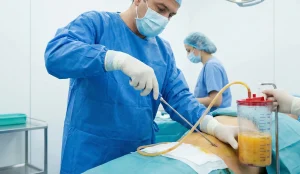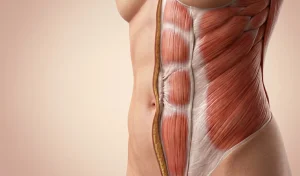
Vaser uses ultrasound; Bodyjet uses water pressure.
It sometimes seems that the world of Cosmetic Surgery is growing so fast that patients are inundated with brand names that sound more like sci-fi gadgets. Two of the most talked-about liposuction technologies are VASER and Bodyjet. Both are highly advanced, minimally invasive Medical Procedures for unwanted fat removal, yet they are completely different tools serving different purposes.
We, at Lin Health Europe Clinic, disagree with the notion that “one size fits all” when it comes to body contouring. The decision between Vaser and Bodyjet shouldn’t be influenced by the marketing hype, but rather your individual biological requirements. Do you want “six-pack” abs or do you want to get fat for a Brazilian Butt Lift (BBL)? Knowing the mechanics—Ultrasound vs. Water Pressure—will help you decide what’s right for your body. It is a decision that determines the quality of your outcome. Back then, liposuction was a blunt tool, merely sucking out bulk. Nowadays, with machines like Vaser and Bodyjet, the treatment is done at a cellular level. This development means that not only your fat but also your skin quality and your long-term goals can be considered when customizing the treatment, thereby the technology serves your anatomy rather than being controlled by it.
VASER: Ultrasound and Heat Potency
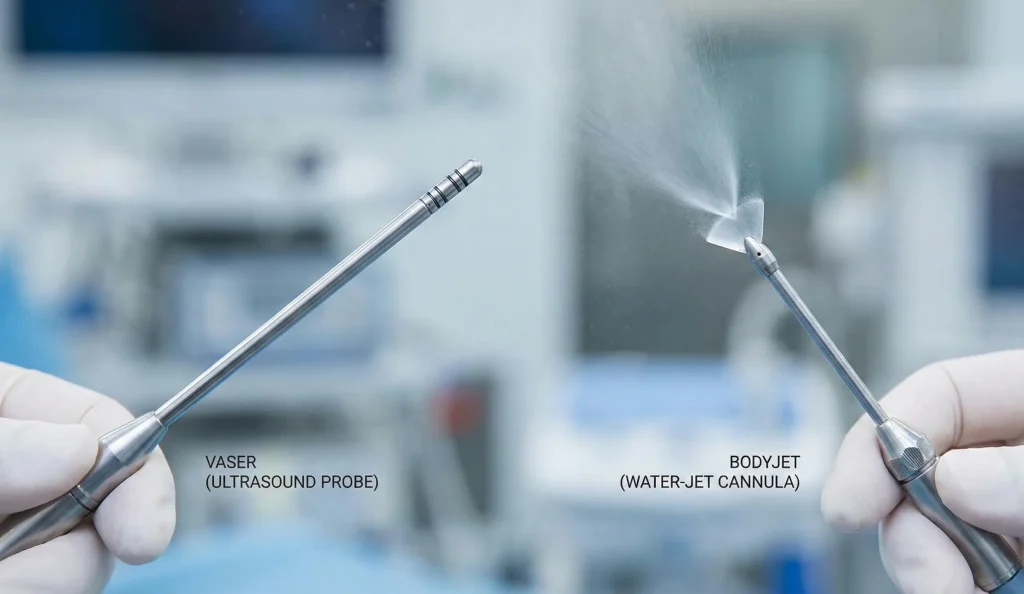
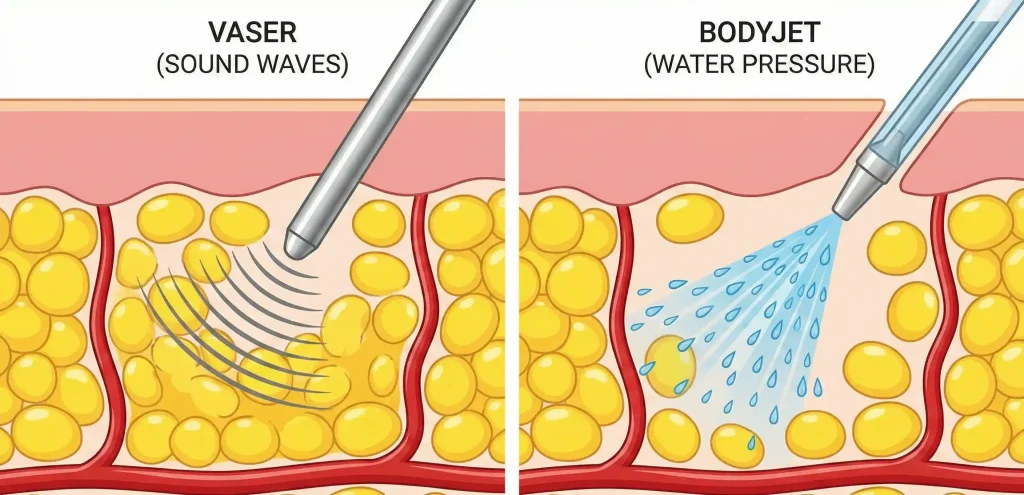
VASER stands for Vibration Amplification of Sound Energy at Resonance, and it is a technology that utilizes energy. It generates heat and vibration by using ultrasonic frequency. When the Vaser probe is inserted under the skin, the emitted sound waves cause a phenomenon known as “cavitation”. This causes the fat cells to separate, and the fat is then emulsified (melted) into liquid oil, which is sucked out afterwards.
Vaser’s Heat is its hallmark. This thermal energy is quite beneficial in two ways. It can be very effective in breaking down tough fibrous fat (e.g. male chest or back). Moreover, this heat can stimulate collagen production by activating the skin’s underside. Therefore, Vaser is a great option for Skin Tightening and High-Definition Sculpting where the skin is expected to slowly retract over muscles. This thermal effect comes as a bonus for those patients who have “difficult” fat deposit areas such as post-liposuction fibrosis or male chest (gynecomastia) dense tissue. By “melting” this resistance, Vaser allows the surgeon to move through the tissue effortlessly, thereby reducing the mechanical trauma that leads to prolonged soreness. It’s as if the physical struggle is turned into a smooth, artistic flow by simply liquefying the obstacle,
Bodyjet: How The Water Works in a Gentle Way
Bodyjet, which is also called Water-Assisted Liposuction (WAL), is a totally different method. It does not use heat but rather a vibrating, fan-shaped spray of saline solution (water) to separate fat cells from connective tissue.
Simply picture the difference between a pressure washer cleaning a driveway and a scraper. Bodyjet “cleans” the fat cells off the muscle and skin without damaging them. Since there is definitely no Heat involved, thermal burns are out of the question. As a result, the procedure is very safe for the body’s internal structures (blood vessels and nerves), and the patients often experience less bruising and swelling than when heat-based methods are used. Bodyjet therefore offers very limited to no skin tightening because there is no heat. Since the water jet is very accurate, it almost behaves like a nerve protector. Instead of damaging the nerve endings, it simply washes around them. This is the reason why Bodyjet patients typically regain full skin sensation much sooner than those who undergo thermal procedures. It is the method of choice for patients with Lipedema, for whom it is as essential to preserve lymphatic vessels as it is to remove the painful fat.
Fat Transfer Factor: The Reason Why Bodyjet is the Winner in BBL
The major difference between the two is in Fat Viability. If you are only interested in fat removal, both are equally good. But if the removed fat is intended for reuse in breast or buttocks augmentation (BBL), then the technique will matter.
Not only can Vaser cause harm to the fat cells by heating them, but it may also rupture their membranes. Nevertheless, the survival rate of the transferred fat may be lower, although a highly trained surgeon may still be able to harvest viable fat from the Vaser. Bodyjet has been praised as the Gold Standard for Fat Grafting for a long time now. The reason is that it gently dislodges the cells without inflicting trauma or heat; hence, the obtained fat is perfectly clean, very viable, and immediately ready for reinjection. If you are skinny and BBL is such that you can only survive by fat that is 100% viable, then Bodyjet is usually the machine of choice.
Recovery and Pain Profile
The recovery mainly depends on how much the tissue has been affected. Bodyjet utilizes as one of the elements that aid the detachment of the tumescent fluid (numbing water) which, in most cases, results in a longer-lasting analgesic effect after the surgery. Patients usually describe less pain in the first 48 hours.
VASER recovery is a bit different. Old-school mechanical lipo caused a lot more traumatization, but even though Vaser is much less traumatic, the internal thermal energy can lead to feelings of “stiffness” or a deep ache not unlike that which follows a heavy workout. Moreover, since Vaser converts fat to liquid, a patient may have to endure slightly longer drainage times to guarantee that all the fluid has been eliminated. In fact, both techniques have made it possible for patients to return to work within 3 to 5 days, which is notably faster than with traditional liposuction. Another aspect of fluid management also accounts for the difference. In the Bodyjet system, infiltration and suction happen at the same time, so the body is not overloaded with tumescent fluid for long periods. This lowers the systemic fluid shift that causes grogginess or bloating. On the other hand, Vaser’s thermal energy results in a mild inflammatory healing response that, besides being good for skin tightening, leads to a longer period of internal swelling (edema) which needs constant use of compression garments.
Liposuction in Turkey
At Lin Health Europe Clinic we are very lucky not to have to limit your choice, for we have both technologies. The final call is taken when you come for your surgical consultation.
- If you require high-definition etching, suffer from fibrous fat (back rolls, gynecomastia), or your skin condition is such that mild tightening is adequate, then we opt for VASER.
- When you are about to have a Lipofilling procedure (Breast or Buttock augmentation) and the goal is to maximize fat survival above all else, we pick Bodyjet.
- The Hybrid Approach: We often resort to a hybrid approach in the hybrid technique cases where after harvesting the fat required for transfer with Bodyjet, we use Vaser for the rest of the areas to sculpt and tighten the skin. Our patients get “the best of both worlds” from this. We know every body map is different. The same person who has a need to protect the lymphatics with the gentle touch of Bodyjet on their inner thighs might require Vaser’s power for their back rolls to tighten the thick skin. The fact that we can move from one technology to another in the same OR is what makes us stand out. We do not force your body to fit a machine; we choose the physics that will sculpt your masterpiece.
Frequently Asked Questions About Vaser and Bodyjet
Bodyjet has a reputation for being better for BBL because it gently uses water pressure to release the fat cells, thus keeping them unchanged and alive for the transfer, which is highly beneficial for the graft’s survival rate.
Not really. Since Bodyjet doesn’t operate with heat, it doesn’t lead to collagen stimulation or skin tightening. If your skin is loose, you would have a better result with Vaser or J-Plasma.
Vaser procedure may result in a little more internal soreness because of the heat energy used, but the truth is that both Vaser and Bodyjet are far less painful than the traditional mechanical liposuction.
Certainly. Most of the time, we employ Bodyjet to delicately extract the fat for the transfer and then, in the same operation, use Vaser to contour the muscles and get the skin tighter.
Absolutely. Vaser is a great choice when dealing with very fibrous areas such as the back and male chest, but the surgeon needs to be very experienced with heat control in order to avoid burns.
Man, D., & Meyer, H. (2007). Water-jet-assisted lipoplasty. Aesthetic Surgery Journal.
Sasaki, G. H. (2010). Water-assisted liposuction for body contouring and lipoharvesting: safety and efficacy in 41 consecutive patients. Aesthetic Surgery Journal.
Jewell, M. L. (2002). Clinical application of VASER-assisted lipoplasty: A pilot study. Aesthetic Surgery Journal.
Hoyos, A. E. (2011). High Definition Body Sculpting: Art and Advanced Lipoplasty. Springer.