
Implants over 450–500cc are considered large.
A Breast Augmentation consultation is a virtual clash between dreams and reality. Most of the time, patients come along with a “wish picture” of a celebrity or influencer and a request for a specific implant volume, usually a nice round number like 350cc or 500cc, convinced that the volume is the exact definition of the look. Yet, “How big is too big?” is not a question of one’s taste or judgment; rather, it is a question of the anatomical body’s capability to survive and adapt.
The selection of an implant size is by far the most significant and at the same time, the most risky in the surgical planning process. Selecting an implant beyond the biological limits of your chest wall and skin elasticity is not just sacrificing your aesthetic for “fake”; you are also jeopardizing long-term complications like tissue thinning, palpable rippling, and the unstoppable effect of gravity known as “bottoming out.” At Lin Health Europe Clinic, we take the talk away from cup sizes and cubic centimeters (cc) and concentrate more on the bio-dynamic limits of your body. We want you to understand why your friend’s 400cc implant might look natural on her, but it could be a surgical disaster for you.
The Tissue Envelope: Your Biological Container
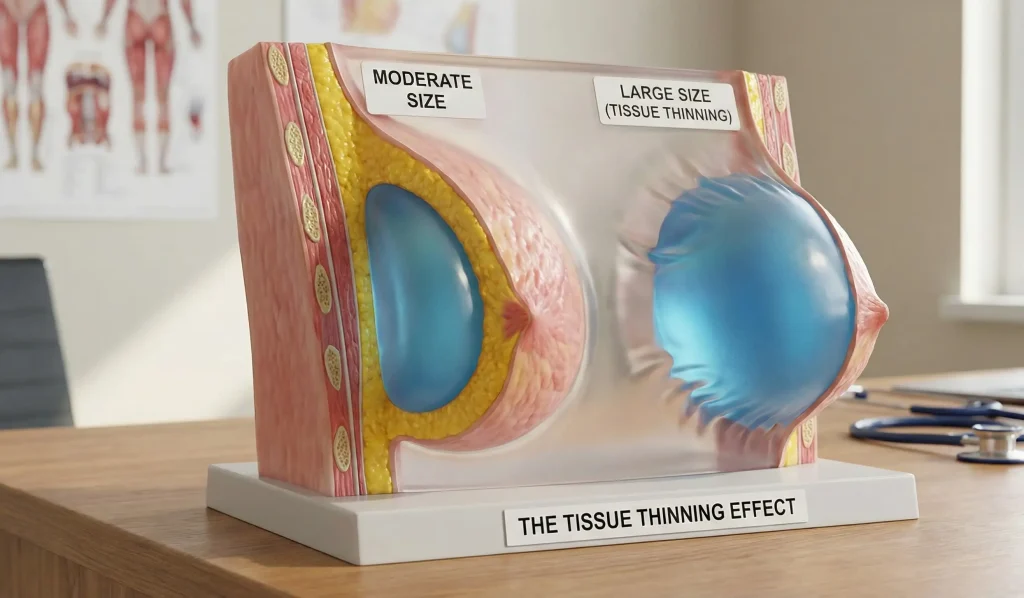
What limits the implant size? The easiest way to answer this question is to get to know the “Tissue Envelope” first. Your breast is not just a bag to be filled; it is a combination of the skin, fat, and gland that together have a limited capacity to stretch. By putting a Breast Implant inside you, we are basically asking your skin to increase in size to take care of the new bulk.
When the implant size is in the range of the skin’s ability to stretch, the skin will comfortably stretch, resulting in a soft, natural slope. Swelling the breast with an oversized implant increases the pressure within the breast to dangerous levels. This increased internal pressure means that the blood vessels supplying the skin and the breast tissue are compressed. Eventually, due to continuous pressure, the patient’s tissues start to atrophy (thin). The end of such a story is a disaster: the implant becomes so visible that you can almost see it through the very thin skin; this is where “rippling” or wrinkling at the edges becomes visible. After that, the tissue thinning is so severe that one can hardly think of fat grafting as a method for tissue thickening. That is why “too big” is any volume that forces the compromise of your natural cover´s blood supply or thickness.
The Gravity Factor: Bottoming Out
Physics is definitely the adversary of large implants. One 300cc implant weighs approximately 0.6 pounds. While one 600cc implant weighs more than 1.3 pounds. Although it may not seem as a big thing, the reality is that this weight is always on your chest wall, supported only by your skin and a couple of internal ligaments.
If you pick an implant size that is not supported by your body’s structures, the breast will be pulled down by gravity. The implant moving down the chest wall is a gradual process and this causes the lower skin of the breast to be stretched until the nipple follows the direction of the sky—the “Bottoming Out” deformity. Sometimes, the implant can even slide beyond the infold, and this gives rise to the “double bubble” look. The bottoming out breast correction is usually a lot more complicated than the original surgery and often, the use of expensive internal mesh (such as Galaflex) becomes necessary to create an internal bra. We often tell our patients: “You can have big implants, or you can have perky implants for a long time, but you usually can’t have both.” In fact, the key to long-lasting firmness is to keep the weight at a level that can be managed.
The “Base Width” Rule: Why CCs Are Misleading
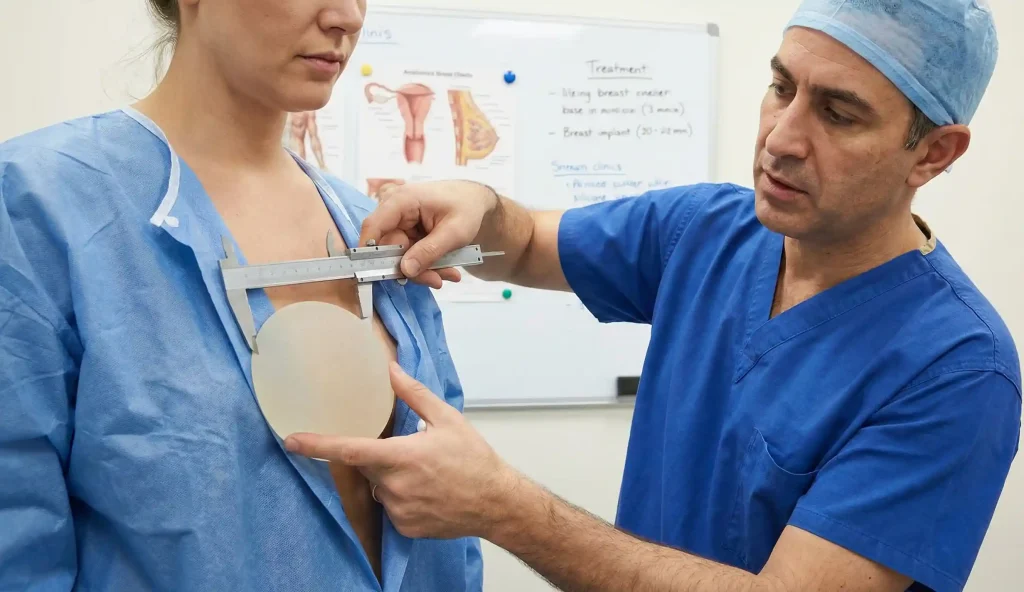
Patients’ most typical error is their obsession with “CCs” (cubic centimeters) as the only measure of size. In fact, Implant Size is multidimensional as it includes height, projection, and most importantly, Base Width. The base width of the implant should correspond to the base width of your natural breast’s footprint.
For example, if your natural breast is 11.5 centimeters across, then fitting a 13.5 centimeter implant (which could be a high-volume 500cc) is anatomically impossible without repercussions. The implant that is too large will act either by folding to fit into the pocket or it will spread too much sideways, causing discomfort with the arm movement (lateral displacement), or it will merge in the middle to cause “symmastia” (the dreaded “uniboob” where the cleavage skin lifts off the bone). At Lin Health Europe Clinic, we use calipers and measure your chest width down to the millimeter. Your “maximum size” is determined mathematically through this measurement. We cannot increase your width if you want more volume than your width allows. We need to increase projection (how far it sticks out) instead to avoid the side-wall deformities.
The “Fake” Look: Nipple Position and Upper Pole
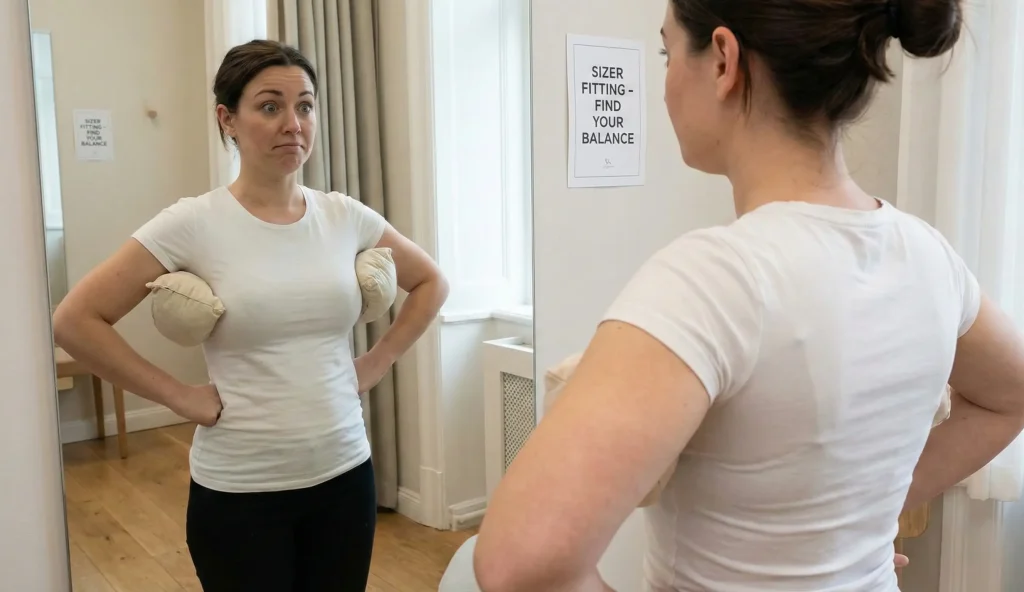
The “too big” that comes with a fake look is more frequently about the joint of the nipple and the implant. The nipple is at the point of maximum projection in a natural breast. However, when an Implant Size is way too big, the upper part of the breast (the décolletage) is filled so much that it seems as the nipple is quite low in relation to the mound.
The result is the typical “bolted-on” or “torpedo” appearance, where the breast looks like a sphere sitting high on the chest instead of a teardrop. Plus, large implants are known to stretch the areola. So, if your areolas are small and dainty, a huge implant will stretch them into big, pale discs. This stretching can also cause permanent damage to the sensory nerves, resulting in loss of sensation. We use 3D simulation software to help patients visualize a volume-induced distortion of their nipple-areola complex. Quite often, just witnessing the potential change on a screen will persuade the patient to lower the volume until a more harmonious size is achieved.
Lin Health Europe Clinic: The “High Profile” Trick
At Lin Health Europe Clinic in Turkey, we help our patients to have the “impact” of a big size without the drawbacks of a wide footprint. Often, we make use of Ultra-High Profile implants. These implants offer more volume with a smaller base and therefore, instead of spreading outwards, they project forward.
This is why even a small-sized patient can enjoy a 350cc or 400cc implant look without the implant rubbing against her arms or conforming together in the middle. Also, for those patients who are borderline “too big” for their tissue, we resort to a Dual-Plane Placement. The implant is partially covered by the muscle, which then acts like an internal strap, bearing the implant’s weight and concealing its edges. This extra layer between the implant and the skin rescues the patient from rippling and sagging, so the volume may be pushed a little further than when the implant is placed over the muscle.
Frequently Asked Questions About Implant Size
Your doctor will determine the Base Width of your breast. Your Implant Size normally should not be wider than this by more than 0.5-1 cm if you want to prevent problems like symmastia or lateral displacement.
That is almost impossible. Skinny patients do not have a lot of skin to cover their breast. Trying to put a big Implant Size under tight skin raises the risk of the implant being palpable (you can feel the edges) or the wound opening up (dehiscence).
Potentially yes. Having about 2-3 pounds extra on your chest in the form of a pair of big implants can be quite a load. This is enough to shift your center of gravity forward, which can result in neck, shoulder, and upper back strain over time.
It is an effect of a heavy Implant Size that stretches the lower skin of the breast so the implant slides downwards even though the nipple stays in its original place or even points upwards. The only way to fix it is a surgery with mesh.
In the case of narrow patients, the answer is yes. High Profile implants let you have more volume (CCs) without making the base wider, which is why they are the most secure choice for a small frame to go ”big”.
Tebbetts, J. B. (2002). A system for breast implant selection based on patient tissue characteristics and implant dynamics. Plastic and Reconstructive Surgery.
Adams, W. P., Jr. (2008). The process of breast augmentation: four sequential steps for optimizing outcomes. Plastic and Reconstructive Surgery.
Mallucci, P., & Branford, O. A. (2014). Concepts in aesthetic breast dimensions: analysis of the ideal breast. Journal of Plastic, Reconstructive & Aesthetic Surgery.