
Yes, temporary hair loss after surgery is common.
You’ve been through surgery, an anesthetic, and the first few weeks of recovery, and you’re still alive. You are gradually returning to your old self and most probably loving the new nose or flat stomach. One day, you suddenly see a really disturbing pattern, there is a lot of hair in your hairbrush every morning, and your shower drain is getting clogged more and more often. To many patients, this sudden hair fall is scarier than the surgery because they were not expecting it and can’t control it. They doubt if they might be reacting late to medications or if their hair loss is irreversible.
The long and short of it is that yes, it is very normal. Actually, it is one of the top side effects people report after major surgeries like tummy tucks, bariatric operations, or vast body contouring. What happens is not male or female pattern baldness but a temporary physiologic reaction which is called Telogen Effluvium. This is essentially the body’s method of diverting resources while in a state of an emergency. Here at Lin Health Europe Clinic, we completely understand that this hair loss scare is intense, but the fact is it is a well-known biological phenomenon and in most cases, you will not go bald.
The Three-Month Time Lag: The Reason for the Delayed Effect
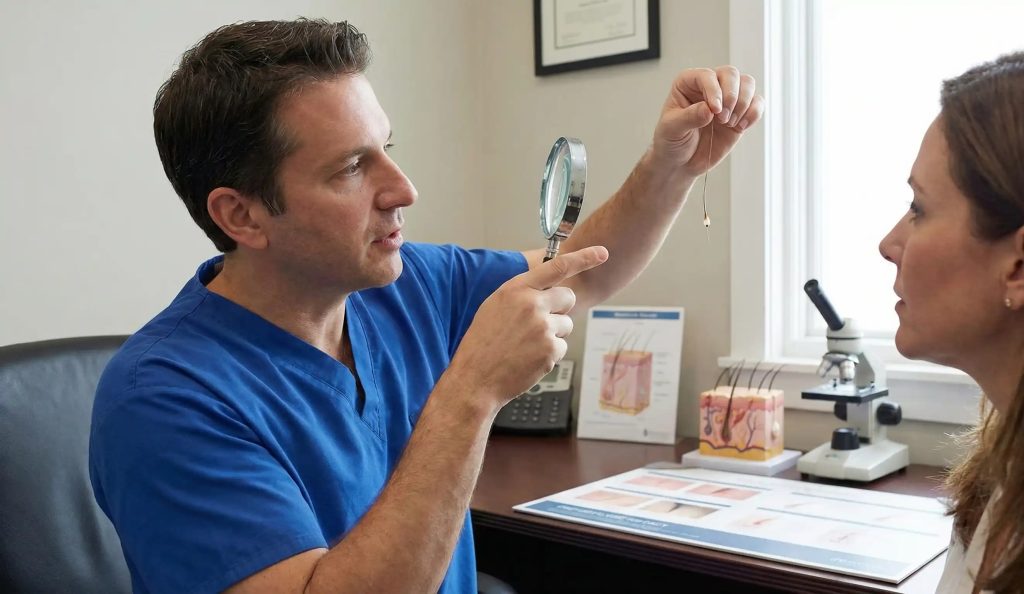
Among the puzzling elements of post-surgical hair loss is when it occurs. Most patients freak out because the shedding usually starts three months after the operation, not right away. This gap causes most people to think that the hair loss has nothing to do with the operation, they even blame a shampoo or diet. What it comes down to is that the time is totally in line with the human hair growth cycle.
Hair follicles pass through three phases, a growth phase (Anagen), a transition phase (Catagen), and a resting phase (Telogen). In a normal state, about 90% of your hair would be in the growth phase and the rest in the resting phase. A major surgery will disrupt your entire system in a very unpleasant way. It is almost like after a heavy stress, large numbers of follicles are pushed prematurely from an already growing state to the resting state, so that less energy is consumed. These hairs do not fall out right away; they are still attached to your scalp for roughly three months while the follicle is in a quiet state. When the new hair eventually breaks through the surface of the scalp, the old hair is shed. So, the hair that you lose at month three was actually “killed” during surgery; it just took that long for it to fall off.
The Anesthesia Story: Is It the Medication or the Stress?
One of the most common assumptions is that anesthetic drugs are harmful to hair follicles. Patients are frequently concerned that the “chemicals are still in their system.” Most people do not realize this is not possible chemically speaking. A person’s blood is cleared of anesthetic substances very rapidly, typically within a few days. The issue is not with the medication, but with the Physiological Stress that the anesthesia and surgery together impose on the patient.
When a major surgery is performed on you, your body will be engaged in a hyper-metabolic state in order to heal your wounds and fight infection that may be there. This will mean that an enormous amount of energy, protein, and nutrients will be used. From the body’s point of view, hair is quite a dispensable tissue. For example, the body will divert the blood and nutrients that would go to your scalp in order to give them to your abdominal muscles or nasal cartilage. Hair loss, therefore, is just like the collateral damage of a body that is working very hard to heal you, not the sign of poison.
The Nutrient Drain: Iron and Protein Depletion
Depending on the type of operation, there might be some loss of blood, which means that the levels of Ferritin (the iron store) will be lowered as well. An important factor in the cell growth of hair follicles is iron which is a part of the enzyme ribonucleotide reductase. Hair follicle cells grow much faster than other cells of the body, so they react to iron deficiency very quickly. A drop in your ferritin level to a certain value (usually 40 ng/mL) means that the growth of hair will be halted.
Furthermore, your protein consumption is going to be deeply eaten by the healing of your wounds. The main protein of skin, collagen, is formed from amino acids. In case your diet after the surgery is not providing enough protein, the body will use the amino acids from your hair instead of making them available for other tissues through the hair. This is what causes post-surgical hair loss mostly. Thus, there are more cases of hair loss in tummy tuck (large wound) and bariatric (rapid weight loss/malabsorption) patients than in smaller surgeries like eyelid surgery.
Surgery-Induced Hair Loss Duration: Like a Passing Storm
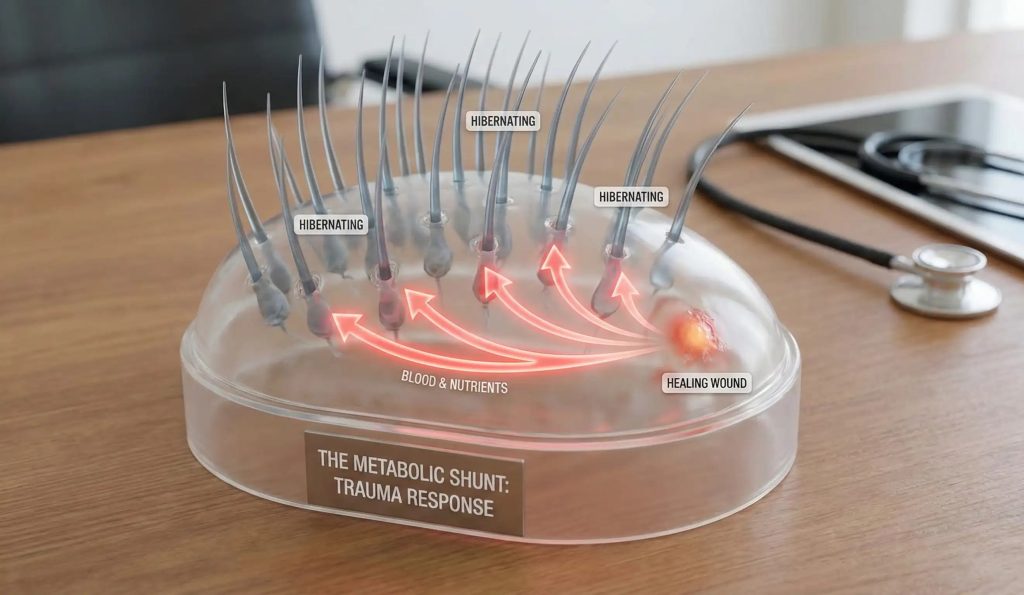
The primary point that you should take home here is that Telogen Effluvium is a temporary condition. In comparison to hereditary hair loss (androgenetic alopecia), which causes follicle shrinking and eventual loss of hair production, surgical hair loss does not affect the follicles. In fact, the follicles take no harm and thus, remain viable; they have simply been put on hold.
Normally, the hair loss phase runs from 3 to 6 months. When the body finally perceives that stress or exhaustion is not there anymore and the nutritional levels are good, the follicles change their status to the Anagen phase. “Baby hairs” in fuzzy form will be noticed first along the hairline at around 6 or 7 months. Even though significant volume loss of up to 30-50% density can happen, it most times grows back fully within a year without any medical assistance at all, provided your general health is not compromised.
Lin Health Europe Clinic: Prophylactic Approach
At Lin Health Europe Clinic, we do not see anyone as only an incision. We understand that hair loss may mar the excitement of the newly acquired look, so we are always ready to go the extra mile for that to not happen. Upon identifying low reserve levels before the operation, supplementation is started right away to give the body a cushion in case surgery does deplete the trace elements. Hence, on the brink of surgery, we have the patient’s blood panel to reveal Ferritin, Vitamin D, and Zinc levels if necessary.
During your post-operative period, we supply nutritionally hair-friendly instructions with an emphasis on the high-protein diet and collagen supplementation. In cases where the patient gets extremely distressed about the shedding, we can provide PRP (platelet-rich plasma) therapy during a follow-up appointment to support them psychologically. With PRP, the scalp is injected with a concentrated dose of growth factors so that the follicles get a “wakening” signal and the shedding phase might be shortened. We want you to understand that this is merely a phase, and your hair will grow back just like your confidence did.
Frequently Asked Questions About Hair Loss After Surgery
Yes, a number of studies point out that a high percentage of people having major surgery suffer from shedding post-operation which is technically called Telogen Effluvium – their bodies are simply under metabolic stress.
No. The hair root is not killed by anesthesia. A temporary interruption in the hair cycle is what it triggers. Post-surgical hair loss, after the body heals, the hair will grow back.
The loss tends to be at the highest level 3 to 4 months after surgery and goes away pretty much naturally by the 6th month. In case your hair loss after surgery situation continue up to and beyond 6 months, take a look at your iron and thyroid levels.
You can somewhat help by having good iron stores before surgery and eating enough protein during your recovery. Nevertheless, if the body is stressed out significantly, it is very unlikely that hair loss after surgery can be prevented totally.
Yes, hair loss can post-op definitely be worse with this surgery. When you have a huge surgery like a tummy tuck or body lift, more tissue repair is involved which results in a lot more metabolic demand compared to smaller surgeries, so hair loss after surgery is more common.
Headington, J. T. (1993). Telogen effluvium: new concepts and review. Archives of Dermatology.
Malkud, S. (2015). Telogen Effluvium: A Review. Journal of Clinical and Diagnostic Research.
Tosti, A., & Pazzaglia, M. (2007). Drug-induced hair loss and hair growth. Drug Safety.