Yes, nostrils can change during healing.
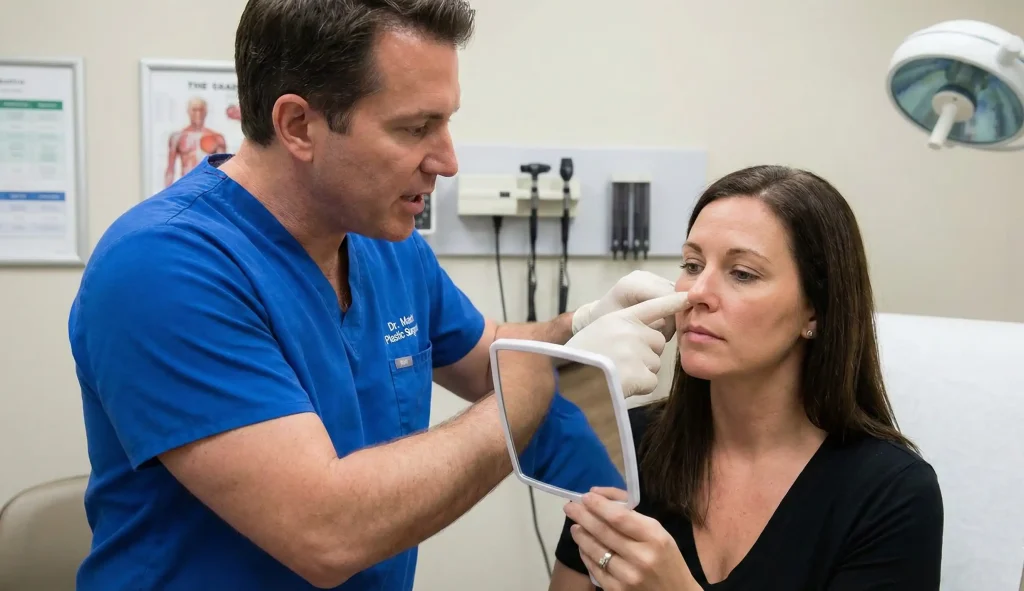
There is a phase of almost all rhinoplasty recoveries that we mark as the “Nostril Inspection Phase.” About two weeks after the removal of the cast, the patient usually gets a magnifying mirror, tilts the head back, and carefully examines the base of the nose. Panic: one nostril is oval and the other one is like a teardrop. One is up and the other is down. The immediate worry is that the surgeon has left them uneven by mistake.
This fear is rational but more often than not, it is early. The nostrils are, in fact, the last part of the nose to get completely healed after a rhinoplasty. Being soft tissue structures attached to rigid cartilage, they are very easily affected by swelling and scar contraction. Besides, no face is perfectly symmetrical, and the asymmetry you see in the first months is usually not the final result. At Lin Health Europe Clinic, we give our patients the support they need to pass through the “awkward phase” and explain why your nostrils currently resemble distant cousins, but eventually they will be like sisters.
The “Sisters, Not Twins” Rule: Managing Expectations
The first lesson in nostril beauty is the truth of nature: almost no one has perfectly symmetrical nostrils. If you look at the pictures of yourself before the surgery (taken from the “worm’s eye view”), you will most likely notice that your nostrils were already not symmetrical before the operation. Perhaps one was wider, or the columella (the bridge between them) was not straight.
Rhinoplasty can help make the nostrils more symmetrical, however, it is rarely the case that it achieves exact symmetry as in mathematics. What is aimed at is a certain level of harmony and not a perfectly identical reflection. Moreover, the very operation alters the supporting structures. Should we derotate a tip (drop it down) or project it (push it out), changes in the nostril rims occur thus altering the shape. After surgery, patients examine their faces with an extent of scrutiny that they never had before, coming across “imperfections” that were always there or are within the range of natural human variation.
The Swelling Factor: Why One Side Lags Behind
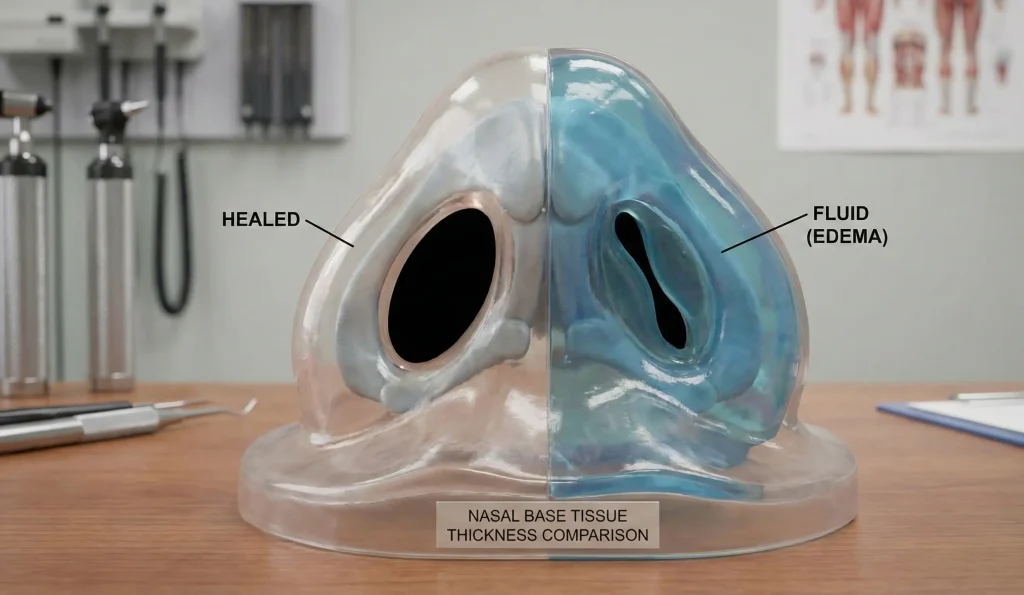
The leading reason for the post-surgical asymmetry issue is Uneven Edema (swelling). Swelling does not get better evenly. Depending on your sleeping habits (if you lie on your right side), the lymph fluid will be collected more on that side due to gravity. This can result in one side of the nostril appearing thicker and thus its opening will be a different shape compared to the other (“drier”) side.
There is also a difference between the internal works. If your septum was deviated, your surgeon certainly did a more extensive dissection on one side, which means that side experienced more trauma and will take longer to get rid of swelling, even 6 to 9 months. A swollen nostril rim might look like it is higher or retracted. We often tell our patients that evaluating nostril symmetry at 3 months is like judging a painting that is only half-finished. You have to wait until all the water has drained in order to know your real face.
Alarplasty Healing: The Scars Need to Soften
If you decide to get an Alar Base Reduction (Alarplasty)—a procedure that involves taking out some skin from the nostril’s side to make it less wide—then you will have cuts on the outside of the nose that are in the crease of the nose. As the cuts heal, they are going to contract.
What happens is that the scar tissue pulls when it gets older. At first, it is totally normal for one of the scars to become tighter than the other; this, in turn, would cause that nostril to be slightly raised or pulled in for a short period of time. Thus, this can be an abnormal shape that you will notice when you smile, and you will feel the nostril is tight. But, it is only a matter of time. As the scar gets older and, in fact, softer (between months 6 and 12), the skin becomes less tight and the nostril naturally comes back to the more normal, symmetrical shape. Often, the use of massage is able to assist in speeding up the scar tissue becoming less stiff.
Columellar Tilt: The Leaning Tower
Sometimes, it is not the nostrils themselves that give the “uneven” effect, but rather the Columella (the middle piece running vertically between the nostrils) is swollen or leaning. If the graft in the tip is still settling down or if there is one side that is still swollen in the columella, then it can displace the center point.
This causes an optical illusion effect where one nostril is super big and the other one is really tiny. As the tip becomes clearer and the columella straightens (which is a very slow process sometimes taking over a year), the nostrils will automatically come back to alignment. Yet, when the asymmetry is a result of a “hanging columella” (i.e., the middle part of the columella is too long and hangs down) or a “retracted ala” (i.e., the nostril rim is lifted up too much), then such a problem may be structural and thus it might need a minor revision if after a year the situation is still the same.
Lin Health Europe Clinic: Precision Calipers
In Lin Health Europe Clinic, we are fanatics of the “worm’s eye view” as we thoroughly understand that it is the angle that you use to look at yourself in the mirror. We have used surgical calipers during the operation to measure the nostril width and height to the very millimeter. If we have to do an Alarplasty, we draw the lines of the excision when the patient is awake (if it is possible) or we use a special technique for the stitches to make sure the fold is natural and the scar is hidden.
Moreover, we employ “Rim Grafts” which are small strips of cartilage that are laid along the nostril edge in order to keep the rim from collapsing or retracting during the period of healing. This structural support provides the nostril with a firm yet smooth curve and it keeps the “pinched” appearance at bay. We will honestly guide you throughout the recovery: if we see a certain defect is just swelling that will go away, or a quirk in your structure which is a thing that makes your nose uniquely yours, we will tell you for sure.
Frequently Asked Questions About Uneven Nostrils After Rhino
The main reason is uneven swelling. If one side of your nose is swollen with more fluid, then it will change the appearance of the uneven nostrils. Such a situation goes away gradually as the swelling reduces over the next 6-12 months.
Basically, yes. In case any asymmetry is noticeable after 1 year, a small revision or “alarplasty” is quite often able to alter the size or shape of the uneven nostrils so that the difference disappears.
Indeed. Right after the cast is taken off, the nose is swollen and its tissues are stiff. During the following year, as the nasal tip lowers and the swelling discontinues, the uneven nostrils will alter their shapes, most likely becoming less rough and more balanced.
Well, if the uneven nostrils look asymmetric due to a very minor retraction or notch, then a very little amount of Hyaluronic Acid filler can be placed to the area to bring the rim down and achieve better symmetry without any surgical intervention.
At the very least, you should give yourself 6 months of healing time, better if 12. Because the nasal tip is the slowest to heal, adolescents mest often see their uneven nostrils being the last part that finally assumes the ideal shape.
Guyuron, B. (2002). Dynamics of rhinoplasty and the alar base. Plastic and Reconstructive Surgery.
Rohrich, R. J., et al. (2003). The importance of the alar-columellar relationship. Plastic and Reconstructive Surgery.
Toriumi, D. M. (2006). Structure approach in rhinoplasty. Facial Plastic Surgery Clinics.