
Recovery usually takes about 1–2 weeks.
Otoplasty or ear pinning surgery is quite a different type of cosmetic surgery since it is one of the few operations that is mainly carried out on small children (as young as 6) and adults. Whether you are resolving a problem of protruding ears that has bothered you for years or fixing asymmetry, the aim is identical: to mold the ear’s cartilage in a way that the ears lie flat against the head. Due to the fact that ears are protruding and visible, patients quite often worry that their recovery will be painful or they will be socially isolated.
The wonderful thing about it is the recovery after otoplasty is very fast compared to other facial surgeries like rhinoplasty that. The mind and everyday functioning of most patients return to normal within a few days. On the other hand, it takes the cartilage a few weeks before it is completely fixed in its new form because of the permanent hardening. In other words, although you generally feel well, you have to be aware that your ears are still fragile from a structural point of view. This is why the post-operative stages are not so much about pain relief but more about protecting one’s ears from unfortunate accidents. Therefore, at Lin Health Europe Clinic, we will take you step-by-step through the “Headband Phase” so that once the bandages are removed, the ears will not protrude anymore and this will be permanent.
The Immediate Aftermath: The “Turban” Phase (Days 1-3)
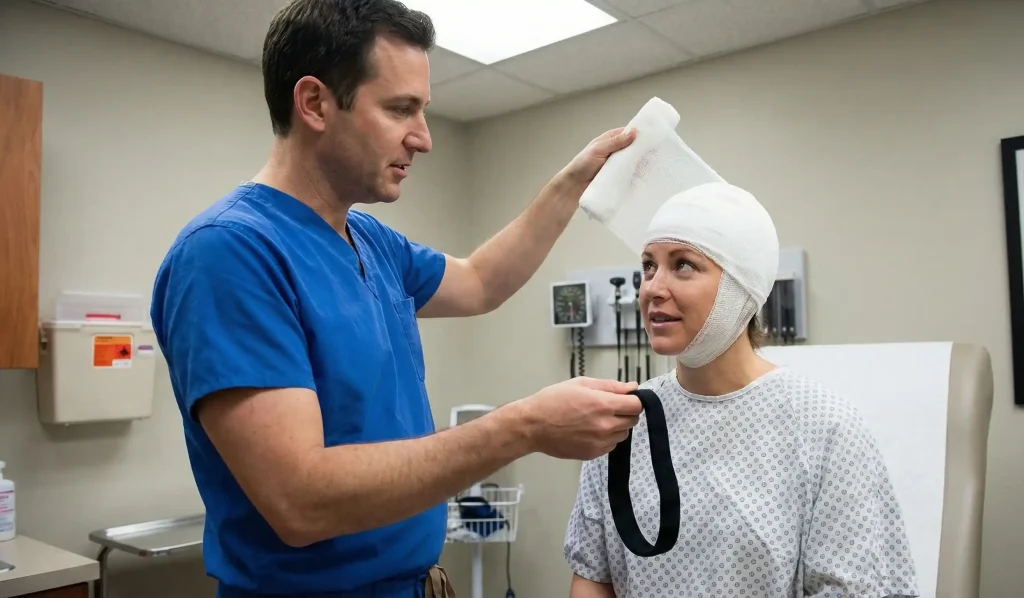
Upon waking up from your operation, you will not be able to see your ears. Your head will be wrapped in a big, turban-like, head bandage. This dressing is very important—it exerts pressure that prevents blood clots by compressing the blood vessels and besides that, it helps keep the ears in the new position while the healing glue is bonding the tissues.
The discomfort experienced during this time is basically a dull, throbbing pain or a feeling of warmness in your ears. Such symptoms are normal and can be easily healed with the help of painkillers given by the doctor. The bandage chin strap is the most troublesome part as it makes it hard to eat. Therefore, we would advise taking a soft diet such as soups, smoothies, and yogurt for the first couple of days to help you avoid chewing too much which draws the ear muscles. It is very important to keep the bandage dry and undisturbed until your first follow-up visit.
The Reveal and The Headband: Week 1 to Week 2
On the 3rd or 4th day, you will come back to the clinic to get the large dressing removed. This will mark your “Reveal” moment. At first, your ears might feel sore, swollen, and have some bruises but you will immediately get to see the difference in their angle.
After the removal of a medical dressing, a patient is moved to a Compression Headband. The appearance of this band is similar to that of a sports sweatband or a tennis band. You are required to wear this headband day and night (except when bathing) for the first week after the bandage removal. This headband works as a splint. After the cartilage has been scored and stitched, if the ear is pushed forward accidentally (e.g. if one turns over in bed), the internal sutures may break, leading to the ear popping out (“recurrence”). While sleeping, the patient is protected from not only the pillow but also from the hands by the headband.
Social Recovery vs. Physical Recovery
Socially, a person can recover from an otoplasty very quickly. After the removal of the large dressing (Day 3-4), most adults are ready to get back to work at a desk or to school provided that they don’t mind wearing the headband and don’t mind their ears being visible or they can hide them with hair. The behind-the-ear stitches are typically dissolving ones, so there will be no pain from a suture removal appointment.
On the other hand, your Physical Recovery will still be quite a lengthy process. From the 14th day, you are permitted to wear the headband only during sleep. This “night-only” schedule needs to be maintained for 4 to 6 weeks at least. This point is so important that it is not up for discussion. During sleep, our body loses control over the head position. It only takes a single night of sleeping on a folded ear to destroy the surgical result. The cartilage is surrounded by scar tissue which is only fully developed after 6 weeks allowing it to have enough strength to defy gravity as well as pressure.
Sensitivity and Numbness: The “Frozen” Feeling
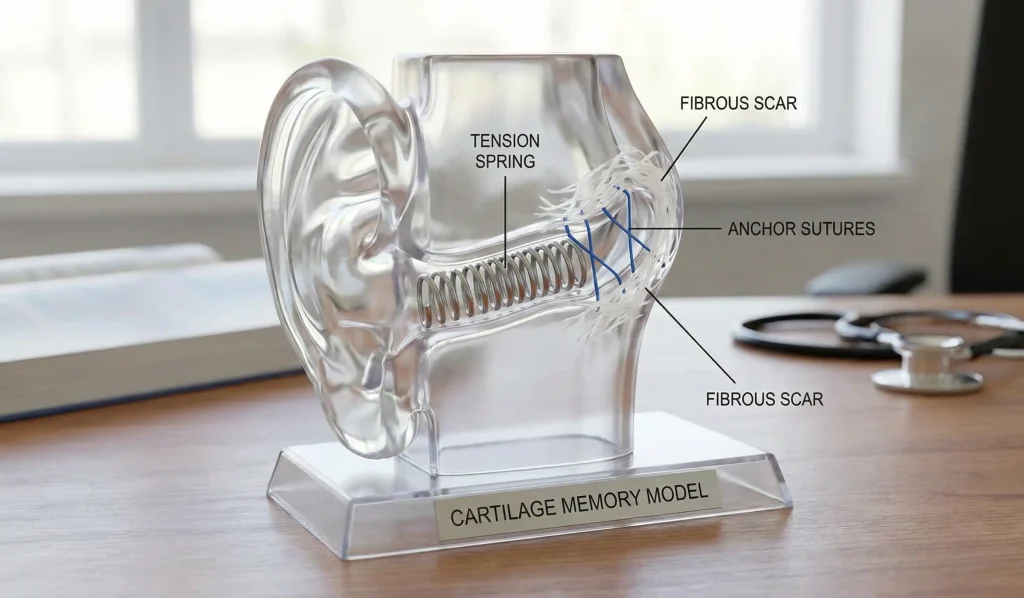
A strange, albeit common, result after an otoplasty is altered sensory perception. Because to obtain the cartilage, the skin behind the ear has been detached, the nerves in that area are temporarily shocked. Your ears may be numb and feel “wooden” to the touch for a number of weeks.
On the contrary, after the nerves are again functional (usually around the 2nd or 3rd month), you may have “paresthesia”—the term for sudden, sharp, electric-like pains or an intense itch. Actually, this is an encouraging indicator, as it shows the nerves are healing. During the cold season, patients also complain of their ears feeling very cold when exposed to the wind. The advice we give for going outside in cold weather for the first couple of months is to wear a beanie or earmuffs as the ears will hurt more than usual because of the damaged blood circulation during the healing phase.
Lin Health Europe Difference: The “Invisible” Incision
At the Lin Health Europe Clinic, we aim at lessening the visible evidence of the surgical procedure so that your recovery remains discreet. We make our incisions well hidden in the retroauricular sulcus (the natural crease behind the ear) so that the scar will be almost unnoticeable after it has healed. After that, we implement the “conchal setback” method that fixes the ear to the mastoid bone (the skull), thereby giving a firm, long-lasting hold which lessens the reliance on bandages.
Additionally, we issue a personalized recovery kit, which comprises a customized, adjustable headband that feels more comfortable than the conventional ones available in pharmacies. If we observe one ear tending to drift, we will first detect this and use taping protocols to fix the situation without a second surgery. Our wish is that the recovery period should be only a small blip on the lifetime radar of confidence.
Frequently Asked Questions About Otoplasty Recovery
Generally, you wear it all day and night for the first week, and then only at night for the following 4 to 6 weeks. This is to keep the ears from getting folded when you sleep during otoplasty recovery.
Typically, after the big dressing comes off (Day 3 or 4), you are free to have a shower and wash your hair gently. However, you need to be extra careful that you do not rub behind your ears too much and also make sure that no strong shampoo goes into the incision which is healing after otoplasty.
It is felt more like a dull ache which most people would agree was the case, not a sharp pain. Discomfort is the greatest in the first 3 days and can easily be handled with painkillers. In fact, severe pain is very unlikely to be experienced in otoplasty recovery.
For the first 3 to 4 weeks at least, it is best if you sleep on your back with your head raised. The ears receive direct pressure if you sleep on your side, which might cause pain and thus, the early results could be jeopardized during otoplasty recovery.
It’s a bit difficult. The arms of the glasses come down right where the incision is. You might have to fix the glasses to your forehead with a tape or wear some padding on the arms of the glasses during the first 2 weeks to prevent pressure behind the ears during otoplasty recovery.
Furnas, D. W. (1968). Correction of prominent ears by conchamastoid sutures. Plastic and Reconstructive Surgery.
Limandjaja, G. C., et al. (2009). Complications of otoplasty: a literature review. Journal of Plastic, Reconstructive & Aesthetic Surgery.
Mustardé, J. C. (1963). The correction of prominent ears using simple mattress sutures. British Journal of Plastic Surgery.