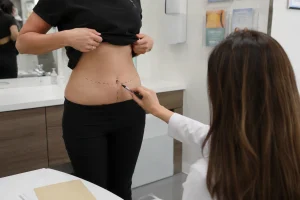
It is ideal for addressing extensive lower abdominal sagging.
People who have undergone or committed to losing a lot of weight are often initially thrilled, but a new problem often appears: excess skin. Although a simple tummy tuck might generally be helpful for restoring a female body after pregnancy, the procedure does not really work for weight loss patients who have recently shed 40, 50, or even 60 kilos. These individuals often notice that standard abdominoplasty only helps a little and they still have a “boxy,” wide appearance instead of a well-shaped waist.
The FDL Tummy Tuck or Fleur-de-Lis Abdominoplasty, which was named so because the incision pattern looks like a lily flower, is a surgical procedure that not only sees the problem in three dimensions but also offers the solution in three dimensions as well. It is a far more intensive treatment than the conventional tummy tuck and entails a vertical scar of the length of the torso and the main focus of the abdomen. The patients should not be afraid of an additional scar because it will be the only way for them to get rid of the “spare tire” completely and carve out a snatched, hourglass waist that a standard pull-down technique simply cannot achieve.
The Limits of Standard Tummy Tucks: The “Boxy” Problem
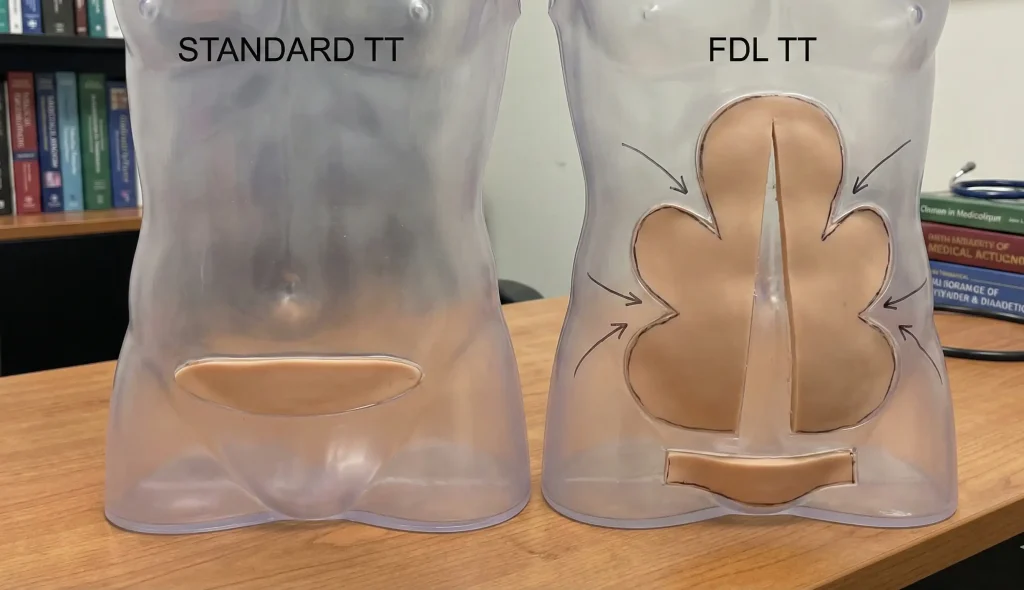
In order to decide if you really need an FDL, you have to understand what the standard tummy tuck is capable of doing and what it doesn’t do. A conventional abdominoplasty will only allow the skin to be pulled in one direction: down. It handles the issue of vertical laxity (loosening). Consider the situation when you put on a loose shirt and pull it down at the hem; the front of it will be more or less smooth but the sides will not necessarily be tighter.
With massive weight loss patients, the skin has been stretched in every direction so that there is really a lot of horizontal laxity. The person has a lot of hanging skin such as a “coat” that goes all around the body. One can imagine a massive weight loss skin removal surgeon doing a standard abdominoplasty on such a patient, the result after the operation might be a skin-tight shrink-wrapped body but at the same time with a torso that is flat but quite square. The waist is still broad because the surgeon does not pull the skin in toward the center. “Flat” is not really what these patients had in mind when they were dreaming of getting a body with curves.
The Mechanics of FDL: The Corset Effect
The FDL Tummy Tuck addresses the problem of length by tightening the skin in two directions: down and in. Besides the conventional horizontal incision along the pubic line, the operating surgeon cuts along the midline vertically. It is a good way to explain that, like dressmaking, one takes away a brief wedge-shaped piece of fabric from the center of the stomach.
You may see it like a dress or a suit jacket that is taken in at the seams. Taking out this vertical strip of tissue enables us to bring the oblique muscles and skin from the sides by pulling them toward the midline. This is the creation of a wonderful “corset effect” which actually narrows the waist and changes the hourglass markedly. The standard one as it is known to most of the patients does not get rid of the loose skin draping over the belly button (epigastric area) but the Abdominoplasty in a Fleur-de-Lis way does.
The Trade-Off: Accepting the Vertical Scar
What ultimately makes a patient decide to become an FDL Tummy Tuck patient is, indeed, just one question: “May a vertical scar be a price for a flat and narrow waist?” Even though the usual tummy tuck scar can be hidden inside the underwear, the scar made during the FDL Tummy Tuck extends from the bottom of the abdomen to the top, sometimes even all the way to near the breastbone.
If a patient has only minimal skin issue, then this scar will never be a good compromise. Nothing wrong but every fine line is a sore spot that needs another fixation. But, for the post-bariatric patients, almost always this trade-off gets accepted as a gift. This new line not only matures and changes into a thin white line that can hardly be seen, but more importantly, it replaces a disfigured, hanging torso with a contoured, athletic shape. Most people who underwent FDL surgery say that it is a better option for them to have a scar that they can see rather than a bulge that they can feel. In our Lin Health Europe Clinic, we perform very meticulous multi-layer closure techniques so as to make this scar as thin as possible so that after 18 months at the most it might be even imperceptible.
The Self-Test: The “Pinch” Diagnosis
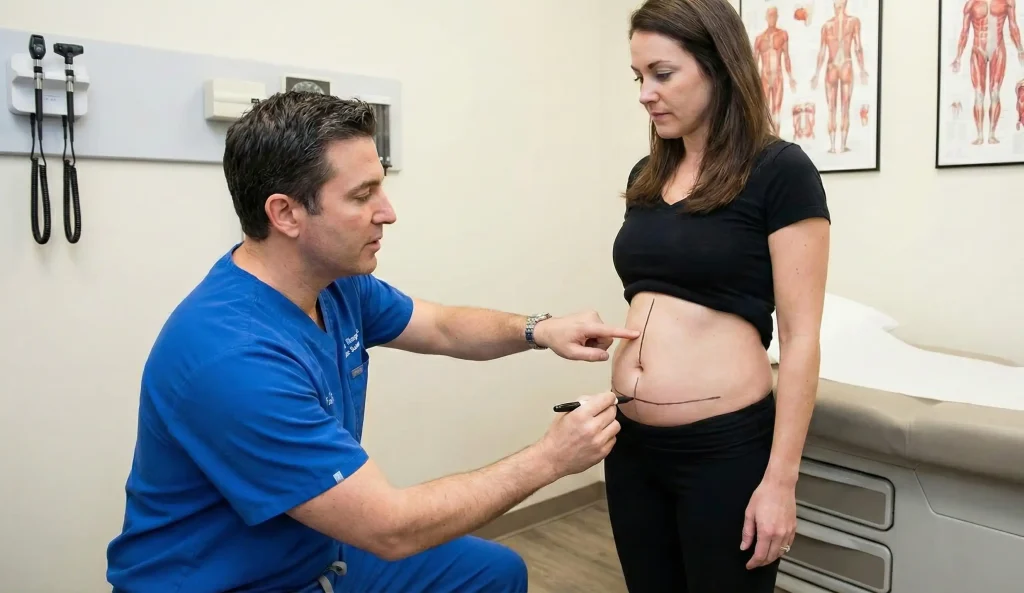
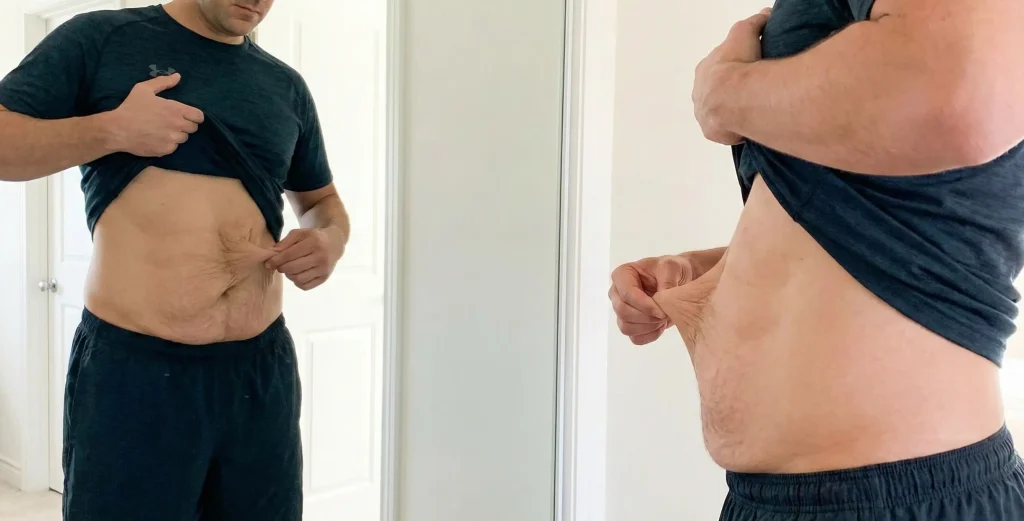
What is it that you should do to know if you are a proper candidate for FDL without even going for a consultation? By using the so-called “Pinch Test,” you will be able to do this very simply at home. Just face the mirror and pinch the skin of the central part of the upper stomach (above the belly button) vertically.
In case you do a considerable amount of skin, e.g. 20 cm or even more and bring that skin together in the middle, it greatly affects the contour of your waist, probably you need FDL. If the skin around the navel is quite tight and what bothers you is only a “pannus” of skin that hangs at the bottom, then a classic belly tuck will most likely be sufficient. The FDL is a procedure aimed at those who have “excess skin laterally”, the skin is so loose that it is like a coat that is three sizes too big.
Lin Health Europe Difference: High-Definition Contouring
The Lin Health Europe Clinic in Turkey has been working in the area of post-bariatric body contouring for a long time. We are aware that patients coming for the FDL have special physiological needs and some of these patients might have been obese for a long time resulting in reduction in protein reserves or the circulatory system may have been compromised. Our surgical procedure is safe and results in good looks. We frequently resect the FDL and simultaneously perform Muscle Repair (Rectus Plication) not only vertically but possibly also involve the use of oblique tightening in order to get the greatest waist narrowing effect.
Moreover, extra care is given to the “T-junction” or the point where the scars intersect. It is the area where most problems are experienced with the healing (necrosis). Our doctors use special blood-flow friendly techniques to ensure that this most delicate part heals well and strongly. We do not merely cut off skin; with your help, we shape a brand-new body closing with the minimum of scars the chapter of your struggle with weight and unveiling the defined, curvy figure of your dreams.
Frequently Asked Questions About FDL Tummy Tuck
FDL is an abbreviation of Fleur-de-Lis which is the term for the outline of the surgical cut (shaped similarly to a lily flower). To fix the horizontal skin excess, it figures a vertical scar.
Just a bit. Since the FDL Tummy Tuck takes the incisions longer and the skin undermining more considerable, the swelling can be more significant, and the person recovering might feel very tight. Nonetheless, the time away from work (2-3 weeks) is almost the same.
As a matter of fact. In the same way, an FDL Tummy Tuck also lifts and tightens the mons pubis (pubic area) which in many cases sags a lot after massive weight loss (a procedure called a monsplasty).
Liposuction will get rid of fat but it can’t tighten the skin that is loose. With massive weight loss patients, the skin failure is the issue, not the fat. They will be left with hanging skin if lipo is done only. The FDL Tummy Tuck is the only one that can get rid of the excess skin fabrics.
None of the scars totally disappear. The vertical scar from an FDL Tummy Tuck will turn to a faint line after 12-18 months, but if you don’t wear a shirt, it will always be there.
Hurwitz, D. J. (2016). Fleur-de-Lis Abdominoplasty. Clinics in Plastic Surgery.
Dellon, A. L. (1985). Fleur-de-Lis Abdominoplasty. Aesthetic Plastic Surgery.
Aly, A. S. (2010). Body Contouring After Massive Weight Loss. Thieme.