Usually after 4–6 weeks.
For those who have to wear glasses due to less-than-perfect vision, the joy of a new nose can be quickly overshadowed by a flash of practical concern: “How will I see?” Glasses, which have become an indispensable part of our lifestyle from driving to computer work, suddenly turn into a potential risk just after rhinoplasty surgery. The bridge of the nose, which is the natural spot where glasses sit, usually is the exact place where the most delicate surgical work is done. The worry is justified as putting weight on a nose that is still healing does not only cause pain, it can lead to structural damage.
Conflicting advice is abundant on the internet, with some forums advising one week and other three months. The reality depends on the specific surgical methods used in your procedure and the nature of bone healing. At Lin Europe Clinic, we realize that you cannot just stop living your life for six weeks. Going through the “blind phase” means understanding the bone healing process and using a few helpful tricks that allow you to go on your daily activities without endangering the straightness of your new nose profile.
The Mechanics of Deformation: Why Glasses Are Dangerous
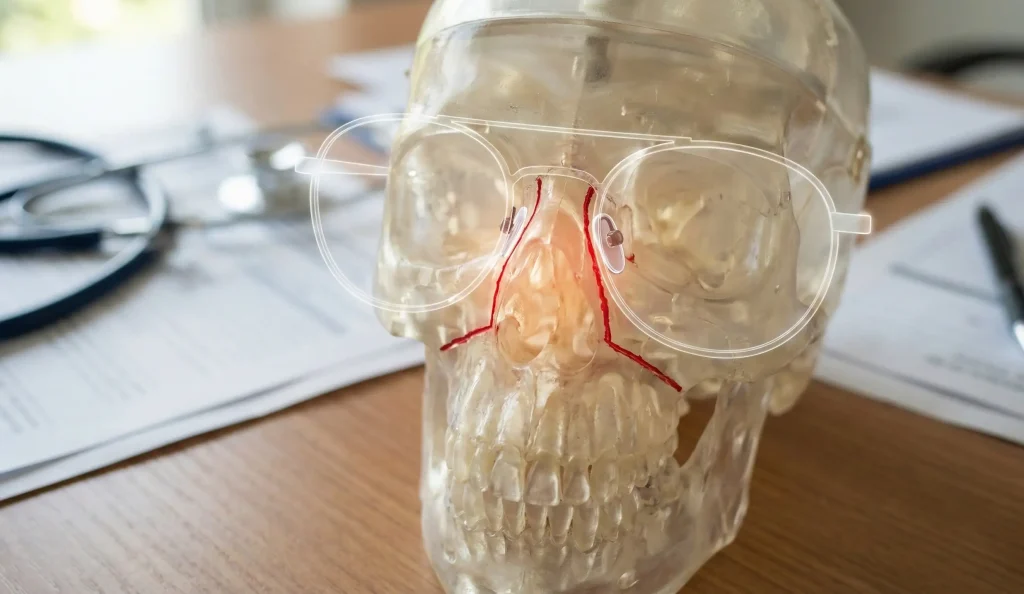
The only way for you to comprehend the danger fully is to understand what surgery did to the nasal bones. In most rhinoplasties, particularly those that are intended to remove a hump or make a broad bridge narrower, the surgeon performs “osteotomies.” That is the controlled fracturing of the nasal bones to be able to reposition them inwards. Essentially, in the initial period after the surgery, these bones are like floating bones. Together with the internal healing and the external cast, they are maintained, but not yet joined. In fact, they are sensitive, able to move, and pliable.
The pads of a pair of glasses put a continuous and highly localized pressure right on the cracks in the bones, which basically means that they are being pressed by the force of a penciled thumb print slowly and continuously. The pressure from the glasses changes the position of the nasal bones if they are still loose. The most frequent problem is that the “indentations” or dents get permanently formed in the surface of the skin and the tissue which is swollen and therefore easily pressed. In fact, this is not about pain, but about how shapes behave. Even if feeling no discomfort, the tiny shifting can spoil the exact straight dorsal line your surgeon put so much effort into creating.
The Critical Timeline: The Six-Week Rule
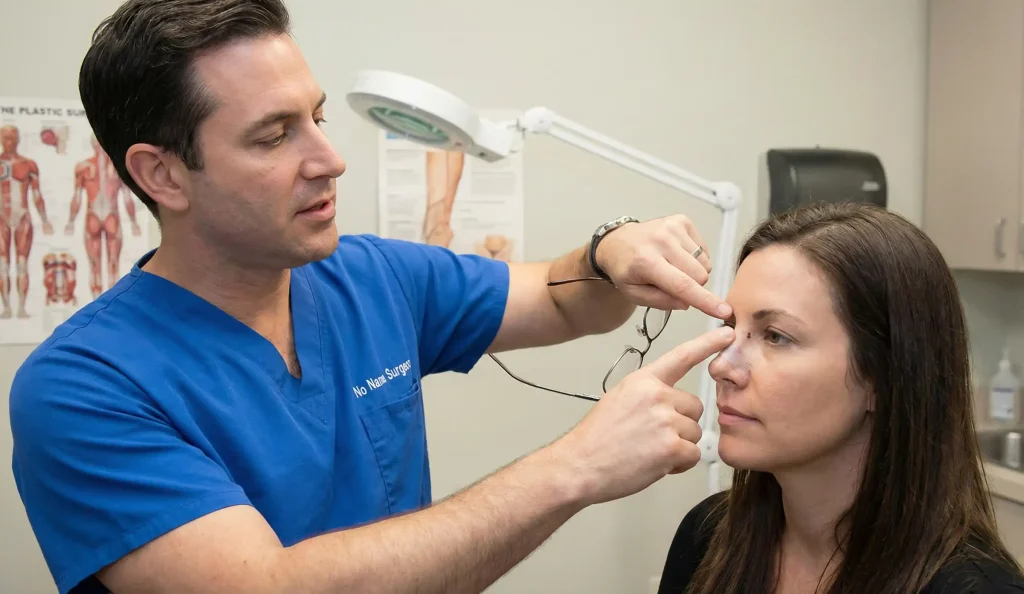
The general “Golden Rule” in plastic surgery is that you should not put any kind of pressure by glasses on the nose for at least 6 weeks after the surgery. This is a rule of thumb that comes from the time it takes for the bones to unite.
Having said that, there is a unique time in the first week when the regular timeline does not apply. Due to the fact that during the whole first week a strong thermoplastic cast (splint) is glued to your nose, you could actually put the glasses over this cast as the rigid plastic shell would allow the weight to be distributed, thus the bone underneath being protected from the pressure of the pad of the glasses. The real risk starts as soon as the cast is taken off at your one-week check-up. The Day 7 to Week 6 period is when your nose is exposed, swollen, and unprotected, thus it is a strict no for any frame that is supported by the bridge.
Surviving the Blur: Alternative Solutions
Apart from contact lenses, there are no other solutions that can be worn immediately after surgery. Moreover, if you also had eyelid surgery, the use of contacts should be delayed. If you absolutely cannot wear contacts, then the only possible solution is changing the way your glasses are worn by avoiding the nose completely.
The most popular method is to attach your glasses to your forehead with tape. Yes, it does look ridiculous but with the use of medical tape to suspend the bridge of the glasses from your forehead, the nose pads barely touch the skin, thus preventing any harm yet you still get the benefits of glasses if you work from home. Another option is that patients may use “cheek-supporting” glasses holders or post-surgical frames that have been designed especially for this situation. Such products are characterized by short legs that rest on the maxillary (cheek) bones and so the frame is completely lifted off the nasal bridge. Thanks to such a solution you can enjoy perfect vision while the bones are still healing without receiving one single gram of your weight.
The Sunglasses Trap: Why “Lightweight” Isn’t Enough

There is a widespread misunderstanding that prescription glasses are dangerous while sunglasses “lightweight” are safe. The reality is different. Even plastic sunglasses apply some pressure and, considering swollen tissue, the repeated application of pressure can lead to damage. Due to the skin and soft tissue on the bridge being saturated with fluid, thus the skin being like a sponge, the application of a frame, although light, may cause the fluid to be pushed out of certain spots which leads to the formation of dents or grooves. Such visible irregularities may take months to disappear, if at all, or become permanent.
Therefore, our recommendation is to wait the whole 6 weeks even for sunglasses. The time after 6 weeks should be when you start to use frames again but gradually. The first time you put on glasses after a long break, wear them only for 30 minutes, and then look at yourself in the mirror. Should you notice deep red marks that do not disappear within a few minutes, the nose is still tender and too swollen to be firm. At that point, you need to halt and try again after another week. Seriously, it is much better to suffer a bit from the sun glare for a few weeks than to have to undergo revision surgery for an indentation.
Lin Europe Clinic Difference: Comprehensive Aftercare
We do not simply give you a new nose and send you on your way at Lin Europe Clinic in Turkey. We also prepare you for the changes in your lifestyle that will be necessary to keep the nose safe. It is during your pre-operative consultation that we find out about your visual needs and if it turns out that you wear the glasses quite often we will even help you to get the cheek-support device along with planning on the use of contact lenses even before you go into the operating theater.
We also put emphasis on the skin of the nose as a separate matter. Since pressure from glasses can change the bone position, an exacerbated situation can result in necrosis, (death of tissue) or pigmentation spots that become permanent on the newly healed skin. We keep a close eye on your nose’s bridge during the check-up visits in the follow-ups. Your recovery phase is an essential part of a satisfactory outcome and our commitment to a perfect, even and symmetrical nose extending for a lifetime includes helping you through the “when no glasses” stage.
Frequently Asked Questions About Glasses After Rhinoplasty
No. Even light plastic sunglasses can leave marks because the nose is swollen and the skin is soft. Give it a 6-week break for any frame that touches the bridge of the nose.
The momentary bump is generally okay and the bone won’t likely be shifted. The risk is from continuous pressure over hours. Look at yourself in the mirror, if the nose is still straight, then you are probably okay.
Sure. There are some “Doctor CO Eyewear”-style glasses and generic “cheek support” pads that stick to your glasses and help transfer the weight to your cheeks instead of your nose.
I would definitely say heavy, oversized frame fans should wait at least 2-3 months. The bone is already healed at six weeks mark but the soft tissue can still be quite sensitive and heavy pressure may cause the discomfort for a longer period of time.
Almost always the answer is no. The moment you feel up to it, it is totally okay to use contact lenses, the day after surgery most probably. However, if you had blepharoplasty (eyelid surgery) alongside your nose job, then you have to wait for 2 weeks.
Guyuron, B. (2010). Rhinoplasty. Elsevier Health Sciences.
Gruber, R. P., et al. (2011). The delivery approach to the nose. Clinics in Plastic Surgery.
Rohrich, R. J., & Ahmad, J. (2011). Rhinoplasty. Plastic and Reconstructive Surgery.