Usually 1–2 times per week early on.
After surgery was over, you put on the compression garment and got ready to heal. Unfortunately, within two days, you are alarmed to find that you are swelling. Your limbs feel heavy, your skin tight, shiny, and you can actually feel fluid, like when you press on a waterbed. The regular body contouring surgery aftermath is: Edema (swelling).
Although the surgeon removes the fat or tightens the skin, the surgery alters your body’s main waste disposal system temporarily- the lymphatic system. While these lymphatic pathways are being restored, fluids get trapped under your skin, forming a reservoir of stagnant fluid which, if left untreated, will turn into fibrous tissue. Manual Lymphatic Drainage (MLD) is the solution here. At Lin Europe Clinic, we hold the view that post-lipo or tummy tuck massage is not a “spa luxury”; it is actually a non-negotiable medical requirement. Most often your massage schedule diary significantly influences the difference between a smooth, nicely sculpted result and a lumpy, uneven one.
The “Traffic Jam” Analogy: Why You Need Help
You can picture your lymphatic system as being a motorway network that helps in removing waste fluid from your tissues. Liposuction or surgical intervention is comparable to a huge roadwork in which several lanes of the motorway are closed. The fluid (cars) is still coming, but the road is blocked. The result is a massive traffic jam—this is the swelling you see.
Eventually your body will find its own way to open the lanes, but it is a slow process. MLD is like a traffic cop who finds detours (collateral vessels) to get traffic flowing again. The massage therapist works with the lymph nodes (normally in the armpits or groin) as the direction of the lymph flow, manually ending the congestion and making sure everything is in order. Conversely, do not expect that the protein-rich fluid will be “washed away” all by itself, since it results in the surrounding tissue being overgrown with fibrous tissue, which ultimately leads to the formation of lumps and ridges on the skin (fibrosis).
The Perfect Plan: The Principle of Reducing Frequency
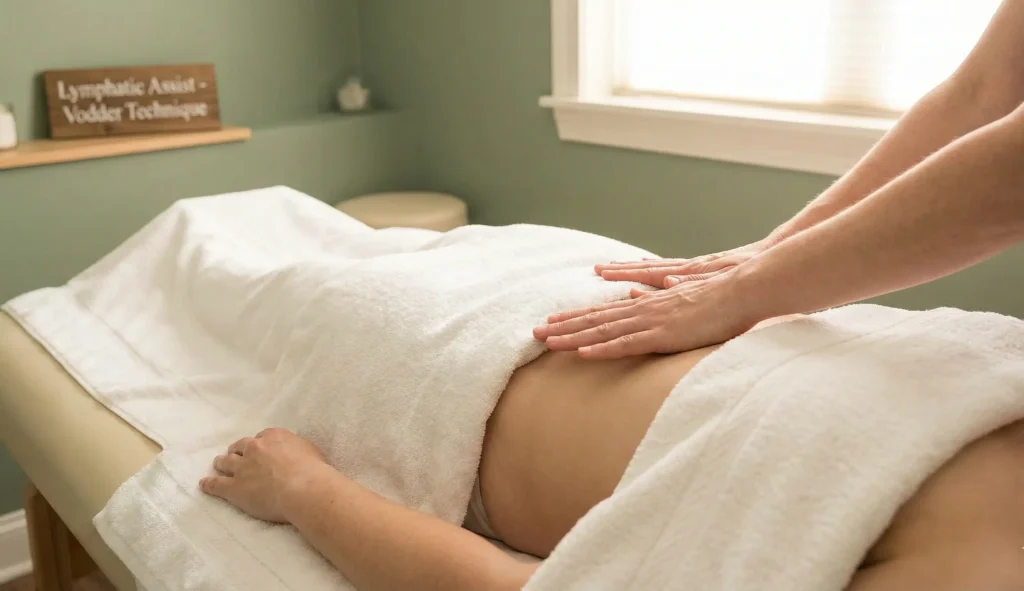
How frequently a question may be answered by your particular surgical procedure and the amount of fluid you are retaining; still, there is a golden rule that we most commonly suggest to liposuction and body contouring patients.
- 1-2 Week Sessions (The Surge of Swelling): During the initial two weeks after surgery, the swelling is made up primarily of liquid that will be easy to move around. Hence the period of utmost importance. You should either have therapy sessions daily, or at least 3 to 4 sessions per week. The intention here is to let the liquid roll out so that the skin can attach itself to the muscle. When you have a drain, the massage speeds up the evacuation.
- 3-4 Week Sessions (The Phase of Softening the Skin): With the fluid turning into the earliest stage of scar tissue (the “woody” phase), your doctor may revise the number of MLDs to 2 per week. The therapist will have to use techniques to keep up the softness of the tissues while breaking down the hardness that naturally occurs at this time.
- Month 2 Onwards (The Phase of Maintenance): At this stage, most of the swelling would have disappeared and what remains is mostly residual puffiness. Weekly MLDs in combination with daily self-massages are usually sufficient, until the tissues become completely “soft” and compliant again.
It Should Not Be Painful: The Misconception of “Very Light Touch”
Another wrong idea about lymphatic massage is that it has to hurt in order to be effective. At times, patients believe that in order for the therapist to get to the fat, he or she will have to “crush” it or “squeeze” the fluid out very forcefully. That is not only the case but dangerously so.
Lymphatic vessels are extremely thin structures and lay just under the skin. Pressing too hard (imagine a deep tissue sports massage) will actually cause the vessels to collapse and therefore stop the flow completely. The stretching of the skin should go along with a slow and gentle rhythmic pumping of the lymphatic massage. It must only be comforting and not one causing discomfort. If the physical therapist makes you suffer bruises or produces tears, then indeed, you have done it incorrectly and you are at risk of hurting your already delicate tissues.
Professional or Court DIY: Can It Be Performed by You?
For maintenance, we strongly advocate that patients acquire self-massage skills but for the first two weeks, nothing can beat a professional. This is because a professional looks for the “opening of the drain” initially.
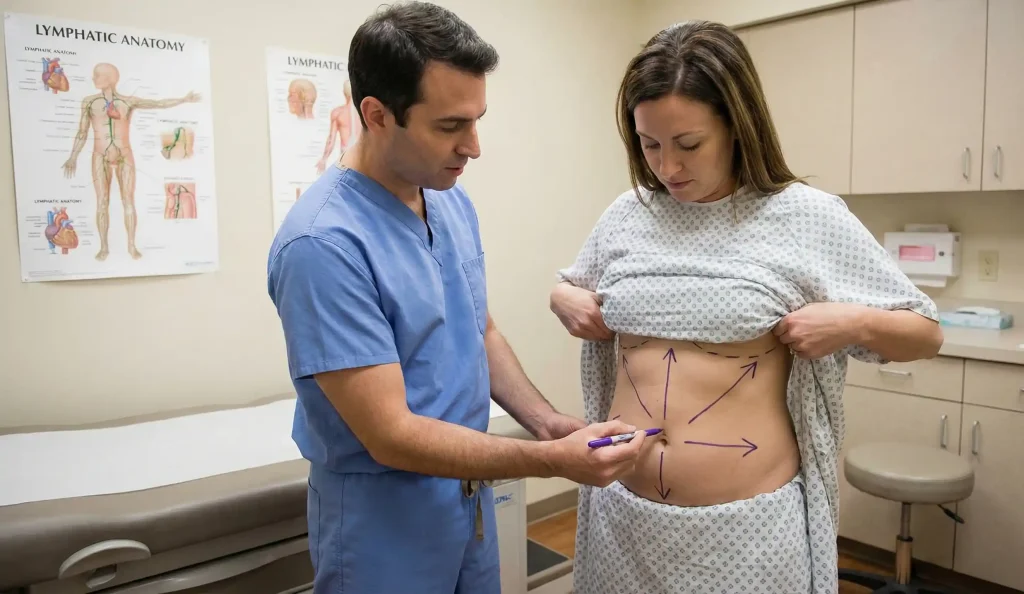
Without first clearing the path, it is impossible to push fluid from your stomach or legs. The professional therapist if you so want can start by, basically, “priming the pump” of your lymph nodes at the neck (terminus), armpits (axilla), and groin (inguinal nodes). If you go ahead and rub your belly without opening these gateways, then you are, in effect, just pushing fluid into a closed door. Professional care throughout the “Intensive Phase” is our recommendation, gradually shifting to DIY methods as the drains are taken out and the first shock of injury has passed.
The Outcomes of Neglecting: Fibrosis and Seromas
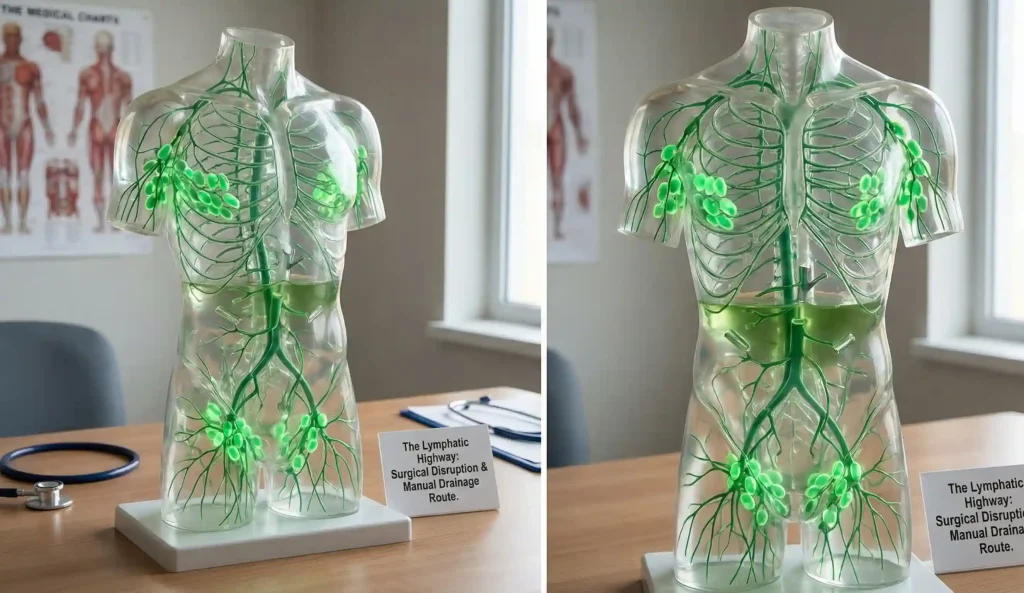
Are you wondering what will happen if you don’t take into account the doctor’s instructions and miss massages? Some patients heal fine, but many develop complications. The most common is Fibrosis—the deep hardening of subcutaneous tissue to a greater degree. The trapped fluid forms new tissues in a honeycomb pattern, hence the hard lumps or “washboarding” under the skin that you can feel.
In worse cases, the fluid accumulation creates a Seroma—a pocket of liquid that separates the skin from the muscle, preventing healing entirely. Draining the seroma with a needle is sometimes necessary, but regular massage can prevent this problem from occurring.
Lin Europe Experience: An All-Round Therapy
At Lin Europe Clinic in Turkey, we not only schedule your surgical procedure but also schedule your post-surgical healing period. The massage therapist is a surgical partner in our eyes. Our post-operative packages often include initial lymphatic sessions because we want to inspect your skin.
Our therapists, who perform these treatments, act as your health monitoring system. They are capable of sighting various skin deceases such as infection, necrosis, or seroma days before you could even realize it. Your exact incision pattern directional strokes is the kind of information that we provide you at these sessions, thus we are giving you the power to be in charge of your own healing at home. You could say that we hold the idea that the hands that operated on you are as important as the hands that heal you.
Frequently Asked Questions About Lymphatic Massage
Absolutely, to a great extent. By easing the pressure of the fluid on your nerves, MLD usually offers instant relief from the tight, bursting sensation that accompanies swelling after surgery.
No . Percussive massage guns are dangerously too harsh on very recently healing tissue. They might lead to internal bleeding, seromas, and increased inflammation. For 6-8 weeks, keep to only manual hands-on therapy.
A standard MLD session takes 45 to 60 minutes. It is very unlikely that a short 20 minutes session will be enough to stimulate the full systemic flow that is necessary to clear a surgical load.
Especially within the very first week, yes. If your incisions (or drain holes) are still not closed, massage will force the excess tumescent fluid out. This is good—better out than in!
In the absence of a specialist, get your surgeon to show you how to perform “self-manual lymphatic drainage”, or find a physical therapist trained in lymphedema management.
Masson, I. F., et al. (2014). Manual lymphatic drainage and therapeutic ultrasound in liposuction and lipoabdominoplasty. BMJ Case Reports.
Godoy, J. M., et al. (2011). Manual Lymphatic Therapy: A New Concept. The Journal of Phlebology.
Chow, I., et al. (2015). Postoperative management in body contouring. Clinics in Plastic Surgery.