
It depends on the complexity of the case.
When you start looking into surgery on the nose, the first thing you see is a clear-cut decision that seems to split the surgical world completely into two: Open vs. Closed.
Patients often come across threads where “Closed Rhinoplasty” is hailed as the best, modern, scarless option, while “Open Rhinoplasty” is sometimes wrongly associated with being invasive or old-fashioned. All this gives rise to needless tension. Patients turn to us with the questions like, “Could you do it closed? I really don’t want my nose to be peeled back.”
There is no such thing as a better method that fits both techniques in a universal way. It is similar to a situation where someone asks you if a hammer is better than a screwdriver; in which case, the answer largely depends on what you want to make. The decision about whether to use an open or closed rhinoplasty comes from the characteristics of the nose and the results you want, rather than the surgeon’s preference. At Lin Europe Clinic, we use both methods, and we think that the most suitable one is that which produces the most predictable, durable result for your unique face.
Closed Rhinoplasty: The “Internal” Approach

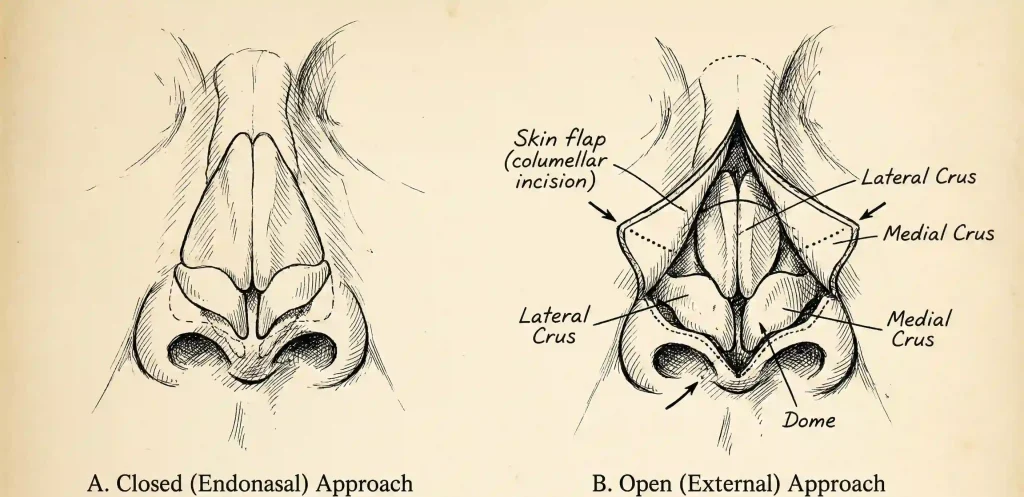
Closed Rhinoplasty (Endonasal Rhinoplasty) refers to the procedure where all the cuts are made inside the nostrils. There is no incision on the external skin and thus, absolutely no visible scar.
- Plus Side: One of the main advantages is the Quick Times of Recovery. Since the skin is not completely detached from the cartilage, the lymphatic drainage vessels are mostly undamaged. Therefore, the swelling (edema) after surgery is to a great extent reduced at the nasal tip. Most patients become “camera-ready” several weeks earlier than if they had undergone the open method.
- Perfect Match: Closed rhinoplasty can be an effective option for patients whose main requirement is “Bridge Work”. If your dorsal hump (a bump on the bridge) has to be shaved or if the nasal bones need to be narrowed (osteotomy), then the closed method suits the case well. It gives the doctor an opportunity to deal with the roof without touching the foundation.
Open Rhinoplasty: The “Structural” Approach
Open Rhinoplasty (External Rhinoplasty) requires the joining of the cuts inside the nostrils with a very short incision across the columella (the skin strip between the nostrils). This makes it possible for the doctor to lift the nasal skin like a hood of a car.
- Plus Side: The major advantage of an open approach is the use of the perfect combination of Visibility and Precision along with a magnified view through the microscope. Having the skin lifted, the surgeon is able to see the nasal cartilages in their natural, extended state. We are capable of identifying even an asymmetry down to the micron. Besides, it makes possible plastic operations in terms of grafting, suturing, and restructuring, which without a direct view would be very tricky to carry out through the nostril.
- Perfect Match: If you are looking to make changes to your Nose Tip—getting rid of a bulbous tip, lifting a droopy tip, or correcting a crooked/asymmetric nose—then Open Rhinoplasty stands for an almost absolute best choice. The tip work of a certain complexity usually calls for grafting and suturing, which requires direct visual access. It is also the queen’s way for Revision Rhinoplasty, where the presence of scar tissue from the previous procedures makes the anatomy uncertain.
The Stability Factor: Preventing the “Collapsed” Look
Besides the immediate visual impact, the nose’s aging should also be taken into account. Just like the rest of your face, your nose is exposed to the effects of gravity that pulls the tip downward with years.
One of the clearest, and to a large extent, overlooked benefits of the Open Approach is the possibility of reinforcing the structure very easily, e.g. the so-called “columellar struts” or “spreader grafts.” These are small pieces of cartilage that function as tent poles, thereby keeping the airways open and the tip constantly lifted. In Closed Rhinoplasty, the capability of putting in place these extremely accurate structural supports is very much limited and is also quite difficult. If at the outset, you have a fragile cartilage framework, then the decision to go for Open method can be regarded as an investment in the durability of your outcome. It is not only ensuring that your nose will remain attractive for the first year but it is forestalling the necessity for a revision surgery after ten years when the gravity will have exerted its effect.
The Swelling Trade-Off
The predominant “price” of the open method is not the scar (which fades away almost to invisibility), but the Tip Swelling. Since the open cut temporarily severs the superficial lymphatic vessels, fluid drains very slowly from the tip of the nose. While the patient that undergoes a closed rhinoplasty procedure might see the final tip of the nose shape in half a year, the one with an open rhinoplasty operation will probably notice minor changes in the tip size for a year to a year and a half. A patient that has thick skin and opts for open rhinoplasty must remain patient and diligent in using post-op taping in order to restrain this long-lasting edema.
The Myth of the “Blind” Surgeon
Opponents of closed rhinoplasty sometimes refer to it as “blind surgery.” Of course, it is a bit of a stretch. Sure, the visibility is not great but seasoned practitioners can still identify the anatomical features by using the instruments. Nevertheless, it is true that closed rhinoplasty is more dependent on the surgeon’s tactile feeling, whereas, open rhinoplasty mainly depends on the visual confirmation.
Thanks to the advent of Piezo (Ultrasonic) Rhinoplasty, the distinctions are getting blurred. Although we are capable of doing very accurate bone cleaning without causing a lot of damage, when it comes to the delicate cartilage work of the tip, open view remains the most secure way of ensuring symmetry.
The Lin Europe Clinic: Customization
At Lin Europe Clinic, we don’t fit every patient into one single mold.
- Got a straight nose with a simple bump: Most probably we’ll suggest Closed. Why make a scar and add extra swelling if it is not necessary?
- Got a wide, boxy tip, a deviated septum, or need major reshaping: Then the message would be Open. The promise of perfect symmetry and structural support is definitely worth the minor trouble of a little scar.
We want to see our patients abandon the idea of looking for a “technique” and instead, start looking for a “result”. Give the surgeon the benefit of the doubt in choice of the access that will help him/her in delivering the nose that you had a simulation with.
Frequently Asked Questions About Open vs. Closed Rhinoplasty
No. Pain levels are very similar. The cut on the columella does not cause much pain; most of the discomfort after both types of surgery comes from the congestion inside the nose.
Generally, yes or it may be that the procedure time is shorter. Open rhinoplasty takes longer due to the very careful dissection and closure that is required and this may be reflected in the operating room costs.
Technically, yes but it is very difficult. “Delivery techniques” allow some tip work through closed incisions, but for significant refinement of a wide, bulbous tip, the open approach offers far superior control and predictability.
Many surgeons who talk about the structural integrity aspect, argue that it is. With open surgery we can stitch the grafts exactly where we want them, so over time the nose is less likely to collapse or develop dents compared with the closed techniques, where grafts are sometimes simply “stuffed” in pockets without being secured.
No. The columellar incision should heal up as a fine, almost invisible line. After 1 year, the scar is hardly noticeable by the naked eye unless someone is very close to your nose and looking up it.
Gunter, J. P. (1990). The merits of the open approach in rhinoplasty. Plastic and Reconstructive Surgery.
Tebbetts, J. B. (2001). Primary rhinoplasty via the open approach. Facial Plastic Surgery Clinics.
Caffrey, J. (2018). Open vs closed rhinoplasty: a systematic review and meta-analysis. Aesthetic Surgery Journal.