Usually temporary fibrosis that softens over time.
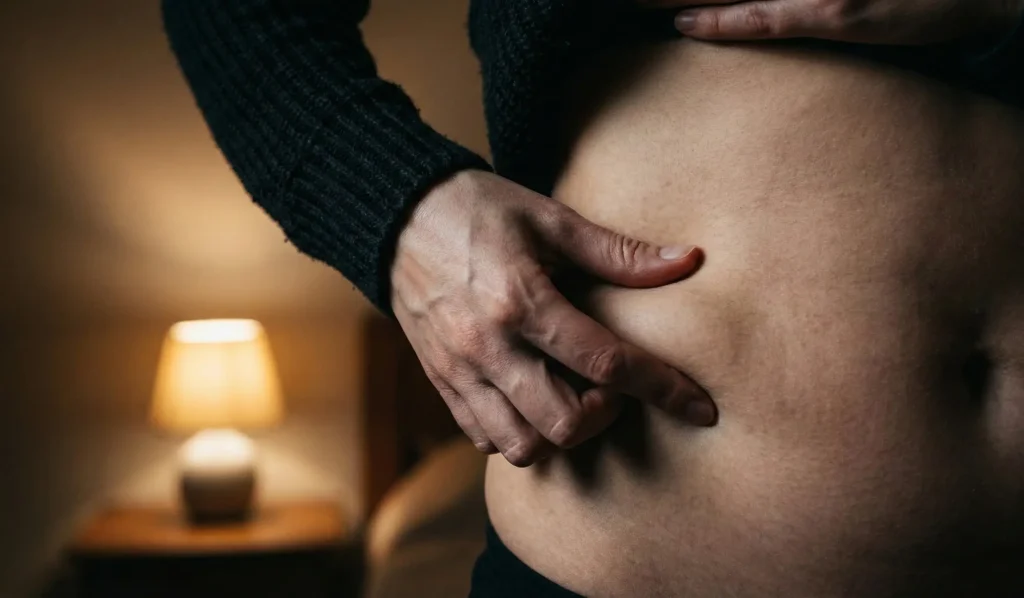
It is said that the first week after liposuction is the “honeymoon phase.” Of course, you are swollen, but your body shape appears flawless, and you are happy. However, the third or fourth week comes, and you are worried. You put your hand on the spot you have treated – whether it is the stomach, thighs or arms – and instead of feeling nice smooth skin under the hand, you feel hard lumps, ridges, or the surface that resembles a cobblestone street.
The patients are sure to panic at this moment and send the clinic a message. “Is that the remaining fat? Did the surgeon leave a spot? Is it a failure?” The answer is almost always no. You are not touching fat, what you are touching is Fibrosis (scar tissue) and trapped inflammation. It is a normal, predictable biological reaction to the trauma of surgery. In fact, if you did not create some scar tissue, you would not heal. Besides healing, the scar tissue also forms bumps. The scar tissue formation, particularly fibrous tissue, is often not uniform, and because some parts of the tissues heal at different rates, the result is a lumpy or bumpy feeling.
Bumpy Biology – What Is Fibrosis?
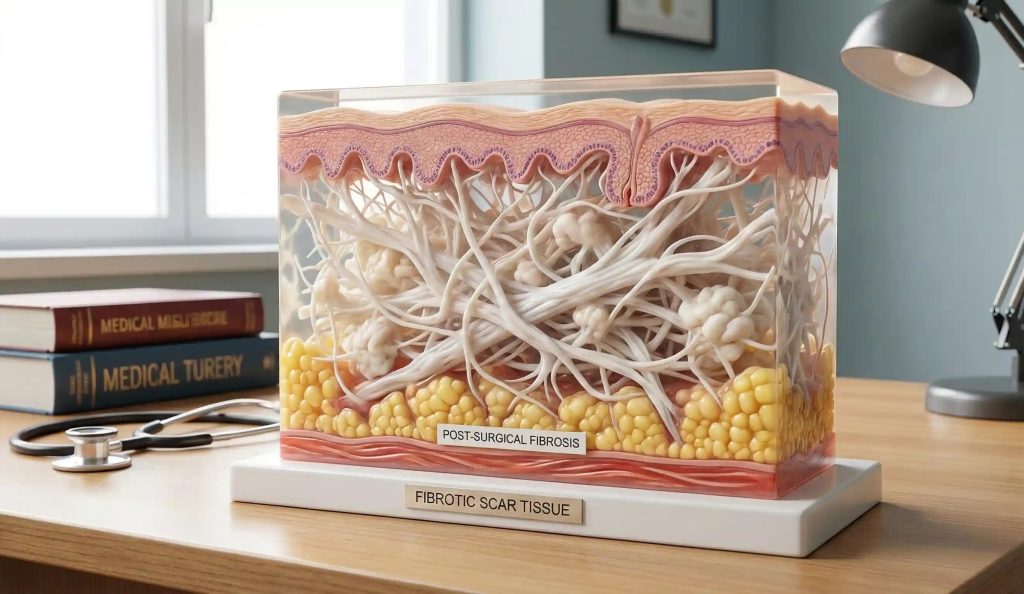
You need to imagine that liposuction leaves thousands of tiny tunnels in the fat layer. The cannula passes through the fat layer to break and suck the fat cells out. Once the fat is sucked out, the tunnels are empty spaces. Your body is aware that empty space is dangerous so it immediately goes to fill those spaces and the skin is glued back down to the muscle.
The “glue” your body uses is Collagen. In the first few weeks, this collagen is laid down in a disorganized, messy fashion. It is thick, rigid, and indiscriminate. This rapid production of scar tissue causes the treated areas to feel hard, stiff, and board-like. This condition is formally known as Post-Surgical Fibrosis. It feels lumpy because the collagen production isn’t perfectly even—some areas heal faster than others, creating peaks and valleys under the skin.
Feeling Lumpy = Scar Tissue Not Fat
What you will do well to know first and foremost is that the hardness you feel is either fibrosis or fat. Patients perennially mistake the hardness for fat, but in real life they can tell the difference by simply touching and feeling.
- If you were able to pinch a fatty inch before operation, and the same pinch after operation gives a soft inch, it could be residual fat (of course the swelling has to go down first before you can say this with certainty).
- Fibrosis or scar tissue is really hard. It is very common for it to be sensitive to the touch and it will feel stiff and very …you know like when you think of wood, plastic, or a hard boiled egg in terms of things that feel “hard” – that’s the kind of hardness that fibrosis will give you.
The Role of Lymphatic Drainage: Smoothing the Cement
Think of fibrosis as wet cement that your body deposits at the surgical site. Manual Lymphatic Drainage (MLD) takes the role of the trowel that makes it smooth before it dries. The lymphatic system is responsible for draining the fluid containing dead cells and inflammatory markers. After lipo, this system is temporarily overwhelmed and damaged. Fluid gets trapped (edema), which hardens the fibrosis further.
A regular professional lymphatic massage is a must. It does two things:
- Drains Fluid: It physically pushes the trapped swelling, hence the fluid, towards the lymph nodes, which reduces the hardness.
- Organizes Collagen: The specific pressure techniques help align the collagen fibers smoothly rather than letting them clump into knots. Patients who skip massage often end up with prolonged stiffness and “permanent” lumps that take months to resolve naturally.
The Faja Factor: Compression Wrinkles
There is a chance that the bumps are not inside but are indentations instead. Wearing a compression garment (faja) that is ill-fitting or produces creases can cause indentations in the healing tissue. The tissue is like clay being molded during the first month, and a faja that presses into your waist or creases at the groin can leave a temporary dent that looks like a lump. The reason why we recommend using Lipo Foams (soft foam boards) inside the garment is because the foam acts as a buffer, distributing the pressure of the garment evenly across the skin so that the “glue” sets flat.
When Is It Permanent?
Only in very few cases are scar tissue and fibrosis the permanent survivors. Most people have the “bumpy” or “lumpy” phase at week 4, which gradually disappears by month 3 or 4 when the scar tissue matures and softens (this process is called remodeling). Nevertheless, if the bumps last for more than 6 months, it might be a sign that the fat necrosis is encapsulated (the dead fat cells which have become calcified) or that there are true irregularities. In these cases, treatments such as steroid injections or revision surgery can be considered. However, the 6th week is too soon to judge your results; your body is still a construction site.
The Lin Europe Clinic Difference: Hands-On Recovery
We warn you of the “lump phase” at Lin Europe Clinic in Turkey even before you go into the operating room. Surprise, we know, causes anxiety. Our post-op protocol has professional lymphatic massages scheduled on a regular basis, and we consider them part of the surgery, not the optional add-ons.
We also teach our patients self-massage that they can do at home in between professional sessions. At each follow-up, we check whether your compression garment fits you well, and if it is not causing tourniquet lines that lead to ripples. We are there with you in the “woody” phase, reassuring you that underneath the hardness, your new contours are waiting to emerge.
Frequently Asked Questions About Lipo Lumps
The peak of stiffness is usually around the 3rd to 6th week after which it gradually gets softer for the next 3 to 6 months; sometimes it can take a whole year for complete disappearance.
No. Treatment with percussive massage guns is considered to be too rough for tissues that are still at the early healing stage and thus, may lead to worsening of inflammation or seromas. Limit yourself to manual massage only until completely healed.
Indeed, devices such as Venus Legacy or Velashape used 6 weeks post-surgery can be incredibly helpful by warming the tissue, enhancing blood flow, and thereby softening the stubborn fibrosis.
Lipo foams refer to soft polyurethane foam sheets that you put between your skin and the compression garment. They serve to prevent folds and ensure that the skin heals flat.
Yes, adequate hydration not only helps the body to flush out the lymphatic fluid that imparts the stiffness but also dehydration will make the body hold onto waste products in the tissues.
Chow, I., et al. (2015). Postoperative management in body contouring. Clinics in Plastic Surgery.
Fernandez, R., et al. (2013). The effects of manual lymphatic drainage on fibrosis after liposuction. Journal of Cosmetic & Laser Therapy.
Shiffman, M. A. (2006). Liposuction: Principles and Practice. Springer.