It depends on whether the issue is brows or eyelids.
This might be the first thing that comes up in the conversation with people who’ve been thinking about refreshing their face appearance. Suddenly you realize that your eyes give away your fatigue to the world. You even get mistake for having a heavy lid that is so close to your lashes that its appearance is almost making it impossible to apply eyeshadow. Or the feeling of constantly having to raise your eyebrows just to see better may have gotten etched in your memory. After all, you thought the answer is Eyelid Surgery (Blepharoplasty) which gets rid of the drooping skin.
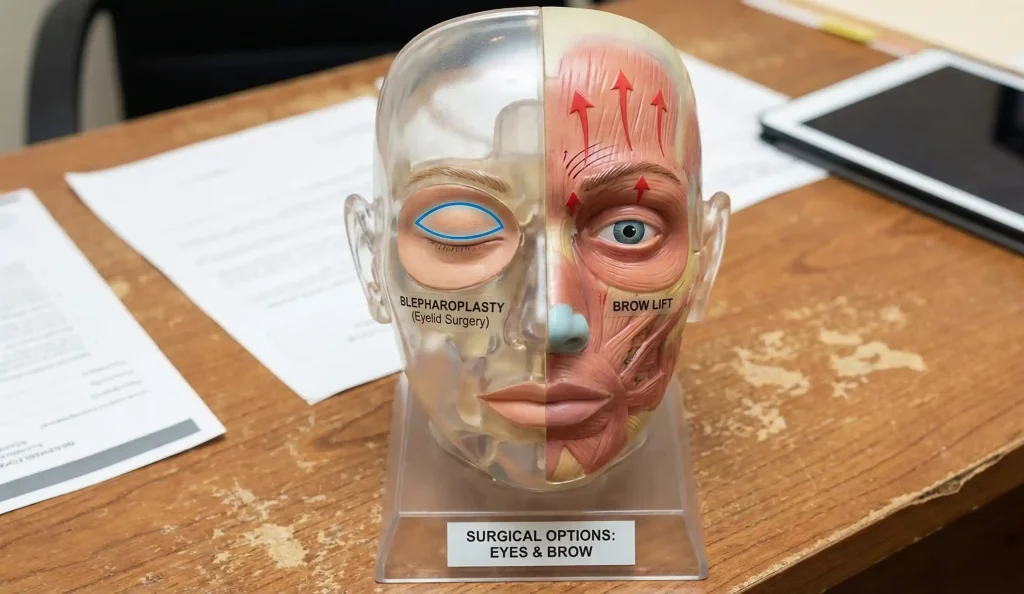
Yet more than a third of the cases, the eyelids actually aren’t the culprit at all. The main issue is the heavy and sagging look of the forehead, which starts pushing the eyebrows down onto the eyes after a while. To say the difference simply, the eyelid is “the curtain” and the eyebrow is “the curtain rod”. And if the rod falls, the curtain touches the floor. If you cut the curtain (Blepharoplasty) but leave the rod low (Brow Ptosis), you will still look angry or tired. At Lin Europe Clinic, we rely on accurate diagnostic procedures to find out which treatment—or the combination of treatments—is the “better” option for your singular anatomy.
The “Manual Lift” Test

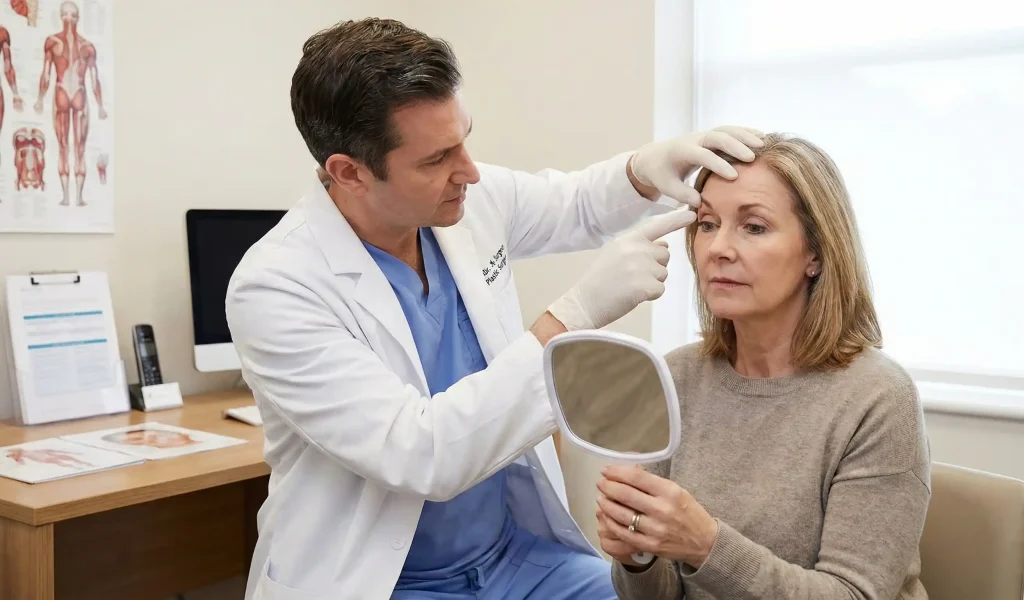
By doing the simple test in the mirror you can have a pretty good idea of what treatment is appropriate for you. Make sure you are not raising your eyebrows while relaxing and looking at yourself in the mirror.
- Scenario A: You are supposed to place your fingers on the eyebrows and make a gentle labor backward to the point where your brows were when you were 20 (usually right at or above the orbital bone).
- Scenario B: If you putting a finger beneath the brows and raising them up to make the eyes more visible you are likely needing a Brow Lift.Scenario B: You are going to do an Upper Blepharoplasty if there is still an amount of skin that is wrinkled and hanging over your eyelid crease in the area even after the brow has been lifted.
- Scenario C: If you putting a finger beneath the brows and raising them up to make the eyes more visible you are likely needing a Brow Lift.
- Scenario D: You are going to do an Upper Blepharoplasty if there is still an amount of skin that is wrinkled and hanging over your eyelid crease in the area even after the brow has been lifted.
Eyelid Surgery (Blepharoplasty): Clearing the View
Upper Blepharoplasty is an operation focused only on the eyelid. So, it is going to deal with the “excess curtain”. We, humans, become old and with our aging, the skin of the upper eyelid in the place of loss of its elasticity, stretches, and the fat pads around the eye may protrude (bulge) forward.
- The surgeon hides the incision in the natural fold of the eyelid, removes the skin and fat, and closes the incision with stitches.
- People who have their eyebrows in the right, even slightly high position but suffer from extremely thin, redundant skin, which is almost hanging directly over their lashes and may even be touching their eyelashes, are the ones for whom this treatment is going to be the best.
- The drawback is that with this kind of treatment, a facial expression cannot be changed. Though the eyes do look more attractive, the face still looks like it is weighed down by the frown in the brow area.
Brow Lift: Resetting the Frame
A Brow Lift (Forehead Lift) is focused on the heavy brow positioning. Forehead skin looseness, which can be considered as one of four primary causes of “aging,” can cause the whole eyebrow complex to sag, and thus the eyes become crowded.
- To perform an endoscopic brow lift or temporal lift, single, small incisions along the hairline are used. The surgeon separates the ligaments responsible for the brows being pulled down and then brings the tissue up to a youthful place again.
- They are the ones who have “hooded eyes” due to a heavy forehead, have deep, horizontal wrinkles on their foreheads, or whose eyebrows are located below the eyesocket bone and therefore give the impression of having either a sad or an angry expression.
- In addition to this, a special type of brow lift called a temporal lift will be done to only the outer brow to make it look like the trendy “Fox Eye” or “Bella Hadid” look.
The Danger of the Wrong Choice
Picking the incorrect treatment may ruin your face look quite drastically.
- When the person’s main problem is ptotic brows, but the eyelid excess skin is removed, then the heavy brow is still hanging, and the skin is still pressed down. To compensate the skin naturally, the plastic surgeon will remove the skin from the upper lids more than necessary and will be forced to close the lids by pulling the skin of the forehead downward. This heightens the area of the brow causing the enforced connection between the brows and the eyelashes and the end result is no “eyeshadow space” and a masculine, caveman-like appearance.
- Raising the eyebrows without the corresponding removal of eyelid skin after which the upper eyelids’ wrinkled and damaged skin remains, and the effect is that the eyes continue to look old.
The Power of Combination
For most people who are above 45, it’s not a question of “one or the other” but of both. Very often the most incredible changes are the ones resulting from the combination of treatments. We do a slight brow lift to refresh the face and free the eyes from the burden of the skin and at the same time, a conservative blepharoplasty to remove only the excess skin that is left and in this way we restore to the eye the shape of the square frame which is the normal, youthful one, free from the look of “startled” caused by a single brow lift or the “hollow” one due to a very aggressive blepharoplasty.
Facial Rejuvenation in Turkey
We at Lin Europe Clinic are well aware of how a patient chooses a clinic for their eye surgery in Turkey. Our main concern is to keep the harmony rather than aggressive pulling. It is our surgeons’ specialty to perform an Endoscopic Brow Lift which avoids the huge traditional “ear to ear” lift scars. Your entire upper face area, including the hairline, forehead, brows, and eyelids, will be evaluated together as one single aesthetic unit.
Beyond that, we are also aware of the fact that in addition to the commonly known differences in eyelid structure among various ethnic groups, major anatomical differences exist as well. The eyelid of an Asian requires a different technique to that of a Caucasian or a Middle Eastern. By adjusting the direction of the lift and the quantity of skin to be removed, you are going to look like the refreshed version of you, not a completely new person.
Frequently Asked Questions About Brow vs. Lid Surgery
A brow lift can definitely help to “hooded” look in the eyelids by lifting the heavy tissue that is just above it. However, the procedure won’t get rid of the actual excess skin or fat pads on the eyelid itself.
Unfortunately, standard blepharoplasty is only meant to remove excess skin from the eyelid. It does not address the dynamic wrinkles (crow’s feet) that appear at the corners of the eyes. The latter can be treated with Botox, or a temporal lift.
Only if the surgeon does a poor job. Nowadays, with endoscopic techniques, the doctor can perform the operation to the patient’s satisfaction, and the result will be a subtle natural lift that brings the brow back to its original position rather than lifting it too far and causing the “surprised” look.
Absolutely, a brow lift and blepharoplasty at the same time is very common. Surgeons often recommend it so that the patient will have a complete upper facial rejuvenation during a single recovery.
The results from blepharoplasty are really enduring since the skin that is removed does not grow back. Although, aging still continues. Similarly, the effect of a brow lift would last about 10 years, depending on some of your personal factors such as skin elasticity, gravity, etc.
Codner, M. A., et al. (2010). Upper eyelid blepharoplasty: The role of the brow. Plastic and Reconstructive Surgery.
Knize, D. M. (2009). An anatomically based study of the mechanism of eyebrow ptosis. Plastic and Reconstructive Surgery.
Rohrich, R. J., & Beran, S. J. (1998). Evolving concepts of the upper brow-lid complex. Plastic and Reconstructive Surgery.