It can be caused by weak tissue, trauma, or early activity
Most of the time, we picture breast implants as inert, fixed objects – once they are inserted, they are there forever; Nevertheless, a breast implant is actually a dynamic device held in place by a pocket of your own soft tissue. Some settling is natural and necessary for a “drop and fluff” result, but in fact, Implant Displacement refers to the device sliding permanently out of its intended position, creating noticeable asymmetry or deformity. After noticing a change, patients frequently get upset and ask, “Is it something I did, or was the surgery a failure?”
Usually, the answer to the question “What causes an implant to move?” is a tripartite one involving surgical technique, tissue quality, and gravity. Displacement hardly ever happens all of a sudden; it is ordinarily the gradual, continuous slip due to the “pocket” that was made internally by the surgeon being either initially too large or getting stretched out over time. Lin Europe Clinic is of the opinion that mastering the pocket’s mechanisms is what helps most to avoid these troubles as well as to identify the time for a revision.
The Foundation: The Pocket and The Fold

The greatest number of displacement cases involve “Bottoming Out.” When this problem occurs, the breast implant goes down beyond the natural crease of the breast (the inframammary fold). As a result of this, visually, we get a breast with a nipple that is quite glamorously elevated on the mound, thus pointing upward, while the volume/bulk is hanging low on the ribs.
The reason for this has to do with the failure of the internal support system. The surgeon makes a pocket for the implant during the operation. The bottom of this “pocket” depends on the natural breast fold as a shelf. If the surgeon lowers the fold too much by his/her cut or the patient’s tissue is inherently too weak to carry the load of a heavy implant, then the shelf collapses. The implant descending towards the stomach slowly elongates the skin by the action of gravity. Thus, it is mainly those women who have chosen implants that are too large for their skin’s capacity for stretch who suffer this problem.
Lateral Displacement: Falling into the Armpit
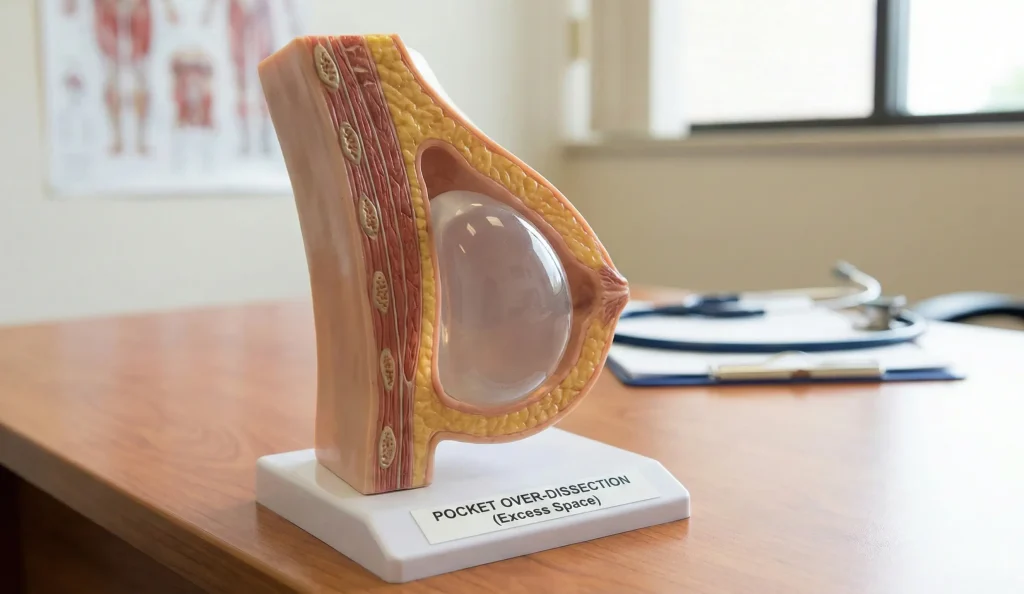
Another complaint that is made quite frequently is the lateral displacement, where the implants end up going outward toward the armpits, especially when the person is lying flat on their back. The breasts do move a little bit to the side (even natural breasts fall to the side), but if there is too much displacement, then you get a wide chest that looks somewhat empty and hollow in the middle.
The cause of this lies in the “over-dissection” of the outer pocket practically and almost exclusively. In case the surgeon releases the muscle or tissue too far toward the side of the chest wall, there will be no lateral barrier to prevent the implant from sliding. Eventually, the arms’ constant movement, pushing the implants further into this space, will make the void bigger. Usually, the solution for this is to sew the outer pocket closed (capsulorrhaphy) in order to build up a new, tighter wall that will hold the implant back toward the center.
Symmastia: The “Uniboob” Effect
Out of all the types of displacement, the one that causes the most anxiety is Symmastia where the implants, instead of separating, come close to or even merge in the center which is the cleavage. As a result, the “uniboob” effect is achieved where the skin lifts off from the breastbone (sternum) and you get this web of floating skin rather than two distinct breasts.
This is a surgical mistake and it is caused by the pocket being cut too close to the midline. The sternum skin area is naturally tight and stuck to the bone; therefore, if the surgeon detaches this bond to make cleavage, he/she will have lost the structural anchor. Once the implants come together after the center connection has been broken, the doctor repairing symmastia will be faced with the complexity of the case because he/she will need to use special internal sutures to re-attach the skin to the breastbone and create the pockets separately again.
Preventing Shifts in Turkey
You want to have your breast surgery in Turkey at Lin Europe Clinic because we focus on the strength of the structure rather than on the size being huge. The prevention of displacement starts right from the moment a patient is taken into the operating room. Our surgeons do not take their “pocket control” varying the width of the pocket to the implant very lightly – they leave no chance for uncertainty by strictly matching the implant space to the implant size, with no margin for error. Implant surface types that emit heavy friction and textured ones or polyurethane are used by us with patients who are weak tissue-wise to help the implant grip the chest wall and resist sliding.
On the other hand, we also give high importance to the post-op compression bra. Within the first 6 weeks, your body naturally develops a capsule around the implant. This capsule is what eventually keeps the implant firmly in/out of place. If you overexert yourself or stop wearing the bra before the capsule hardens, the implant may slip into a wrong position, and the situation will be irreversible. We will lead you carefully through this “make or break” period so that your outcome is set in stone exactly where it is supposed to be.
Frequently Asked Questions About Displacement
It is a diagnostic test for symmastia in which you pull the skin that is between the breasts; if the skin is easily pulled from the bone like a tent, probably, the pockets have merged.
A car accident can definitely cause implant displacement especially if trauma to the seat belt or airbag is so hard that it leads to rupturing of the internal capsule or tearing of the muscle which in turn the implant migrates to a new position suddenly.
We undertake revision surgery where internal sutures are used to re-establish the inframammary fold higher up on the chest wall, a mesh support (like Galaflex) is often used as a stronger hammock.
Not at all, a displaced implant is not a medical emergency and does not release toxins, however it may lead to chronic discomfort, pain in the back, and serious aesthetic issues.
Yes, if it is within the first 6 weeks since the surgery; sleeping on your stomach directly puts pressure on the implants and can push them out of the healing pocket that is why back sleeping is mandatory.
Maxwell, G. P., & Gabriel, A. (2014). Biofilms and breast implant contracture: Was the era of texture a mistake? Aesthetic Surgery Journal.
Handel, N., et al. (2006). Long-term safety and efficacy of polyurethane foam-covered breast implants. Aesthetic Surgery Journal.
Spear, S. L., et al. (2003). The “dynamic” breast: The role of the pectoralis major muscle in breast augmentation. Plastic and Reconstructive Surgery.