Yes, symmastia is a rare complication.
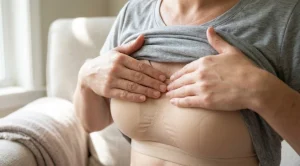
To get the perfect cleavage, one has to understand that there is a thin line between “close together” and “connected.” One of the worst things that can happen after a breast augmentation is Symmastia, which is also known by its slang terms “uniboob” or “bread-loafing.” When the skin over the breastbone (sternum) goes up, it results in the two breast pockets becoming one pocket that spans across the center of the chest. The patient, instead of having two distinct breasts with a defined valley between them, ends up with a bridge of tissue that looks like a continuous shelf.
The answer to “Is it rare?” is that yes, it is pretty rare in primary surgeries, happening in less than 1-2% of the cases when an experienced surgeon performs the operation. The chance, however, increases enormously if you use implants that are too large or wide for your chest, or if the surgeon makes an excessively aggressive incision to create tight cleavage. At Lin Europe Clinic, we always put safety first. We justify why keeping the “No-Fly Zone” on your sternum untouched is the only way to guarantee a natural, attractive outcome.
Cleavage Anatomy: The Sternum “No-Fly Zone”

Cleavage is formed by the processes and connection of the breast and the anatomy of the chest wall. Natural cleavage is not just the breasts coming in contact. It is the visual contrast created by the contours of the breast and the flat, tightly pressed skin of the sternum. The skin on your chest in the center is naturally firmly attached to the bone.
To open more space for implants, surgeons have to cut the skin and muscles. But cutting right on the midline of the chest is the last thing a surgeon would want to do. The midline of the chest has been called the “No-Fly Zone” in the operating room. We could create a pocket for the implant, but we have to stop the new pocket from going all the way to the midline. If the tissues are cut right to the center in an attempt to make the breasts touch hard, the skin is separated from the bone. After that first step is done and the implant pockets merge, the implants will slide to the midline as if there was no barrier in between them, lifting the skin to make a tent.
Shortcomings of Using Too Large Implants
One of the most common and at the same time a totally preventable cause of symmastia is the choice of implant width. Each woman has what is called a Breast Base Width (BBW), which is the measurement of the natural breast footprint.
For instance, if your BBW measures 12cm and you want to get a 14cm wide implant so that your breasts look “huge”, then that extra 2cm is going to cause issues somewhere. The outer side is already limited by muscle so the implant, in most cases, ends up pushing against the center of the chest, breaking down the tissue barrier slowly but surely. The best guarantee of a uniboob-free future is to pick an implant within your natural size range. A good surgeon will save you the trouble by saying “no” when the size might create a problem at the midline.
Types of Symmastia
It is very important that you recognize the difference between the two types of symmastia:
- Congenital (Born with it): Some women have a fence of connective tissue linking the two breast mounds at birth. This a rare developmental abnormality and it has nothing to do with surgery.
- Iatrogenic (Surgically caused): This is the “uniboob” after breast augmentation. When the implant pockets are dissected too closely together (over-dissection) or a large implant creates pressure that wears down the dividing tissue over time, “uniboob” results. (Augmentation causing uniboob = Iatrogenic).
It is Better to Prevent than to Cure

Unboob repair is a very complicated procedure which is why you should try to prevent it from happening in the first place. When the skin has been lifted from the bone that it is normally attached to, re-attaching the skin back to the bone is very difficult, especially when the implants are constantly pressing on that area.
The capsulorrhaphy revision consists of a series of steps, such as removing the implants, healing the tissue for a certain period (sometimes for months), and finally performing a Capsulorrhaphy which involves internal sutures to sew the pocket closed in the center, re-anchoring the skin to the breastbone. Switching to a smaller and textured implant may be necessary to reduce the pressure on the repair. The difficulty of this procedure is the main reason why the initial pocket creation is so important.
Is It a Swelling or Symmastia?
Don’t become frazzled when your cleavage seems to have swelled up after the surgery. During the first several weeks, there might be an accumulation of post-operative fluid (edema) in the center of the chest area, thus, the skin is raised and the breasts look like they are touching each other. This condition is called “False Symmastia”.
After the swelling goes down (which normally takes 4 to 6 weeks), the skin should come back down to the sternum thus the separation between the breasts should become clear. Real symmastia is when the both implants are actually touching each other. You can test for symmastia by pressing the skin between your breasts flat against your bone. If it feels like a trampoline and you can sense fluid or an implant underneath, then you should have it checked by a doctor.
Breast Surgery in Turkey
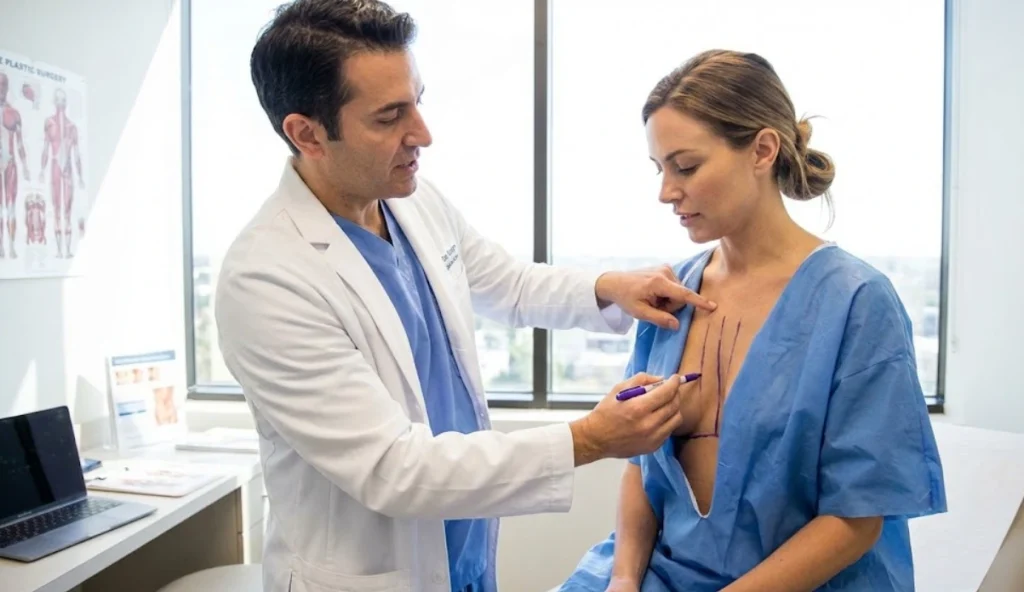
Choosing Lin Europe Clinic for your breast surgery in Turkey is a perfect decision because we use precise preoperative measurements to follow your natural anatomy. The surgeons at our Istanbul branch use the “High Five” dissection techniques—this means that there is always a safe distance between the implant pockets. We use 3D simulation to give you an exact picture of why a certain size may be unsuitable for your frame.
Your whole time in Istanbul is all about safety and longevity. If you already have symmastia and want to get it fixed, our surgeons have the right skills and experience to perform reconstructive surgery. We are very truthful in sizing counseling so that you can have your breasts full, feminine, but definitely separate.
Frequently Asked Questions About Symmastia
Basically, at the very early stages (during recovery), using a special compression bra with a “sternal thong” (a pad that presses on the center chest) can aid the skin in sticking back down. Nevertheless, already set symmastia can only be fixed by surgery.
If you sleep on your side too soon after surgery, your breasts might be pushed together, which can put stress on internal sutures. This is one of the reasons why we advise sleeping on your back during the first 4 to 6 weeks.
It is not a condition that can kill you, but it is a disfigurement and can cause discomfort. The area of the chest that is constantly rubbing can become irritated.
Absolutely. You can have narrow cleavage (breasts touching when wearing a bra) without reconnecting the pockets surgically. The idea is “touching with a bra, separate without a bra.”
Generally, yes. An implant is put under the muscle which gives an extra layer of separation (muscle attachment) that helps keep the pockets separate, therefore, symmastia is less probable than subglandular (over the muscle) placement.
Spear, S. L., et al. (2008). The correction of symmastia. Plastic and Reconstructive Surgery.
McKissock, P. K. (2002). Symmastia: The uniboob. Aesthetic Surgery Journal.
Wong, C. H., & Samuel, M. (2008). The management of symmastia. Clinics in Plastic Surgery.