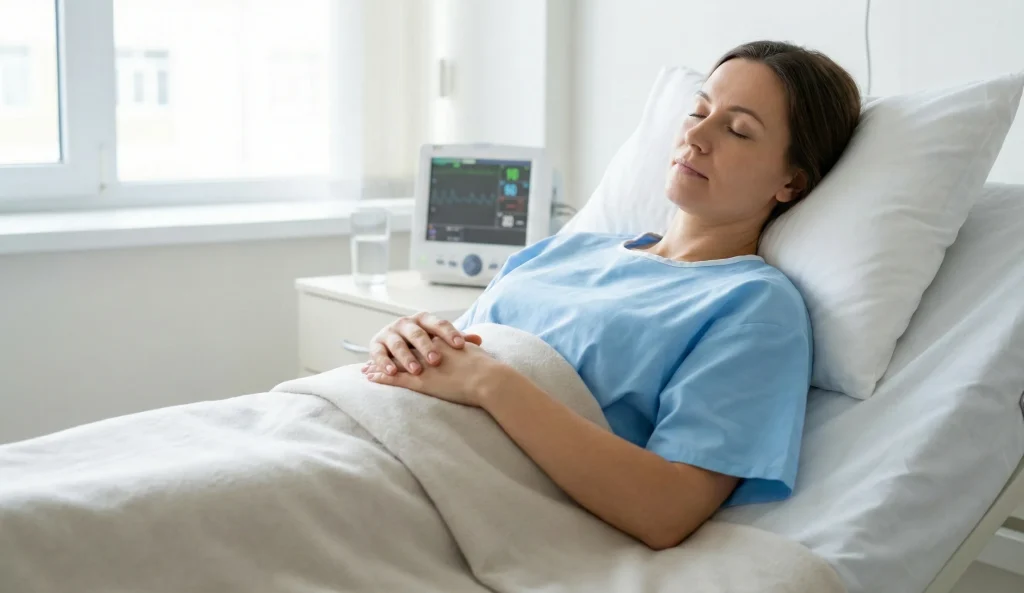
Typically, you need 1-2 days of bed rest after a boob job.
Many people associate recovery from breast augmentation with long days lying in bed doing nothing. However, the reality nowadays is quite different. Resting is one of the healing factors, of course, but it is almost never the case that complete bed rest is required or advised after the first few hours following the operation. At Lin Europe Clinic, we observe rapid healing principles that exclude immobility and encourage gentle movement. We prepare your aftercare program so that you get the optimum balance between rest and activity, thereby reducing the risk of complications due to overrest.
The meaning of bed rest has considerably changed in the field of plastic surgery. Medical practitioners are an almost unanimous voice in promoting the idea of patients engaging in light walking right after regaining consciousness. This change is supported by clinical studies indicating that good circulation is indispensable for tissue repair and complication prevention. You will be allowed to lie down and rest, no doubt about it, but you are not going to be stuck in your bed for a long time. We at Lin Europe Clinic explain what the term “rest” really implies when combined with breast augmentation and help you make a realistic schedule for your return to normal life.
The First 24 to 48 Hours: Maximum Rest Is Essential

The two days after your breast augmentation surgery are basically the time when you focus on resting the most. Elevated rest is your body’s natural response to surgery and during those two days it is busy getting rid of anesthesia and starting the healing of the incisions. Most patients will experience tiredness and may have a feeling of tightness and soreness in the chest area. We recommend that the patient be in a comfortable, preferably slightly raised, position most of the time. Staying still here means not going out and not making any heavy physical exertion although it does not necessarily equate to staying in bed all the time.
Besides, you should be going on short walks in your room once every two hours while you are awake. There are many benefits to this kind of activity as it increases the amount of oxygen in your tissues and also helps prevent blood clots from forming. To be able to prepare your meal and get up from a chair you will probably require help so as to avoid strain on the chest muscles. In other words, the main thing to remember is that you save your strength through minimal physical activity and at the same time you keep the blood flowing.
Why Celebrate Mobility After Surgery?
The practice of prescribing bed rest to patients after breast augmentation falls into disuse because it is associated with several health hazards. Immobility increases the risk of Deep Vein Thrombosis (DVT) – blood clots in the legs as a result of the veins not being used. If by any chance clot(s) get dislodged and go all the way to the lung, it may result in life-threatening conditions.
Another argument against staying in bed is that it contributes to the development of stiffness and muscle pain. Your back and hips will most probably complain if you lie down too much. On the other hand, going for a walk elevate muscle tone and help the mind stay fresh. Lin Europe Clinic practitioners use the word “rest” to mean refraining from heavy tasks and vigorous exercises rather than total ban on walking.
Best Positions for Sleeping and Resting

The quality of rest you get may determine your level of recovery benefits. For the first several weeks post-breast augmentation, back-sleeping with your upper body elevated (about 30 – 45 degrees) is the only option. This sleeping arrangement accomplishes two things at once: swelling in the area will be less thanks to gravity facilitating the drainage of the excess fluid and the tension on the healing incisions is minimal. If the implants are displaced or bleeding, it is too early to be sleeping flat or on the side.
Using a recliner or wedge pillow in bed is probably the most straightforward method of maintaining your upper body elevated. Apart from the comfort factor, this posture will hardly let you turn onto your stomach while sleeping. Furthermore, day-time elevation is a must besides sleeping with the head elevated. When you are in an optimal position, the fluid drains away faster and the implants get settled naturally. By attending to posture alone, you are already contributing to the appearance of your breasts.
When Can I Return to Work and Other Daily Activities?
On an average, 3-5 days post-surgery, the majority of women are capable of doing low-key activities that require very little movement and physical effort. Activities such as working on the computer, reading a book, etc. will be part of this category. At this stage, you are expected to be self-reliant and independent in personal care routines without anyone hovering over you to help. Around this time, the initial post-surgery exhaustion goes away and it is then that a mild pain leftover is easily controlled by medication. Transitioning from recovery mode to being cautious is what basically happens here.
As long as you are still taking painkillers, you should not be driving. It is only after pain-free free motion of the arms is attained that one can safely get behind the wheel. Usually, it takes five to seven days for the pain to wear off and for the muscles to loosen. Time for returning to work will be longer if your work entails heavy lifting. In such a case, you would need at least two to three weeks off work. For office workers, resuming work one week after surgery is considered normal. You keep on enjoying your life by the rules of your body, i.e. you may take a rest when you feel tired, but you have already landed at the end of the road “bed rest.”
When Can I Start Working Out Again?

Once the basics have been discussed, you are probably wondering when you will be able to go back to the gym. The answer to that is not simple because it depends on the kind of workouts you have in mind. An important issue for the doctor is the protection of your internal sutures and the maintenance of implant position. With daily walking, you can increase the distance and speed as your body adjusts. But the point about any high-impact activities, running, or bouncing is that it is something that you must strictly avoid for the first 4 to 6 weeks. What happens is that the breast requires stability for it to form a capsule around the implant, and too much motion counteracts this.
You will be able to engage in upper-body strength training the least amount of time after surgery. If you perform the movements involving pectorals too soon, you may displace the implant laterally or upward, especially when the implant is placed submuscular. Generally, after the fourth week, patients are allowed to exercise their lower body, as long as they avoid jumping and bouncing. By six to eight weeks, you can resume all activities including push-ups and heavy lifting. This patience yields a positive result not only in terms of what is visible but also lasts unfold over time.
Breast Augmentation in Turkey
Doing your breast augmentation surgery in Turkey means that you get not only a brilliant outcome but also a recovery process that hardly feels like one at all. Lin Europe Clinic in Istanbul goes beyond the traditional post-operative period by delivering the highest standards of clinical care coupled with hospitality at its best. We know that the environment has a significant impact on one’s healing process. Away from the usual pressures of life, Istanbul presents a calm and lovely environment, perfect for you to fully concentrate on yourself.
At Lin Europe Clinic, we take care of your recovery at every step. From VIP transportation to your hotel, to thorough follow-ups that ensure you are ready for the journey back home, we are with you all the way. Our “all under one roof” principle means that if you need a surgeon, a nurse, or just some general medical advice, someone is always available to help you. You not only come back home with a new, beautiful body but also with the feeling of having been cared for at a seamless, highly professional level that sets the global standard.
Frequently Asked Questions About Breast Augmentation Recovery
You should be in bed for 24 hours only and during these hours you can get up for bathroom breaks and short walks. After the first day, the doctors will advise against strict bed rest and encourage light movement instead.
Definitely not! You need to keep your back on the bed for at least 4 to 6 weeks. Your body can dislocate the implants and your incisions can be hurt, if you sleep on your side too soon.
You must wear a support bra all the time, day and night, for at least six weeks. Most of the time, you can sleep without a bra after the breast augmentation procedure once your implants have settled.
Generally, you only need very strict bed rest for 24 hours following the operation. Later, short walks will do your blood circulation more good than continuing to lie in bed for a long time.
For the first six weeks, you should always sleep with your head raised to minimize swelling. Your plastic surgeon will advise you when it is safe to sleep flat on your back after breast surgery.
Adams, W. P. (2018). The Process of Breast Augmentation: Four Phases of Care. Thieme Medical Publishers.
Baxter, R. A. (2019). Evidence-based medicine: Breast augmentation. Plastic and Reconstructive Surgery, 144(6), 1073e-1087e.
Caplin, D. A. (2021). Enhanced Recovery After Surgery (ERAS) protocols in cosmetic breast surgery. Aesthetic Surgery Journal, 41(3), 321-329.
Tebbetts, J. B. (2006). Run-of-the-mill recovery or re-engineering the process? Plastic and Reconstructive Surgery, 117(7), 2450-2453.
Wan, D., & Rohrich, R. J. (2018). Modern primary breast augmentation: Best recommendations for patient survival. Plastic and Reconstructive Surgery, 142(6), 933e-946e.