No, otoplasty changes shape, not size.
Relational Proportions vs. Actual Cartilage Dimensions
Mastery of facial geometry is a basic understanding that will help one to manage one’s expectations as a result of the architectural design of the human face. One of the most important questions that a patient might ask while getting the results of otoplasty (ear pinning or reshaping) is, “Will this operation change the size of my ears?” To be precise clinically, an otoplasty is not a size-change surgery. It is a surgical procedure that changes the shape and position of the ears.
The most prominent ears are the ones that come out and are either flat or have a helical fold and large central concha cartilage. Folding the ear back towards the skull by means of an operation results in a drastic reduction of the extent of the ears, which would no longer stick out. Such structural alteration changes the face’s ear proportion visually. Since you do not get stared down when the ears do not stick out too much or frame so widely, your ears will look much smaller and more balanced instantaneously, although the physical size remains unchanged.
Surgical Modifications That Actually Reduce Ear Volume
However, a standard pinning procedure changes the position rather than the size. So, you can integrate a few advanced surgical techniques into your otoplasty as well. Here are some possibilities:
- Conchal Bowl Reduction (Removal): One of the main causes of protruding ears is an extremely deep and enlarged central cartilage cup (the conchal bowl). The surgeon is able to surgically remove a crescent-shaped piece of this deep cartilage; through this surgical procedure, you are actually physically reducing the deep volume and depth of the ear chamber.
- Macrotia Surgery (Ear reduction): For an absolute macrotia when the entire upper third of the ear is physically too large, the surgeon has to carry out a specialized ear reduction. The procedure involves removing a wedge of cartilage and skin from the upper scapha and rim, which will physically reduce the ear’s height and width.
- Earlobe (Lobule) Contouring: A big and sagging earlobe can cause the entire ear to look drawn out. The surgical team can easily perform an earlobe reduction during otoplasty to remove the excess soft tissue, and you will get a better facial contour of the lower part.
Preserving Postoperative Kinetics, Supporting Tissue Settlement
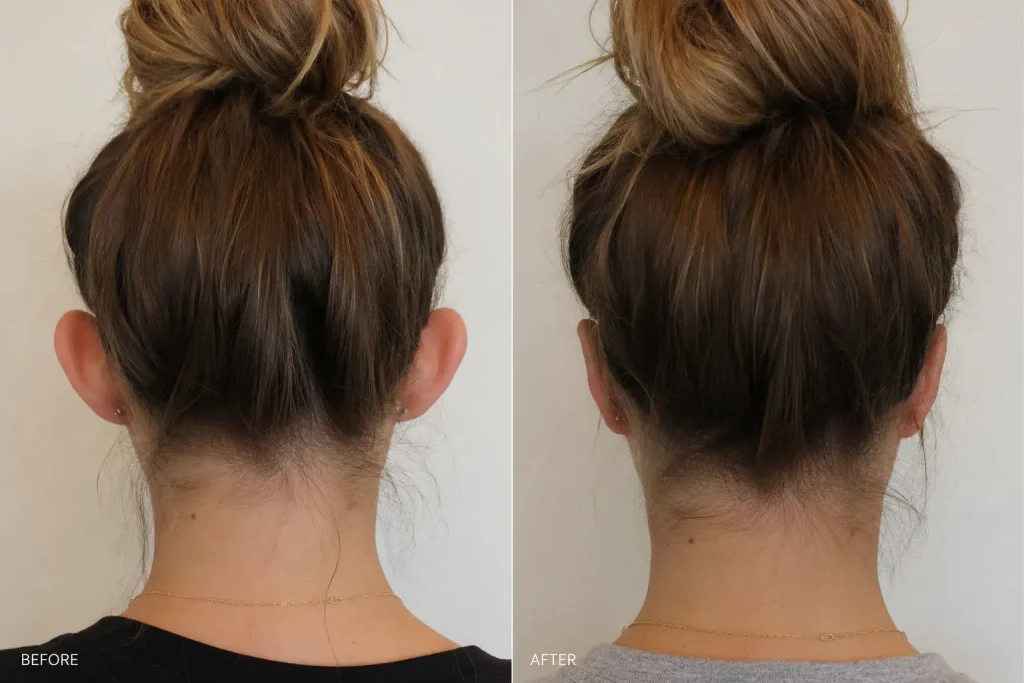
It is very important for one to strictly follow the rules of postoperative conduct, especially for one whose looks are important and one aims for a perfect outcome without compromising their health. After the procedure is done, your ears are only kept in their new position, low-profile, by means of permanent internal sutures (e.g., Mustarde or Furnas stitches) while the cartilage is being remodelled at the cellular level. So that your new-look will stay the way it is, perfectly aligned and symmetrical, healing is very important for you to wear your tailored compression band during the very first seven days, as you need to wear it strictly every night for three to four further weeks.
This protective layer will help prevent accidental bending or folding forward against the sheets during deep sleep. As regards your smoking habits, it is a matter of complete agreement that you have to stop all cigarettes and tobacco products. The main effect of nicotine is to vasoconstrict, and as a consequence of its action, the blood vessels are constricted, and the thin flap of your ears is cut off from its main blood supply – the oxygenated blood.
Framing the Recovery Period Based on Changes in Shape vs.Size
Knowledge of cartilage relaxation will help people to track their facial changes very clearly when the post-surgery early swelling is gone out:
| Recovery Milestone | External Presentation | Underlying Biological Activity |
| Week 1 | Ears appear highly swollen, dark, and tightly pinned | Acute inflammatory phase; tissue fluid buildup can make ears look artificially thick. |
| Weeks 2–4 | Edema drains; lines begin to sharpen | The ears look slightly “over-corrected” or too flat against the head as early skin contraction peaks. |
| Months 2–3 | Cartilage memory softens; structural settlement | Internal sutures integrate fully; ears experience a natural 1–2 mm relaxation forward into a neutral state. |
| Month 6+ | Definitive, balanced facial frame | Swelling is 100% gone; final cartilage proportions and thin posterior scars completely stabilize. |
Otoplasty in Turkey
Lin Europe Clinic is a top-class destination where you can be assured of getting thorough clinical work and compassionate handling of the matter. We acknowledge that it takes a rare level of medical sophistication, openness, and a high degree of emotional support to get expert medical care through the precise recovery phases and protective measures following a complicated otoplsty. We are fully committed to using up-to-date evidence of medical practice. Our five-star resort hotel, which houses LIN Europe Clinic in the heart of Istanbul, has long been a world-renowned center for plastic post-operative care and face contour surgery at an international level in Turkey. We provide a peaceful environment in which health guidance is always followed to international standards of patient safety by the highest-level medical personnel.
Our highly experienced team at LIN Europe Clinic will closely monitor your body dimensions after major surgery, and the post-operative guidance and healing plans will be tailored to your preferences and circumstances through an expert evaluation of your body, using state-of-the-art medical equipment. The medical team is the reason why you can trust us to deliver your transformation and health care at the same level of professionalism as your dream silhouette. We can be your guide on the way to perfecting and maintaining your body figure with peace of mind, and we can also help you find happiness in your body shape change as our highly skilled specialists in the field of beauty surgery at LIN Europe Clinic will deliver it through a great degree of care, with high-tech and up to the very recent surgical technology. It is not difficult to recognize whom to put your faith in and in what company to go on an adventure, with an exclusive medical team behind and at your feet. Experience LIN Europe Clinic’s high-end level of service and achieve your ideal shape that will remain perfectly in your mind through this great journey, all done with the best safety procedures that are being performed in the heart of Turkey.
FAQ:
A normal otoplasty simply alters the position and the angle of your ears making them appear smaller through positioning closer on the head. However, they won’t change the actual size.
Of course. If your ears are very big (macrotia), your plastic surgeon may perform some procedures along with a pinning surgery such as a cartilage reduction or earlobe trim to physically reduce the ears’ height and width.
Your ears are going through a phase of healing where local swellings and retention of fluids from the surgical damage that took place during surgery will leave them looking very thick and bulky over a week. This fluid accumulation is merely a temporary phenomenon.
There actually is a great possibility of the cartilage relapsing if you stop wearing you headband. The headband prevents the internal sutures from snapping before that the cartilage forms its own strong scar tissues through the healing process.
Yes. From the moment when your ears finish their 3-month settling phase and the internal tissues get matured completely, the corrected posture of the ears and the freshly balanced proportions of your face are entirely permanent.
Mustarde, J. C. (1963). The correction of prominent ears using internal mattress sutures: Analyzing structural stability and cartilage memory. Plastic and Reconstructive Surgery, 32(6), 637-643.
Furnas, D. W. (1968). Correction of prominent ears by conchal-mastoid sutures: Evaluating mechanical tension vectors and long-term tissue adherence limits. Clinics in Plastic Surgery, 5(3), 181-192.
Rohrich, R. J., et al. (2014). Advanced postoperative care, nighttime headband garment protocols, and structural stability in secondary facial contouring. Aesthetic Surgery Journal, 34(5), 587-595.