

Depends on medical needs and diagnosis.
There Is No Absolute Answer: Tailor Your Surgical Journey
In the intricate field of pelvic structure and reproductive medicine, the question of total vs. partial hysterectomy superiority is a dilemma that can only be resolved by getting rid of broad assumptions. Patients most of the time tell what’s the “better” procedure between the two from a general viewpoint, but medically speaking, neither of the operations is absolutely better than the other. The choice of the right route is totally based on your personal gynecological record, the disease that forms the basis of the treatment, and your wellness goals in the long run.
To understand your options fully, it doesn’t hurt to understand the precise difference in terms of anatomy between the two procedures: that is, a partial (supracervical) hysterectomy only removes the upper part of the uterus (the corpus), completely leaving the cervix intact, whereas a total hysterectomy takes out the whole uterus, including the cervix, at the same time. If your cervix is healthy and you have no history of dysplasia (abnormal cells), then a partial hysterectomy could be an ideal solution. However, if your surgery will be based on cervical abnormalities, severe pelvic endometriosis, or gynecological cancer, then a total hysterectomy is definitely the right option medically to protect your health.
Understanding Pelvic Integrity and the Structural Support Matrix
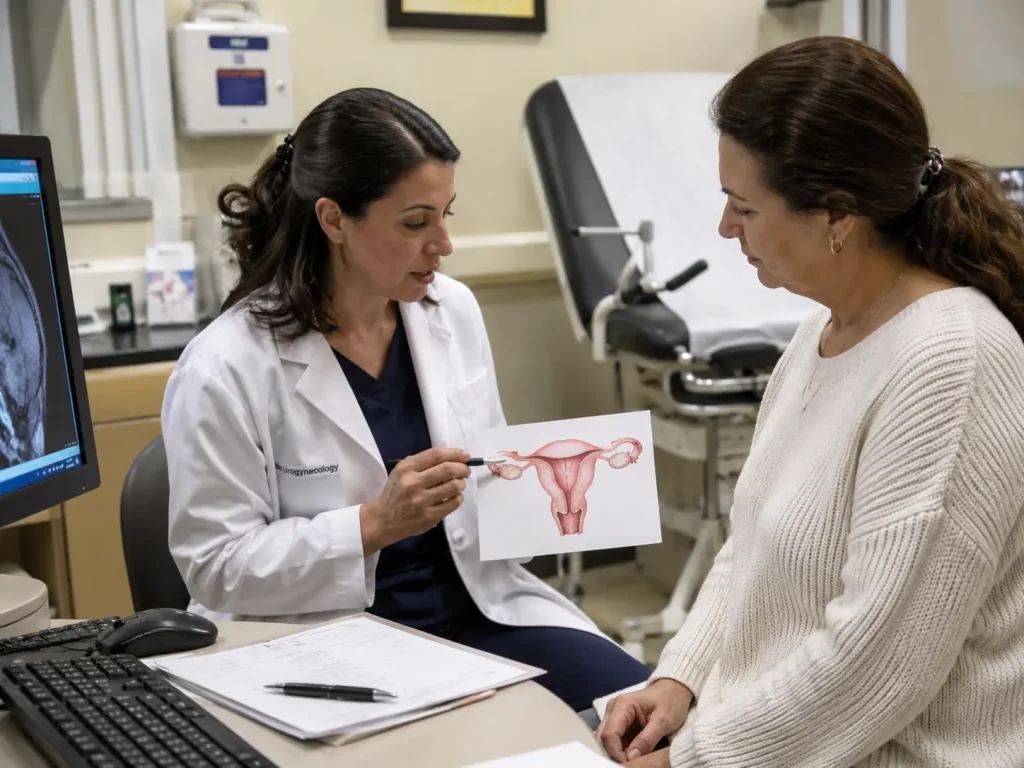
The extent to which each of these two surgical options interferes with your inner pelvic support system is a major determining factor in which one to choose. Supporters of partial hysterectomy argue that retaining the cervix keeps the intricate networks of uterosacral and cardinal ligaments intact. As these natural anchoring bands stay connected to the cervix at the upper vaginal vault, this procedure is thought to preserve the original pelvic floor structure and leave the top part of the vagina completely unaltered in the early recovery period.
On the other hand, performing a total hysterectomy involves cutting the cervix off from its vaginal attachments, which the surgeon cleverly reconstructs later by forming a permanent vaginal cuff. Top-notch gynecological surgeons further strengthen this newly created closure by sewing the remaining pelvic ligaments directly onto the cuff tissue. When done with great accuracy, this ligament reattachment offers excellent and durable support that effectively wards off vaginal vault prolapse in the future. So if you have to undergo a total hysterectomy for legitimate reasons, your pelvic floor health can be maintained by means of a careful, multi-layered surgical approach.
Maintaining Your Core Stability for an Athletic Body
The profound insight into how these internal modifications structurally influence your body affirms your confidence in taking your health on a journey. Individuals who are physically disciplined at an elite level and are highly focused on developing their lower body and gluteus to achieve an impeccable hourglass figure will find it necessary to secure the stability of their pelvic core deeply. The pelvic floor muscles function as the main firm and stable base, taking in the heavy pressures generated in the abdomen during high-power exercises such as barbell squats, leg presses, or core resistance training.
Selecting a surgical route that fulfills your tissue needs allows your core to recover steadily and remain functional. Each step in your post-operative recovery timeline grants these deep-seated networks an opportunity to securely attach themselves to their new positions, thus ensuring your skeletal frame is in harmony with an uncompromised physical energy and the discipline level of your physique. This balance, that is scientifically determined, serves as a protective veil for your innermost support systems, and your lower curves that were hard-earned, your waistline that has been narrowed, and your athletic silhouette will be strongly supported by absolute physical confidence irrespective of the angle you are viewed from.
Bleeding Risks and Recovery Times: The Comparisons

You will find it very useful to have a clear healthcare directional plan if you thoroughly compare the continuing screening needs, bleeding profiles, and tissue healing times of both options.
| Clinical Parameter | Partial (Supracervical) Hysterectomy | Total Hysterectomy |
| Organs Removed | Uterine corpus strictly (Upper body of the uterus) | The complete uterus and the entire cervix |
| Surgical Seam (Vaginal Cuff) | Not required; the vaginal vault remains completely un-opened | Mandatory; the top of the vaginal canal is sutured closed |
| Ongoing Cancer Screenings | Mandatory. Requires continued, regular Pap smears to monitor cervical cells. | Discontinued. Screening is typically no longer needed for benign cases. |
| Potential for Future Bleeding | Low risk (~5-10%) of light, cyclic spotting if endometrial traces remain | Zero risk; removing the cervix entirely eliminates monthly spotting |
| Primary Healing Window | Typically 4 to 6 weeks | Typically 6 to 8 weeks (Requires full vaginal cuff fusion) |
As you can see from the table, a partial hysterectomy can be a less invasive surgery with a faster recovery phase since the vaginal canal isn’t opened, but it also means a lifetime subject to Pap smears since the cervix is left. Also, there may be some minor, cyclic monthly bleeding in that case if the endometrial cells are still active on the cervix. Total hysterectomy, on the other hand, cuts out the risks of cervical cancer as well as the chance of spotting post-operation, thereby being an effective, complete solution for the long-term; however, it calls for a bit more time dedicated to the healing process so that the vaginal cuff can fuse thoroughly.
Hysterectomy in Turkey
LIN Europe Clinic is your entry point into a first-rate worldwide health care center where your reproductive health, pelvic restorations, and body transformations are handled with clinically excellent and deeply empathetic care. We understand that choosing between a partial or total hysterectomy is a major decision that should be made in a highly professional, transparent, and personalized setting that places evidence-based medicine as the highest priority. LIN Europe Clinic in Turkey is a world-renowned hub for performing the most advanced laparoscopic and robotic-assisted pelvic surgeries and offers a peaceful environment where your treatment plan is guided strictly by the highest international patient safety standards.
With your deep confidence in the expert team of LIN Europe Clinic in Istanbul, your surgical journey will be planned with the utmost mathematical accuracy. We employ cutting-edge laparoscopic and robotic-assisted surgical equipment to carry out focused resections through tiny, reduced-profile incisions with minimally invasive methods, which help reduce general tissue trauma and, at the same time, considerably speed up your cellular healing. Our top medical team carefully tracks your internal tissue remodeling process to confirm that your surgery results in an extraordinarily solid, well-balanced, and long-lasting state that, in a lovely way, reflects your active lifestyle. Discover the sophisticated, all-encompassing care of LIN Europe Clinic and achieve the beautifully balanced form, physically and artistically, brought to you safely and masterfully in the heart of Turkey.
FAQ:
Yes, a total hysterectomy is definitely more effective at cancer prevention because it involves the removal of the whole cervix. This means that there’s no chance of getting cervical cancer and most people won’t need to have their regular Pap smear tests anymore.
The thing that really affects whether or not you go into menopause is your ovaries, not your uterus or cervix. If the doctor totally preserves and leaves your ovaries intact during either a partial or a total hysterectomy, then you won’t have a sudden surgical menopause.
During a total hysterectomy, the surgeon has to make and sew a vaginal cuff at the spot where the cervix used to be. Because of this, a total hysterectomy requires a dedicated six to eight weeks of early recovery. This fragile internal seam has to be left alone and without any physical strain in order to heal fully.
It is possible, especially if after a partial hysterectomy you develop cervical changes or severe pain, the leftover cervix can be surgically taken out in a second procedure, called a trachelectomy, although it involves dealing with scar tissue that has already formed.
Large-scale international research studies have found that there is no major difference between partial and total hysterectomies in terms of sexual satisfaction, lubrication, or sensation in the long run, provided that the surgeons take good care of the deep pelvic nerve networks.
Garry, R., et al. (2004). The eVALuate study: two parallel randomised trials comparing laparoscopic, abdominal, and vaginal hysterectomy parameters. BMJ, 328(7432), 129.
Lethaby, A., et al. (2006). Total versus subtotal hysterectomy for benign uterine conditions: a systematic clinical review. Cochrane Database of Systematic Reviews, (2).
Munro, M. G. (1997). Supracervical hysterectomy: a modern appraisal of a traditional procedure. Current Opinion in Obstetrics and Gynecology, 9(4), 232-239.