Yes, beard hair can remain permanent.
A Genetic and Physiological Perspective on Facial Graft Survival
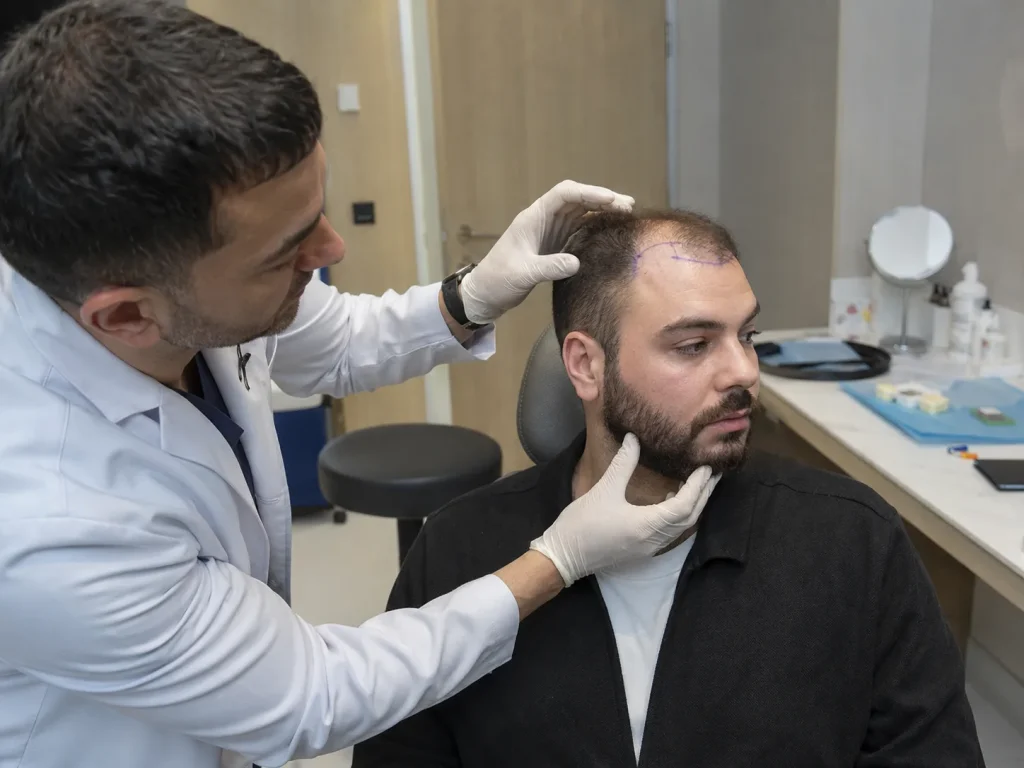
At the forefront of follicular micro-grafting and body hair transplantation (BHT), the ability to judge whether or not the hair obtained from non-scalp grafts will survive and grow in the long-run depends mainly on an understanding of trichological genetics. In cases of very severe androgenetic alopecia (male pattern baldness) when the back of the scalp is very thin, and the amount of traditional donor hair that can be obtained from that area is not sufficient, the area of the beard underneath the jawline is considered to be the most preferable alternative donor resource.
From the viewpoint of a clinical expert, beard hairs transplanted to the head stay there forever. The permanence of hair is determined by a well-established principle known as donor dominance. This principle simply states that a hair follicle preserves its natural characteristics, including genetic resistance to hormones and its hair growth traits, no matter where on the body it is moved. That is, since the beard hairs are genetically insensitive to dihydrotestosterone, the hormone mainly blamed for pattern baldness, these hairs are guaranteed to continue growing and not to thin out even after they have been transplanted to a bald scalp.
Clinico-Biological Features and Follicular Distribution Planning
The longevity of beard hair is, of course, an unquestionable medical fact, but its morphological features are such that they call for expert handling not only at the harvesting stage but also at the transplantation stage to obtain a totally natural-looking result:
- Robust in Thickness and Composed of Single-Hair Units: Beard hairs are inherently rougher, flatter, and broader than conventional hair. Moreover, beard hairs predominantly consist of units that contain only one hair each. This thick diameter provides very high density and an excellent shadowing effect; therefore, these hairs are suitable as broad filler hairs.
- Vertex and Mid-Scalp are Priorities: Due to their coarse nature, the beard hairs are mostly used in a way that hides them well. The reason is that they are not the ideal choice to create a very fine, delicate front hairline. These strong grafts are rather implanted into the crown (vertex) or the mid-scalp area to give maximum depth and natural volume behind a real or constructed hairline of the scalp.
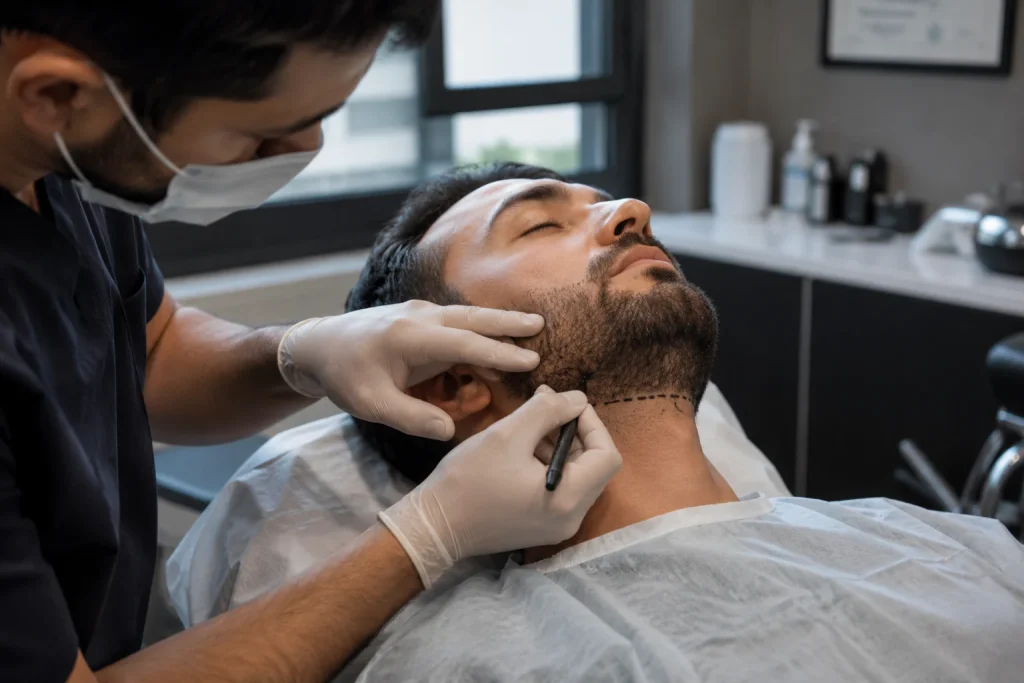
- Mechanism of FUE Extraction: State-of-the-art Follicular Unit Extraction (FUE) technology gets the job done through a very small opening (about 0.6mm in diameter) at the harvesting point. In a beard transplant, the facial donor area will typically be the region under the beard line on the jaw that’s hidden from view and is the least noticeable in a beard. Such a delicate harvesting technique allows the visible facial beard to remain untouched and intact, while obtaining the freshest and undamaged hair for the scalp.
Post-Operative Vascular Environment and Graft Survival Limits
Strict adherence to post-operative conduct guidelines is very important for the best results and especially for people who are very particular about the outcome of their hair restoration procedure. Right after an FUE hair transplant surgery, for about the first 72 hours, the newly placed facial hair follicles depend entirely on plasma for their survival. Exerting intense physical effort or taking in harmful substances in the body has severe consequences for the development of new capillaries, thereby causing an overall negative effect on the survival of transplanted grafts.
To keep a long-term, permanent look of beard grafts through maximum precision of embedding in the skin layers of the scalp, you have to completely leave the recipient scalp area untouched, and sleep with your head about a third higher than the rest of the body that is, in bed at a 30-degree angle, in order to minimize swelling and pressure, and avoid any weight-lifting for at least two weeks. In addition, it is an absolute necessity that you quit any intake of nicotine and tobacco products, the use of which is highly discouraged. Being that the consumption of nicotine can be looked upon as the act of narrowing down one’s system by making the micro-vessels contract, thus, it leads to the scalp being short of the oxygenated blood that newly rooted beard follicles need, and only through that, can carry out the life functions and survive during their early stages of incorporation inside the body.
Facial Hair Structural Growth & Integration Periods
The insight into the biological period of facial hair integration is vital for the patient to be fully informed of his restoration process with no unpleasant surprises whatsoever. It has to be understood that, unlike what most people think, the grafts of facial hair do not sprout day and night, as one might expect; they have to go through shedding and regrowth cycles of the hair, which is quite common for most. Initially, for about 10 days, the roots are secured in the tincus, and small scabs that form at sites of grafts are the result. Then, the scalp becomes inactive between weeks 2 and 6, which is a period referred to as shock loss.
Transplanted hair will completely shed during this time. Yet, this period is a biological one, and it should not be a cause of worry because the live roots are safely under the skin, waiting for the hair to regrow. After about 3 to 4 months from the surgery, new and permanently growing hairs start to emerge from the scalp. Also, since each of these hairs from the face has its own unique pattern of growth, they will keep on getting thicker but in a subtle way so that their texture gradually blends with that of your own scalp hair.
Beard Transplant in Turkey
Deciding on LIN Europe Clinic as your choice for your hair restoration journey, with you and me as patients, means getting on a premium worldwide health resort where your hair restoration, follicular micro-grafting, and complex surgical paths will be handled with complete clinical excellence and heartfelt empathy. The fact that a proper aesthetic arrangement of a successful beard-to-scalp hair transplant, including the recovery part, calls for a high level of precision, transparency, and highly personalized support has convinced us that the priority of our patient care is evidence-based medicine at all levels of our services. LIN Europe Clinic in Turkey serves as the world’s main center of innovation in body hair restoration surgeries and plastic aftercare.
In our serene setting, your recovery will be strictly guided by the best international health standards. So your recovery plans here are the same as for any of your other health care plans that you trust and carry out in your home countries. When you trust and support our experienced specialist doctors at LIN Europe Clinic in Istanbul completely, your post-treatment parameters are closely checked with absolutely medically accurate diagnostic means. We are proud to be an established leader in post-surgery guidance and after-the-fact reviews. We guide you by providing step-by-step explanations of follicular development and the healing process through detailed checklists and high-res imaging.
FAQ:
Yes, the beard hair transplanted to the scalp will be just as permanent because these hair follicles are genetically immune to DHT, which means they can live and grow for the rest of your life.
Beard hair is normally much rougher in texture and grows as individual hairs. So, our top surgeons never place it on the front hairline; they hide them in the crown and mid-scalp to enhance density with a seamless look.
No, the micro FUE punches which we use for extraction are so small that they only take hair from the hidden areas beneath chin and jawline with absolute zero leaving trace or scars.
During the first month shedding can be a temporary experience. Growth from this new hair that is permanent starts in about month 3, and maximum hair thickness and density which are the final, desirable result get achieved in time frame months 8 and 12.
Combining the hair from your regular scalp (which is used to cover the soft front hairline), together with that from your beard (which is the one filling your dense crown) is a powerful and modern strategy that is being applied today by hair transplant specialists in order to give a totally natural covering of the head from above.
Orentreich, N. (1959). Autografts in alopecias and other dermatological conditions: Establishing the foundational parameters of donor dominance. Annals of the New York Academy of Sciences, 83(3), 463-479.
Umar, S. (2016). Body hair transplantation using follicular unit extraction: Managing beard graft parameters and long-term vertex survival. Aesthetic Surgery Journal, 36(3), 289-296.
Rohrich, R. J., et al. (2014). Advanced postoperative care, systemic vasoconstriction limits, and micro-graft stability in secondary hair contouring. Aesthetic Surgery Journal, 34(5), 587-595.