Tummy tuck generally carries greater surgical risks.
Surgical Invasiveness and Systemic Impact
In the advanced discipline of body contouring plastic surgery, assessing the risk levels associated with liposuction and abdominoplasty is dependent on the degree of disruption to anatomical structures. However, the safety level of both liposuction and tummy tuck is quite high if they are done by board-certified specialists. Yet they differ greatly in relation to surgical depth, operating time, and the extent of traumatization caused to the tissues of the body. To sum up from a medical point of view, one could say without hesitation that a belly tuck is generally more risky than liposuction, as it is a much bigger, more invasive restructuring operation.
One major difference is that liposuction only opens tiny incisions of about millimeters in length to physically remove a layer of fat just below the skin, leaving practically all of the skin, muscle layers, and blood vessels untouched. On the contrary, a tummy tuck is a much bigger and lengthier surgery as it involves one big hip-to-hip incision, the physical lifting of the main skin flap, internal stitching of separated abdominal muscles, and removal of several liters of tissue. That huge surgical damage greatly increases demands on cardiovascular function and the patient’s recovery.
The Individual Risk of Tummy Tuck Surgery
Lifting skin in such a large area and reconstructing it are the main reasons why tummy tuck surgeries carry a higher risk of wound healing and circulation problems. Some of the complications that may result from tummy tuck are as follows:
- Delayed Wound Healing/Necrosis of the Skin: The big patch of skin is pulled tight and sutured low on the bikini line. If the blood supply to the margins of this skin flap is limited (due to, for example, too much tension or the use of nicotine), healing of the skin is likely to be a long process or even result in some tissues dying.
- Pulmonary Embolism and Deep Vein Thrombosis: A tummy tuck is such a big surgery, and you’re under general anesthesia for quite a long time. After surgery, because of core muscle pain, patients walk bent, and also since it is hard for them to move a lot, their level of mobility is decreased. This combination of longer surgery time and reduced movement after surgery slightly increases the chances of developing blood clots in the leg, which in turn could lead to a pulmonary embolism.
- Seroma Formation: A very large cavity is left between the abdominal musculature and the epidermis flap; hence, there is a huge chance of fluid accumulation, i.e., seroma development. Surgeons, in most instances, insert surgical drains to prevent that problem at an early stage.
Main Risks of Liposuction Surgery
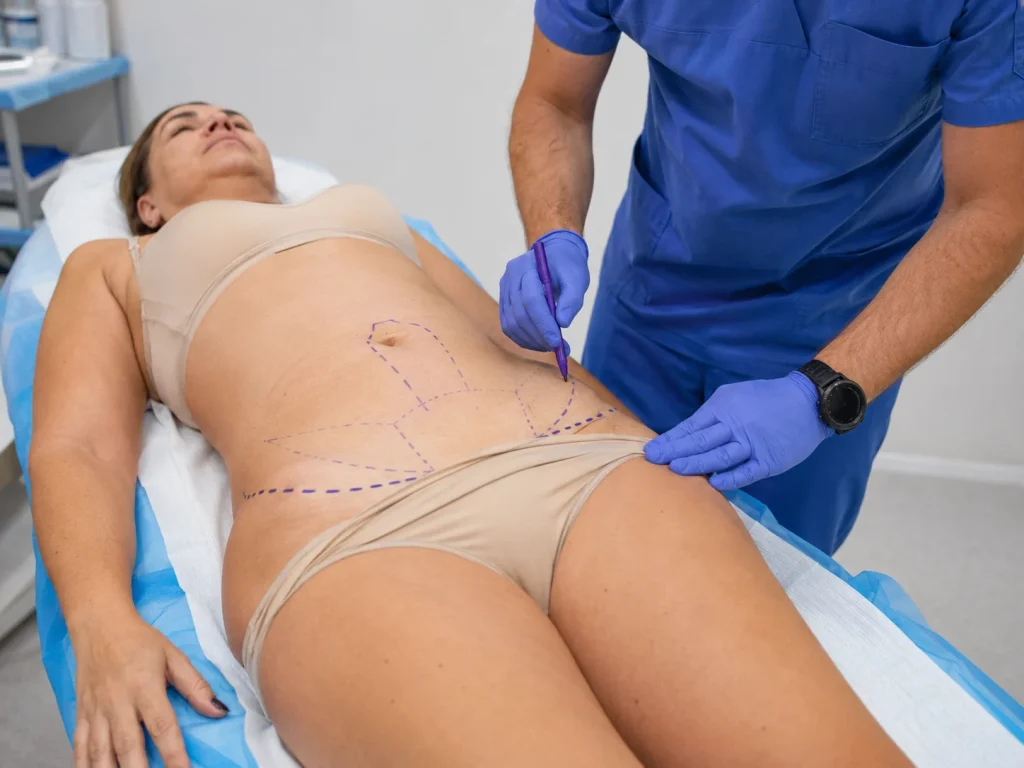
Liposuction is less invasive and requires only small incisions, yet it brings some unique physiological and cosmetic risks, in particular when massive volumes are removed, so they should not be underestimated.
- Fluid shift & Lidocaine Poisoning: The surgeon injects a lot of tumescent fluid (which mainly contains saline and lidocaine with some epinephrine) into the fat of the lipodissolve site. A patient’s large volume of fat is sucked, and the associated fluid is removed, which could lead to significant systemic fluid redistribution and needs to be monitored closely with respect to cardiovascular status during that surgical time.
- Aesthetic Surface Irregularity: The only drawback of liposuction, as far as medical conditions are concerned, is an issue of aesthetics. Uneven removal of fat may result in the formation of ripples, bumps, or wavelines on the face of the skin if combined with a poor skin tone. As such, you can get rid of your fat deposits but still be stuck with skin that appears uneven for the rest of your life without any change.
- Fat Embolism: A rare case in which some of the loosened fat gets into a ruptured blood vessel and travels through the bloodstream towards the lungs or brain. However, with modern blunt- tip cannulas, this kind of complication is so uncommon that it can be practically neglected.
Structural Integrity and Post-Operative Limitations
Strict compliance with medical rules and restrictions is absolutely essential for patients seeking the highest precision and utmost safety in their surgical changes. Both a long and deep tummy tuck incision and many small incisions and tunnels of a liposuction operation are completely healed only with mechanical immobilisation that allows new collagen and fibrin bonds to form over the healing time, especially in the first 6 to 8 weeks following the surgery.
The key part of your recovery and safety is wearing medical-grade compression clothes or an abdominal bandage, which prevents accumulation of fluids (seromas) while ensuring the tissue will heal smoothly without any gaps. Tummy tuck patients should never get straight up from bed or any chair before 1 to 2 weeks because this is a very high physical stress on skin and especially on suture lines under it. Moreover, one has to completely avoid the habit of smoking (nicotine) before and after either a liposuction or tummy tuck surgery since nicotine is a highly potent vasoconstrictor which significantly reduces the diameter of micro-vessels, thus starving the skin and muscles in the area of operation of oxygen that is crucial for prevention of necrosis and other serious complications.
Liposuction vs Tummy Tuck
Choosing LIN Europe Clinic in Turkey to be your partner in the journey from beauty to perfection is to entrust yourself to the hands of professionals who are not only technically excellent but also have that rare, compassionate side to them. Our clinic in Istanbul, Turkey, is where patients can undergo procedures like facial aesthetics, major structural body changes, and a variety of surgeries, all with one thing in mind – getting the best clinical results and having the most beautiful, safe, and peaceful experiences at the same time.
We fully understand that to create a beautiful midsection, besides a major restructuring and repair of abdominal tissues and muscles, the patient has to be very supportive and have a good atmosphere to work with. LIN Europe Clinic is designed to provide you with a very sophisticated, transparent, and strongly supportive environment, where patient safety remains the absolute highest priority through the use of science-based medicine only. With our help and your great expectations of our professional team that will never make you wait, you can trust your deep tissues to our surgeons and be absolutely assured of a secure medical procedure as well as your physical and mental well-being.
FAQ:
As a matter of fact, in most cases, a tummy tuck is a riskier procedure than liposuction. It is a more lengthy and invasive procedure requiring prolonged anesthesia, larger skin openings, muscle tightening, and this increases the chances of developing blood clots and wound healing problems.
Denticle, wavy, or asymmetric contours are the most typical result of liposuction and are considered an aesthetically related complication. Poor skin elasticity is usually involved in cases of dimpling and other abnormalities.
Fluid retention and slower wound healing along the lower section are the most frequently occurring complications of tummy tuck, which are more likely to happen in situations when the skin is pulled extremely tight, or the patient happens to smoke.
Apart from being the result of liposuction, Deep Vein Thrombosis (blood clot) is still a possibility, although it is quite low in terms of frequency. As the procedure is short and the patients can start walking immediately after their surgery, it is considered a safe procedure against clots.
By smoking, you’re doing yourself a disservice. Smoking constricts the blood vessels, thereby greatly impeding blood flow and, as a result, oxygen delivery to the large skin flap that results from a tummy tuck is also reduced. This lack of oxygen will quite often lead to the skin dying (tissue necrosis) and will be followed by a significant wound that will take several months before healing is fully achieved.
Gunter, J. P., & Rohrich, R. J. (1987). Management of abdominal wall laxity, risk mitigation in diastasis recti repair, and subcutaneous tissue sculpting. Plastic and Reconstructive Surgery, 80(2), 161-173. Toriumi, D. M. (2006). Structural body contouring: Comparing surgical invasiveness and complication rates between liposuction and excisional abdominoplasty. Facial Plastic Surgery Clinics of North America, 14(4), 289-301. Rohrich, R. J., et al. (2014). Advanced postoperative care, deep fascial tissue elevation, and cardiovascular risk mitigation protocols in body contouring. Aesthetic Surgery Journal, 34(5), 587-595.