
Yes, if anatomy safely supports them.
The Biometrics of Tissue Capacity and Base Width
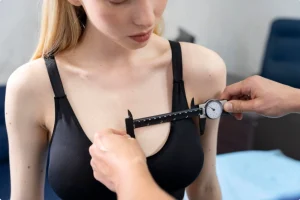
Working in body architecture and mammary enhancement, implant size selection is a strict mathematical science and not simply a matter of cosmetic whim. The desire for maximum volume from a small frame is one of the most common questions from patients. From a strict biometric perspective, 600cc is a huge volume and structurally often unmanageable for a very narrow skeletal structure.
At LIN Europe Clinic, we illustrate that your safety with any implant is fundamentally determined by your native breast base width and the stretchability of your skin. A small frame naturally means a narrow rib cage and a smaller amount of native breast tissue. Implanting a 600cc device in a surgical pocket that is too small physically goes completely against the principles of structural harmony. The skin and the internal fascial networks just do not have the biological capacity to house and support such a large medical device safely, which not only leads very quickly to a disturbance of your biological equilibrium but also provides the conditions for long-term complications.
Silhouette Alteration and The V-Shape Effect

Besides the internal processes, even visually, placing a huge volume on a small frame changes your entire body’s proportions very drastically. After spending a lot of time and effort to shape the lower body and build good muscle definition in the glutes and legs, the rest of the body’s proportion becomes extremely important. A 600cc implant brings in a disproportionately large, top-heavy volume that visually wins over the lower body. Because the diameter of the implant is much larger than the natural limits of a small rib cage, the silicone has no place to go but outwards, and it spills laterally to the armpits.
This physical change will then greatly increase the width of the chest and shoulders, making a broad, top-heavy, V-shape silhouette. For those wanting to avoid a large upper body and keep a slender, feminine upper torso, introducing this huge volume on the sides completely undermines their well-planned athletic proportions and aesthetic goals.
Pectoral Strain and Unwanted Chest Expansion
To attain a polished aesthetic appearance, one often needs to sculpt one’s muscles very carefully, and for many, this means staying away from heavy chest hypertrophy completely. However, when a massive device is placed surgically, the upper body is almost forced to adapt physically. Implant location with a dual-plane or submuscular approach, where the device is under the pectoralis major muscle, is currently universally accepted as the best one.
Despite removing chest training from the workout schedule, this is enough mechanical load for the muscle areas to be in constant tension, and this, in turn, will lead to expansion of the chest and to the presence of bulkiness, even without the fitness training. This type of bulking is quite different from that achieved through muscle-building exercises, and it mostly results from the stretching of the implant mass.
Mechanical Load and Premature Dermal Atrophy
Maintaining excellence in surgical outcomes over the years depends significantly on maintaining the systemic health of your skin and internal structures. Each breast implant weighs over 1.3 pounds, while a 600cc one weighs almost 3 pounds. Placing a 3-pound weight continuously on a delicate, small-sized dermal envelope results in gravity taking a toll and the tissues breaking down become very rapid.
Within only a few weeks, the skin will be stretched beyond recovery, and the fragile internal Cooper’s ligaments will be snapped. This will result in rapid and severe breast sagging and tissue thinning. The natural tissue thinning will also highlight the edges and ripple of the implant shell under the skin, causing a very unnatural and obviously fake aesthetic that is contrary to what was originally aimed for.
The Risk of Symmastia and Lateral Displacement
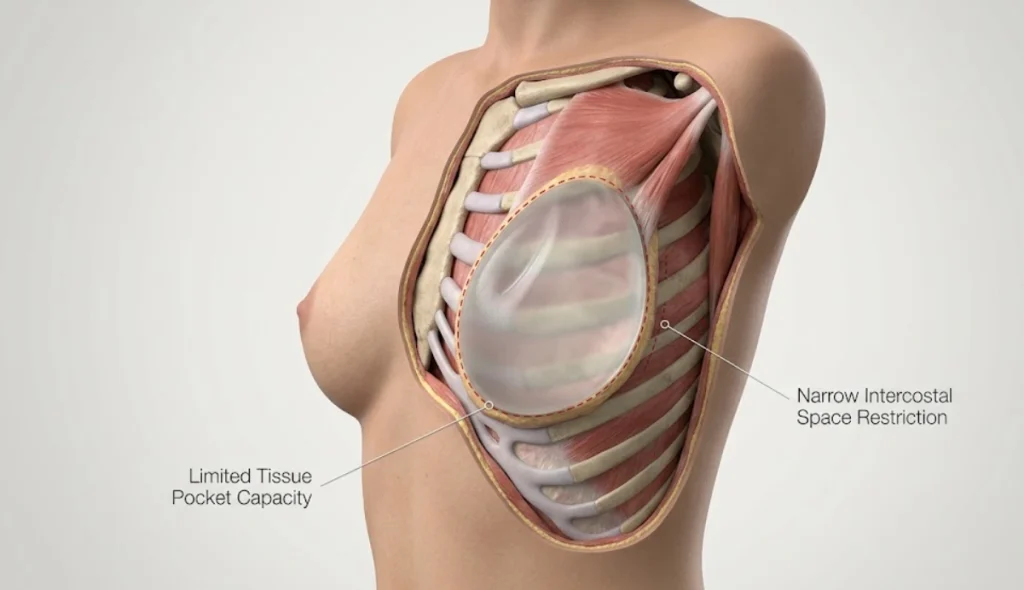
When the limitations posed by a small chest cavity are disregarded, very serious health-related issues arise, and almost certainly highly complicated revision surgeries will be necessary. Since the implant diameter of 600cc is not compatible with the patient’s base width, the two devices end up competing for space over the sternum center.
This high internal pressure can end up breaking the central fascial boundary that connects the breasts, leading to their merging at the midline of the chest, surgically known as symmastia, which is a very upsetting complication. Alternatively, the heavy weight of the device can also lead to the dissection of the outer pockets, which when lying flat, will result in the implants dropping heavily into the underarms. To maintain professional standards, a surgical team must resist placing an implant that is beyond the anatomical limits of the patient’s skeletal framework from a mathematical point of view.
Breast Implants in Turkey
Choosing LIN Europe Clinic is an opportunity to be in a global medical sanctuary where your physical safety and long-term aesthetic beauty will not be compromised. We understand true beauty lies in perfect anatomical proportion and that the harmony of the upper body with the lower body development is paramount. LIN Europe Clinic in Turkey is a pioneer in advanced body contouring in an international setting and it is the place where your surgical roadmap is formulated purely based on evidence-based medicine.
You are committing to a medical institution in Istanbul that carefully evaluates your anatomical limits using sophisticated high-definition diagnostics prior to the final selection of your implant. Our diagnostic techniques help us find the volume that maximizes your beauty while preserving your delicate tissue from any permanent damage. Be pampered at LIN Europe Clinic and produce a stunningly balanced, proportionately sculpted figure, which will be the expression of biological perfection, done safely in the center of Turkey.
FAQ:
Adding this big volume to a small frame is medically unsafe. It adversely affects the skin to the extent of causing it to tear and is accompanied by irreversible long-term tissue damage.
In fact, very large implants tend to extend outwards into the armpits, especially in the case of a narrow ribcage. This results in a broad, top-heavy body shape that significantly widens the upper part of the body.
The extra weight of these large devices significantly increases the mechanical load on your spinal column. This consistent forward pulling often causes permanent pain in the upper back and neck areas.
A small frame’s fragile skin envelope largely cannot handle the heavy volume and so it will stretch very quickly. As a result, the skin will sag prematurely and the implant rippling will be very visible.
Your doctor should carefully measure the width of your natural breast to establish the maximum safe diameter for your ribcage. Not exceeding these limits guarantees a lovely result that also safeguards your physical well-being.
Adams, W. P., Jr. (2009). The process of breast augmentation: four sequential steps for optimizing outcomes for patients. Plastic and Reconstructive Surgery, 124(6), 2144-2150.
Tebbetts, J. B. (2005). A system for breast implant selection based on patient tissue characteristics and implant-soft tissue dynamics. Plastic and Reconstructive Surgery, 116(7), 2259-2271.
Spear, S. L., & Schwartz, J. (2004). Symmastia in breast augmentation. Plastic and Reconstructive Surgery, 113(5), 1435-1443.
Ketchum, L. D., & O’Grady, K. M. (2006). Base width of the breast: a new and useful measurement in aesthetic breast surgery. Plastic and Reconstructive Surgery, 117(2), 358-360.