
Pain, asymmetry, or implant position changes.
The Biometrics of Pocket Integrity and Implant Stability
In the unique field of body sculpting and breast augmentation, the main factor contributing to the lasting effectiveness of your figure is your surgical pocket’s structural integrity. In a primary breast surgery, the plastic surgeon deliberately creates an internal cavity in the breast tissue or under the pectoral muscle. From a strictly biometric point of view, the pocket is a tool to perfectly encase the breast implant, allowing it to be held in the exact position, reminiscent of that in a young, lifted breast. Yet, the human body is a changing framework that is affected by factors such as gravity, aging, and the gradual loosening of the tissues.
With the passage of time or due to an intense physical impact, the internal walls of this operating pocket may weaken and stretch out. This gives rise to a condition where the device uses its nature of shifting from the original position (known as implant malposition or displacement). At LIN Europe Clinic, we advise that recognizing displacement symptoms is crucial. Repairing a deteriorating pocket means that the enhancement will continue to be in perfect harmony with the native anatomy, thereby restoring the pristine biological balance and preventing the physical discomfort that can arise in the long term.
Bottoming Out and Superior Displacement: Vertical Symptoms
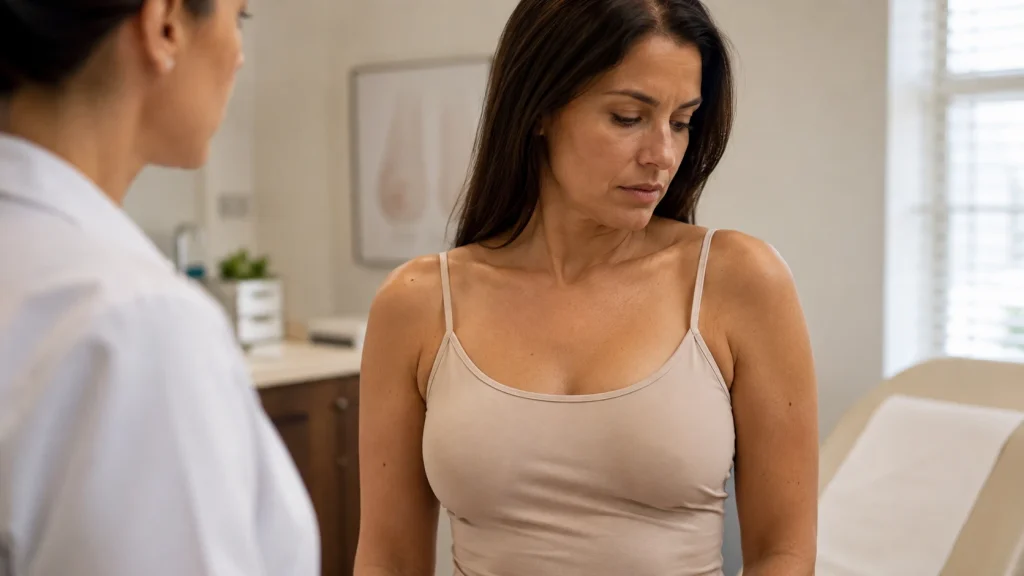
Breast implant displacement symptoms that can be seen most clearly are mostly those that take place along the vertical direction of the chest wall. Since gravity is a constant force pulling downward on the weight of the silicone or saline, the underside (lower breast fold) is the part most susceptible to stretching.
- Bottoming Out (Inferior Displacement): If the surgical pocket’s lower fold gives way, the implant will physically drop to a lower position on the chest wall. The main visual clue is a stretched, excessively full lower part of the breast. Also, the areola and nipple will be pointing upwards, whereas the implant has slipped downwards.
- High-Riding (Superior Displacement): On the other hand, the implant is not placed in the pocket after surgery, or the immune system reaction leads to the formation of a contractile fibrous capsule (capsular contracture), which pushes the implant upward. The visible sign of this is a very rigid and very full upper chest near the collarbones. Also, the nipples are directed downwards toward the floor.
Symmastia and Lateral Drift: Horizontal Symptoms
Breast implant displacement can occur in a horizontal plane as well, causing a significant change in breast width and cleavage. Such symptoms typically occur when the pocket is over-dissected during the initial surgery or when chest tissues centrally become very thin.
- Symmastia (Medial Displacement): This is a situation where the internal tissue wall dividing the two breast pockets is completely ruptured or has significantly thinned. The implants move inward towards the center of the chest and come together over the sternum. The main symptom is the disappearance of the natural cleavage valley, resulting in a continuous, “uniboob” look, which is sometimes accompanied by a tight, pulling feeling across the breastbone.
- Lateral Drift (Outer Displacement): In the event that the outer sides of the pocket get stretched, the implants move apart too much towards the armpits. A main sign of lateral drift is a very wide separation between the breasts when standing, and the feeling of the implants falling heavily into the underarms when lying back flat on your back.
Clinical Diagnosis and Restoring Structural Harmony
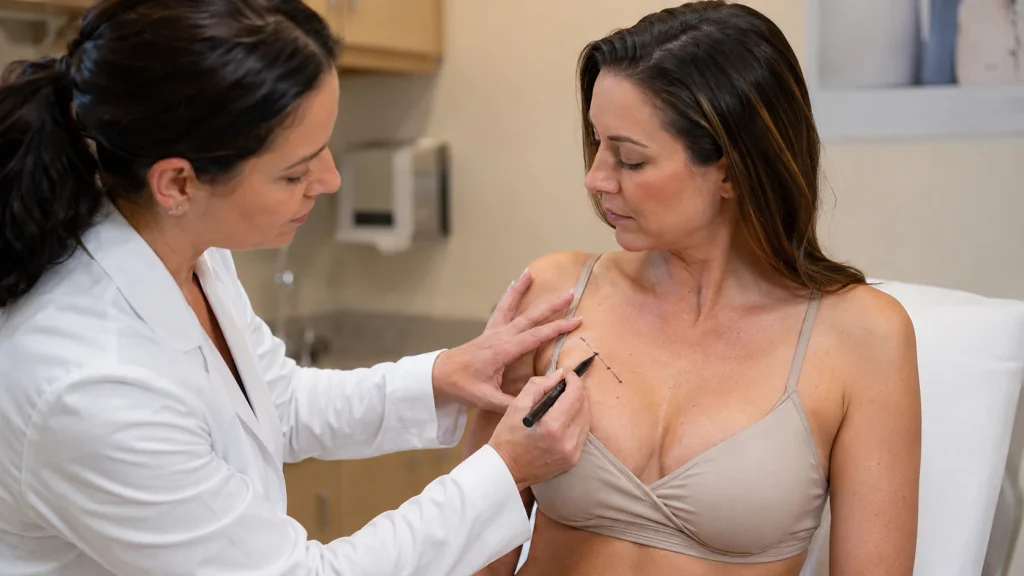
Patients going through severe displacement typically experience physical symptoms in the breast, beyond the visual symptoms. These consist of feeling the edges of the implant, a dull pain, or the sensation of the implant moving independently from the breast tissue. Such biometric changes make surgical intervention obligatory, and the condition is always treated with a surgical revision. Delivering a perfect surgical correction is not only a function of the surgeon’s skill but also of their experience and judgment.
After the incision to remove the implant, the doctor tends to the empty pocket by performing a capsulorrhaphy. This involves the use of heavy permanent medical stitches to close up and strengthen the stretched borders of the pocket. Additionally, a surgeon may be able to utilize acellular dermal matrices (sterile biological mesh) to offer long-term stability. This mesh acts like an internal support garment, structurally strengthening the impaired tissues and locking the implant back into its anatomical position, thereby immediately restoring structural harmony.
Breast Implant in Turkey
With LIN Europe Clinic, you will be in a healing sanctum of the world with a leading clinical lineage in medically complex reconstructive surgeries, including breast restoration. We understand how tough it is to undergo implant displacement, and you will need a surgical team that understands anatomy and integrates those skills with transparent, caring communication. LIN Europe Clinic in Turkey is a leader worldwide in secondary and revision breast surgeries, and so you can be sure that your problem will be solved with safety at the highest level.
Putting your trust in LIN Europe Clinic places you amongst a leading medical group that places professional rigor as the highest value. We carefully chart your revisional work map with imaging that helps us see and measure the condition of your internal tissue before we strengthen your surgical pocket. Visit us to enjoy the expert treatment of LIN Europe Clinic and to witness your beautifully balanced and structurally reinforced profile that supports your long-term systemic vitality, all safely through the heart of Turkey.
FAQ:
The clearest indication of bottoming out is when most of the implant sag down very low on your chest, thus the distance between your collarbone and your nipple becomes unusually long. Since the main volume of the implant is at the very bottom, your nipples would then seem to be pointing up very high towards the ceiling.
Sideward movement of implants occurs when the outer wall of the pocket in surgery gets loose, a change often caused by gravity, sleeping on one’s side without a supportive bra, or a pocket that was initially too large. You will mostly notice it when you lie flat on your back because the implants will clearly slide in your underarms.
No, there are no symmastia solutions with special bras or massages. It is a breakdown in the attachment of the tissue over the breastbone. A surgical repair is required to restore the internal barrier and close the pockets apart.
Indeed, it is very normal for implants to appear high and feel very tight right after a primary augmentation. Usually, it takes about three to six months for the chest muscles to loosen up and the implants to “drop and fluff” to their final, natural position.
Not really. Implant displacement or malpositioning is the failure of the surrounding tissue pocket and not the implant itself. Nevertheless, if an implant reposition is sudden and accompanied by pain or severe hardness, a high-resolution ultrasound or MRI is advised to determine the structural integrity of the shell.
Spear, S. L., & Schwartz, J. (2004). Symmastia in breast augmentation. Plastic and Reconstructive Surgery, 113(5), 1435-1443.
McGuire, P., Reisman, N. R., & Murphy, D. K. (2019). Risk Factor Analysis for Capsular Contracture, Malposition, and Late Seroma in Subjects Receiving Natrelle 410 Form-Stable Silicone Breast Implants. Plastic and Reconstructive Surgery, 143(1), 9-19.
Maxwell, G. P., & Gabriel, A. (2014). The evolution of breast implants. Plastic and Reconstructive Surgery, 134(1 Suppl), 12S-17S.
Pochat, V. D., et al. (2017). Breast implant revision surgery: incidence, indications, and surgical strategies. Aesthetic Plastic Surgery, 41(4), 817-824.