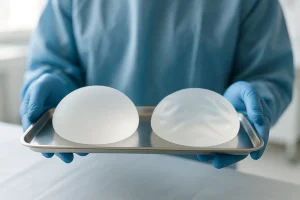
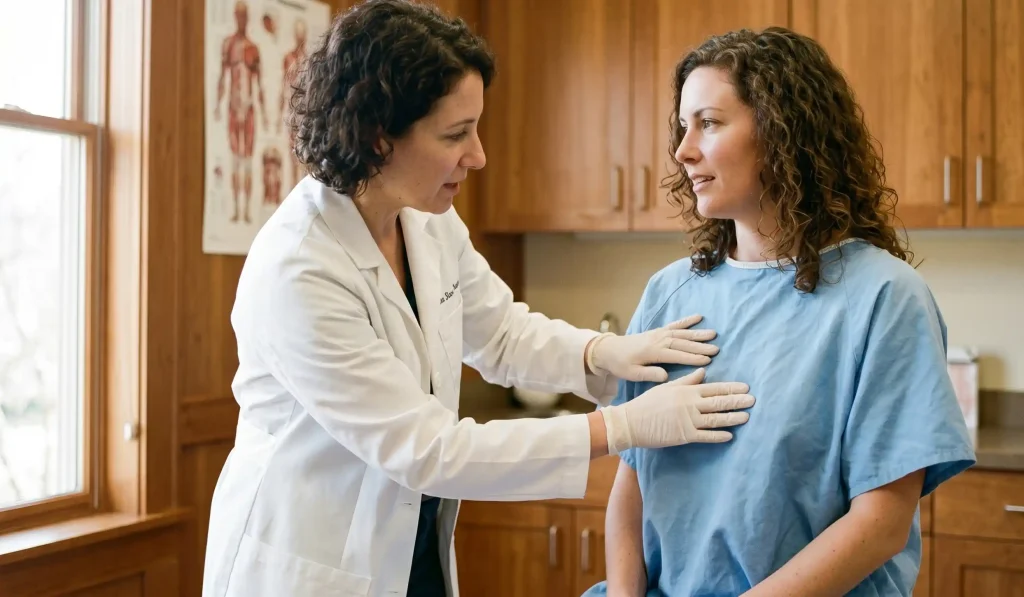
Over-muscle offers recovery, under-muscle looks natural.
Submuscular Placement: The Biometrics of Natural Padding
In the field of breast restoration, submuscular placement (also known as “under the muscle”) is the act of putting the implant under the pectoralis major muscle. Biometrically, this method layers a natural padding over the upper pole of the breasts, which is very important, especially for patients with a very low fat layer, as it will not only prevent the “stuck-on” look but will also craft a beautifully flowing outline from the chest to the breast.
We, at Lin Health Europe Clinic, tell our patients that the submuscular technique is probably the best solution for achieving structural harmony that lasts over time. In addition to using the muscle as a protective layer, this method drastically decreases the biometric risk of capsular contracture – the tightening of the fibrous tissue around the prosthesis. Besides, the glandular tissue system will not be negatively affected by this placement, leading to clearer mammographic images and a more natural biological balance over the years.
Subglandular Placement: Structural Harmony for the Active Lifestyle
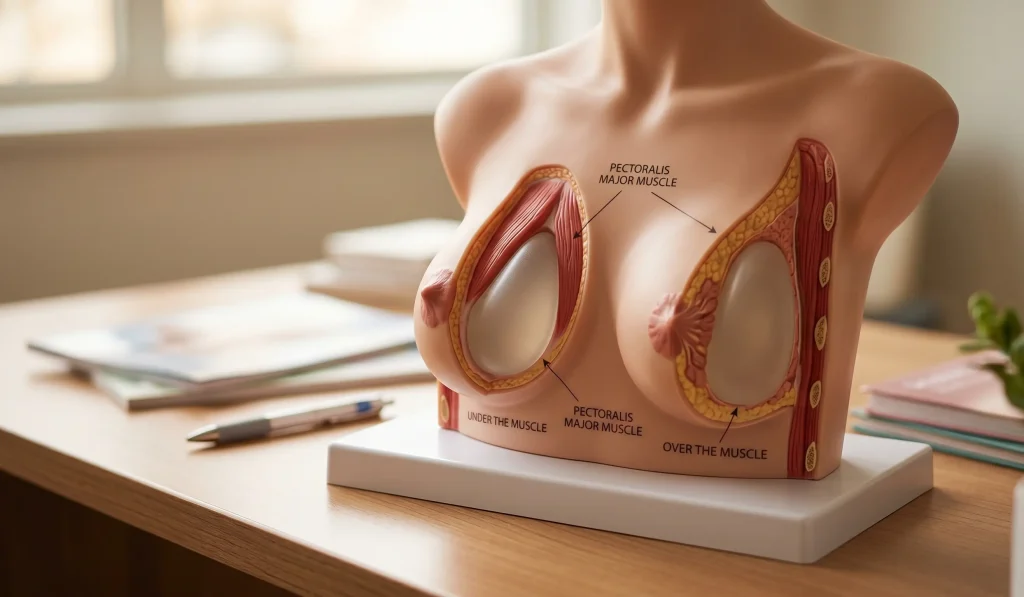
With the “over the muscle” (subglandular) technique, breast implants are situated after the mammary gland but in front of the pectoral muscle. From a biometric point of view, this is a better “mechanical” option for patients who either have a lot of natural tissue coverage or are very physically fit. The fact that the muscle is left untouched means that the recovery period is, in general, shorter, and there is no chance of “animation deformity” – a situation where the implant is moving when the muscle is flexed.
When getting surgical excellence with subglandular placement, you need to have a healthy skin envelope and enough fat to hide the edges of the implant. This technique makes the implants and natural breasts move together so that the silhouette appears lively and responsive. Our team at our Istanbul clinic combines the highest level of clinical skills to assess your tissue density. If the biometrics are favorable, subglandular placement can result in a very nice, sculpted projection with a quicker resumption of high-definition daily activities.
Comparison of Anatomical Stability and Biometric Impact
It is a medical necessity for choosing one of these two approaches to be based upon the unique chest architecture of a patient. The submuscular method is much better in providing resistance against gravity support, which is very important for maintaining the structural harmony of the breast over a long period. On the other hand, subglandular may be the best choice in case of a “pseudoptosis” correction, where the implant needs to be situated lower so that the sagging skin envelope is effectively filled.
| Biometric Factor | Submuscular (Under) | Subglandular (Over) |
| Upper Pole Naturalness | High-definition, smooth transition. | May be palpable in thin patients. |
| Recovery Timeline | Longer due to muscle adaptation. | Rapid return to systemic vitality. |
| Animation Risk | Potential movement with flexing. | Zero risk of movement during flex. |
| Capsular Contracture | Clinically lower risk. | Standard risk levels. |
At Lin Health Europe Clinic, not only do we carry out the rigorous scientific analysis of the skin and muscle in the most professional manner, but we also make sure that the final results achieve the utmost level of beauty and functionality with absolute harmony, whichever placement is chosen.
Systemic Vitality and Mammographic Accuracy

Certainly, one of the aspects that should never be overlooked when discussing the systemic health of a patient over a long period of time is the ability to conduct cancer screening accurately. Biometrically speaking, submuscular breast implants are the best for mammography. Since the implant is less visible behind the muscle, it is easier for the technician to dislocate the implant to get a better view of the glandular tissue.
Moreover, achieving and preserving the biological balance guarantees that your beauty transformation will not disrupt your medical prevention. We work with the latest technology in Turkey to break down and program your breast implant placement in a way that honors your natural anatomy. Whichever you select, over or under the muscle, our main objective is to keep your high-definition placement steady, symmetrical, and treated with the utmost professional care, so that you may enjoy a lifetime of confidence and health.
Lin Health Europe Clinic
Being a part of Lin Health Europe Clinic means that you have entered a global healing center where the details of mammary biometrics are taken care of with an outstanding level of clinical expertise. We realize that the choice between “over” or “under” the muscle will significantly affect your level of comfort, the duration of your recovery, and your long-term silhouette. Our medical center in Turkey excels in the art of surgery, while at the same time providing you with a luxury environment where the whole breast implant surgery is tailored to your individual anatomical necessities.
Lin Health Europe Clinic has a medical setup that shines at combining both artistic and safety aspects. Your transition will be supervised by us with professional dedication, opening up pathways for you to make the choice that is absolutely the best for your body. Have your care and feel the touch of a refined and harmonious state of being with Lin Health Europe Clinic. We hold the lower door to a more sophisticated and merry you.
FAQ:
Today’s implants are really tough and meant to stay in your body for a very long time, but it’s a good idea to see a doctor at least once every 10 years to check that everything is still okay with your implants and your health in general.
This is certainly not a strictly medicare condition. If the implants are still do their job well and look good, there is no need for changing them. Actually, most people have a revision only when they want to harmonize the structure or to renew their high-definition profile as they get older.
In fact, many women have no problem breastfeeding after the surgery since the milk producing tissue normally remains intact during the implant installation. Modern methods are so skillfully done that the natural balance of the milk ducts is preserved.
Besides, these devices are among the most extensively tested products worldwide and are frequently FDA-approved for medical use. To reach the highest level of safety, it is essential to select a JCI-accredited center that upholds professional standards.
The main complications seen in clinics potentially consist of capsular contracture, localized swelling, or over time, a silent rupture. By frequently checking your biometric data, you can be sure to detect any changes in the harmony of your structure and address them skilfully with a clinical expert.
- Tebbetts, J. B. (2002). Systemic Vitality and Surgical Precision in Mammary Procedures. Saunders Elsevier.
- Adams, W. P. (2011). Breast Augmentation: Clinical Mastery and Biometric Stability. Saunders Elsevier.
- Janis, J. E., et al. (2005). Thoracic Anatomy and Biometrics: Implications for Implant Placement. Plastic and Reconstructive Surgery.
- Nahai, F. (2011). The Art of Aesthetic Surgery: Principles and Professional Rigor in Submuscular Augmentation. Quality Medical Publishing.
- Maxwell, G. P., and Gabriel, A. (2014). The Evolution of Breast Implants and Biological Tissue Maturation. Aesthetic Surgery Journal.