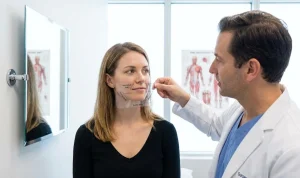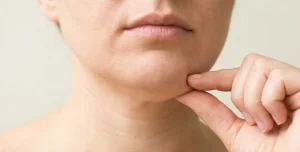

No, visible facial scarring is minimal.
Biometrics of Micro-Incision and Facial Tissue Integrity
Amongst other concerns regarding a facial hair transplant, scarring on the face is the most important one for the majority of patients, as it is the main area defining the face. In fact, a beard transplant done using the latest technology and equipment is basically a “scarless” surgical procedure from a biometric point of view. This is made possible by the employment of ultra-fine micro-punches, which are usually 0.6mm to 0.8mm in diameter. The incisions made by these tools are so tiny that they will not cause any permanent linear scarring visible to the naked eye once the skin has undergone its normal healing process.
At Lin Health Europe Clinic, we consider the protection of the facial tissue integrity a work of art and clinical perfection. We know that the skin on the face is more vascular and sensitive compared to the scalp, thus it requires a very high level of expertise and professional rigor. Our teams in Istanbul go about their work with surgical extraction and implantation tools of such high definition that they not only minimize the trauma to the skin but also respect the natural biometrics of your skin. This allows for the systemic vitality of your body to be supported during the healing process, thereby allowing the micro-incisions to close and become indistinguishable from the natural texture of the skin within a matter of days.
Emerging into Surgical Brilliance: FUE or Strip Harvesting for Beard Transplant
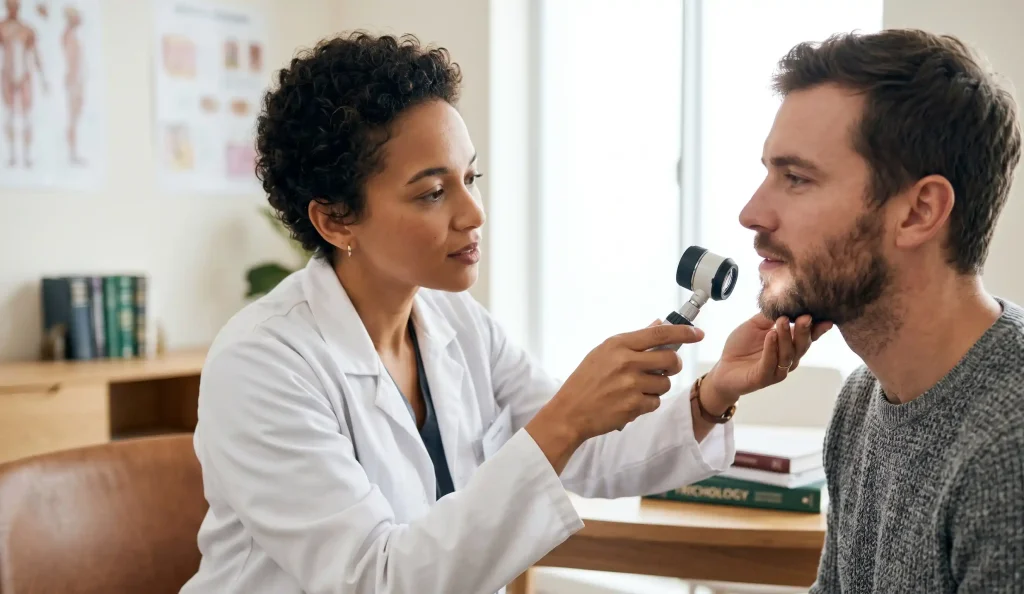
The evolution of hair restoration has witnessed many methods, such as FUT (Follicular Unit Transplantation), where a strip of skin is removed, resulting in the formation of a permanent linear scar. Be that as it may, a beard transplant nowadays is carried out solely by FUE (Follicular Unit Extraction) or DHI (Direct Hair Implantation) as per surgical brilliance. The reason for this is that these procedures only involve the harvesting of individual follicles from the donor area (usually the back of the scalp) and their implantation in the beard area. Since there are no large incisions made, there is absolutely no chance of a “line” scar on either the face or the donor site.
We, at Lin Health Europe Clinic, have a professional rigor that ensures that the donor area is treated with just the same care as the recipient site. We use a “scattered” extraction pattern in order to keep the structural harmony of the hair on the back of the head, thus avoiding any visible thinning or “moth-eaten” look. Regarding the facial side, our surgeons are using placement strategies based on high-definition technology. They make sure that the follicular units are not implanted too close to each other and the facial hair is laid out in single units only in order to avoid the “cobblestoning” effect—small bumps—that appear when less good techniques are used. In this way, we aim for an immaculate and non-obtrusive outcome that is the epitome of medical artistry.
High-Definition Beard Hair Placement: Avoiding Pitting and Redness
“Scarring” is sometimes mistaken for the redness of the skin after surgery or “pitting.” Pitting results when a hair graft is placed too deeply, thus causing a small depression of the skin. Averted only by clinical mastery of depth and angle of implantations. For a beard to be laid flat on the jawline, it has to be placed at a very acute angle. If the angle is wrong, it will disturb the structural harmony of the beard, and also, inflammatory signs resembling a scar may set in.
Consequently, to give you an idea, Lin Health Europe Clinic uses advanced devices such as implant pens with which the surgeon can change the depth, angle, and direction very precisely and effortlessly. Such careful work will make your new hair hard to distinguish from your own hair. Redness, although a sign of better blood circulation and systemic vitality, is temporary during the initial period of the healing process. Our premier team located in Istanbul performs a regimen of post-operative serums that expedite skin maturation, and thus the “pink” phase will rapidly give way to the appearance of a well-shaven beard with absolutely no trace of intervention.
Systemic Vitality and the Donor Area Biometrics
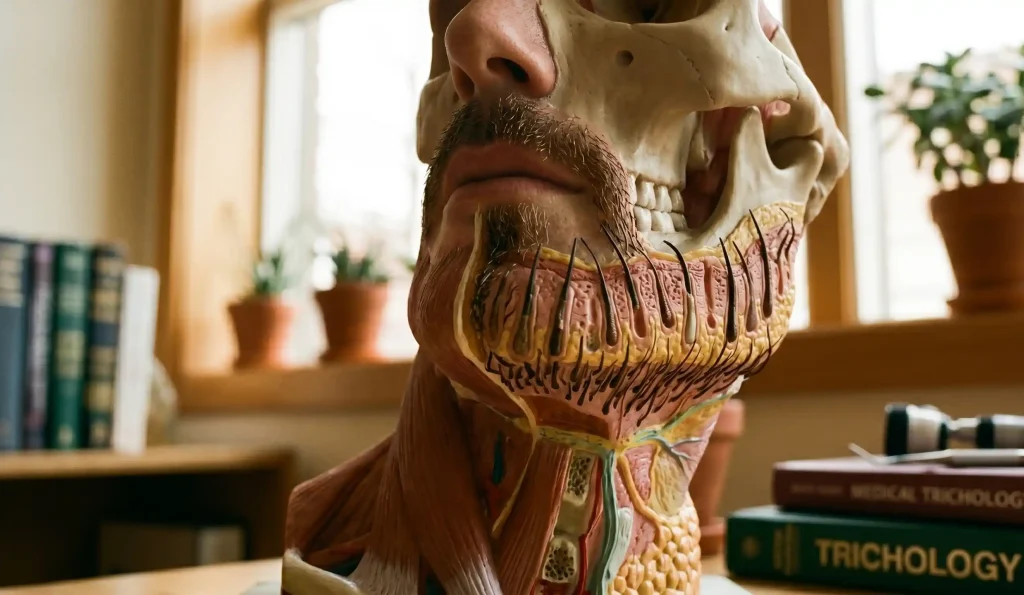
Despite the fact that the face is the center of attention, equal professional rigor is necessary for the donor area to have a scar-free outcome. The back of the scalp is a strong donor area; however, it still obeys certain biological rules. If a lot of grafts are taken from the same spot, the microscars formed will eventually join and be visible as a scar.
Our surgeons will do a biometric evaluation of your donor area hair density in Istanbul prior to any graft removal being done. This way, our doctors can maintain the biological balance of your scalp hair while at the same time helping you reach your high-definition beard goals. By utilizing the smallest possible punch sizes combined with the tactical extraction map, the little white dots (micro-scars) that form in the donor area remain completely hidden by the surrounding hair, even with really short haircuts. Such a comprehensive approach to systemic health is what defines Lin Health Europe Clinic as a refuge for those who desire world-class results without the physical reminders of surgery.
Beard Transplant in Turkey
When you choose Lin Health Europe Clinic for your beard restoration, you prepare yourself to reach the topmost level of aesthetic excellence by a single step. Our center in Turkey also acts as a global sanctuary where surgical brilliance is combined with the highest JCI-accredited safety standards. We know that your face is your best presentation, and so dealing with the risk of scarring is done at a level of clinical mastery unmatched anywhere else in the region. We offer an all-inclusive, full package solution where your recovery is carried out with high-definition monitoring and the best post-operative care.
You put your trust in a medical institution that is superbly equipped to meet the demands of the facial hair restoration treatment when you decide on our clinic in Istanbul. Our expert team constantly adopts the latest medical innovations to ensure that your change towards having a fuller and more masculine image will be managed with absolute professional care. Be it a beard transplant or any other hair restoration technique, the purpose of any treatment is to bring you confidence and a defined jawline. To experience the refined and sophisticated care of Lin Health Europe Clinic is to enjoy results that epitomize the absolute harmony of structure and biology.
FAQ:
With the help of FUE or DHI methods, the incisions are made smaller than 1mm and they heal without a trace of linear scars. The biology of the skin allows these micro spots to vanish as the tissue reaches structural harmony.
The donor site will show very small microscopic dots at the points of follicle extraction. Still, our great thoroughness in work ensures these dots are randomly distributed and cleverly disguised by your existing hair that looks natural.
Redness in a localized area is a sign of the liveliness of the whole body and it generally diminishes after 7 to 14 days. In our Istanbul clinic, we offer specially formulated creams to calm the skin and speed up the healing process.
Absolutely, Istanbul actually leads in the hair transplant industry worldwide. At Lin Health Europe, we merge the local knowledge JCI-accredited with safety and clinical expertise, so you can have a safe and steady recovery.
During the first week there will be small crusts and slight redness. Once the scabs fall off at day 10, the skin normally appears a bit pink, which can be controlled with our top-class post-op skin care protocols.
Unger, W. P., and Shapiro, R. (2010). Hair Restoration Surgery: Biometrics and Procedural Mastery. Informa Healthcare.
Bernstein, R. M., and Rassman, W. R. (2002). Follicular Unit Extraction: Achieving Structural Harmony in Facial Restoration. Dermatologic Surgery.
Tebbetts, J. B. (2002). Systemic Vitality and Surgical Precision in Regenerative Procedures. Saunders Elsevier.
Janis, J. E., et al. (2005). Facial Anatomy and Biometrics: Implications for Beard Reconstruction. Plastic and Reconstructive Surgery.
Epstein, J. S. (2014). Facial Hair Restoration: Clinical Mastery in Beard and Eyebrow Transplantation. Clinics in Plastic Surgery.