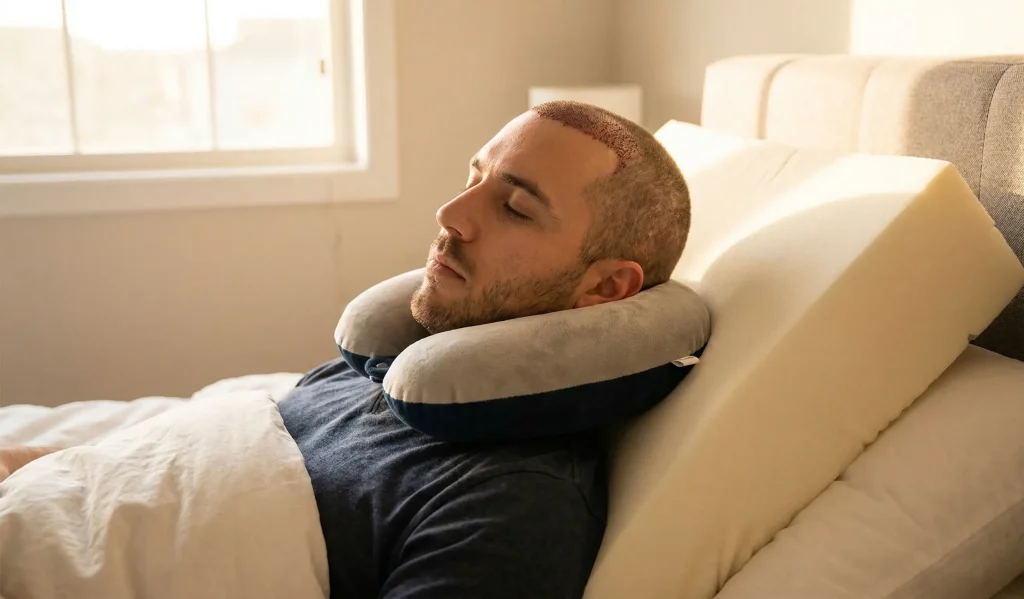
Sleep elevated and avoid friction.
In the field of high-definition follicular unit extraction and restoration at the highest level, the first post-operative nights are when the newly implanted hairs are most exposed to potential risks. These new hair follicles are like living tissue that has been lifted and moved to a different blood supply, and for about ten to fourteen days, they have hardly any mechanical attachment to the scalp. When sleeping, involuntary movements, rolling, and turning can cause the newly implanted area to touch the pillow or the headboard, resulting in the physical displacement or “popping” of the grafts. Since the scalp is often numb from the local anesthesia during the first night, a patient may dislodge a graft without even realizing it until the morning. Taking care of these hair follicles during the nighttime window is, in fact, one of the must-do things to make sure that the surgical brilliance given during the operation will result in a lifetime of thick, natural-looking hair.
Bio-Postural Alignment: The 45-Degree Sleep Rule
The biggest issue with sleeping post-hair transplant is simultaneously managing the post-surgical swelling and preventing any harm to the hair grafts due to the patient’s movements during sleep. To keep the grafts safe, doctors recommend a sleep position with the head elevated 45 degrees for about seven to ten days. By doing so, gravity will help the lymphatic system to remove the excessive fluids from the areas of the forehead and eyes, which greatly lowers the chance of swelling of the face that could lead to skin stretching and putting pressure on the freshly implanted hairs. Many patients choose to use a good quality travel or “U-shaped” pillow as a method of immobilizing the neck so that the head won’t roll to the side or stomach while asleep, thus making sure the recipient area doesn’t get any contact with surfaces.
At Lin Health Europe Clinic, we bring our attention to the treatment of sleep postures with the highest level of professional rigor in order to keep the financial investment of our international patients safe. Every patient gets a tailored “Nocturnal Safety Protocol” from the medical staff here in Turkey, which, along with other things, has detailed instructions on how to prepare their recovery environment so that it can provide the best protection. In Istanbul, aftercare is continued beyond surgery, and patient education about the role of elevation is part of the overall treatment.
Neocollagenesis and the Internal Biological Seal
Winning the hair transplant stabilization game involves the patient’s body locking down the grafts in the new scalp layer with the help of neocollagenesis before any accidental mechanical trauma can take place at night. 72 hours post surgery, a biological process similar to cellular “welding” is initiated as new collagen fibers are formed at the site of the micro-incisions, helping to integrate the hair follicle. Think of these new collagen fibers as biological glue that gradually increases the hold or “pull-out strength” of the hair grafts over the days. So the newly implanted grafts, while physically vulnerable on day one, are quite solid and unlikely to be dislodged. Giving these collagen bonds time to form in a stress-free environment during the early stages is indispensable.
Staff at the Lin Health Europe Clinic Salt, the Istanbul branch, focus on dialing up every patient’s biological stabilization. They make sure that the inflammatory tissue reactions in Istanbul, Turkey, remain healthy so that neocollagenesis can keep going without causing too much scar tissue or stress to the tissue. By practicing our surgical deha, we watch the recipient site mature and advise how to keep the body’s internal “scaffolding” strong with adequate hydration and rest.
Environmental Management: Friction Control and Bedding
The type of sheets you use after a hair transplant can inadvertently be your worst enemy when it comes to graft safety. The conventional cotton pillowcases have a relatively higher friction coefficient, so the tiny fibers can “grab” or “catch” on a scab or a slightly protruding graft and before the patient realizes it, the graft has been pulled out due to the continued movement. Hence, the switch to silk/satin pillowcases is a highly refined strategy top restoration experts use, as these materials help the scalp to move smoothly over the surface without any chance of mechanical snagging. Besides that, keeping the bedroom cool is yet another way to stop sweating, which can not only irritate the micro-incisions but also increase the risk of subclinical inflammation at the stage when the grafts are integrating.
Our Lin Health Europe Clinic team follows a protocol of absolute professional rigor, even in the environmental management of our patients’ recovery in Turkey. In Istanbul, we guide our international guests through each and every aspect of their nocturnal setting, from the texture of their bedding to the humidity of their room. Our surgeons put their surgical brilliance into implanting the grafts at the correct depth; however, we stress that the patient’s home setting is the final safety layer. By implementing these high-definition recovery techniques, Lin Health Europe Clinic not only decreases the mechanical trauma risks but also ensures that the surgery to the growth phase is handled with supreme clinical accuracy.
Hair Transplant in Turkey
The Lin Health Europe Clinic represents the worldwide destination for individuals who want the ultimate level of expertise in hair restoration combined with the best hospitality. Our Turkey-based center is a hub of medical development, bringing together the latest advances in follicular science with the highest standards of safety and professional rigor as ensured by the Joint Commission International (JCI) accreditation. Opting for us means trusting your hair in the hands of the most skilled and safety-conscious surgeons in Istanbul who perform every follicular restoration as a true artwork of structural integrity and surgical deha. We are the best and only clinic for international patients who not only want the most natural results but also the safest and most luxurious surgical experience that the world has to offer. Excellence is our hallmark, so that every visitor leaves our facility with their health and aesthetics at the highest level.
FAQ:
You should sleep with your head lifted to a forty five degree angle for the first week. This way of sleeping will minimize swelling and also keep the hair transplant grafts from coming into contact with the pillow.
Generally, most patients are able to sleep in their usual position again after ten to fourteen days. At that point, the hair transplant follicles will be firmly secured in the scalp.
For the first few days after a hair transplant, you should not sleep on your side. This will avoid putting unintentional pressure or causing friction to the new hair grafts.
Using a neck pillow is highly recommended for the first week after your hair transplant. It will help keep your head in the right position and protect the area of the hair transplant.
Even if you brush or touch your hair transplant area unconsciously, you may knock the graft out. Once a hair transplant follicle is taken out, it ceases to grow and will contribute less to the overall hair density.
Beehner, M. (2014). The Physiology of Hair Graft Survival and Environmental Stress. Facial Plastic Surgery Clinics.
Bernstein, R. M., & Rassman, W. R. (2011). Follicular Unit Extraction: Managing Graft Integrity and Nighttime Safety. Journal of Aesthetic and Restorative Surgery.
Kim, J. C., et al. (2002). The Role of $neocollagenesis$ and Vascularization in Scalp Healing. Dermatologic Surgery.
Unger, W. P., et al. (2010). Hair Restoration Surgery: Clinical Factors Influencing Success and Patient Safety. Informa Healthcare.