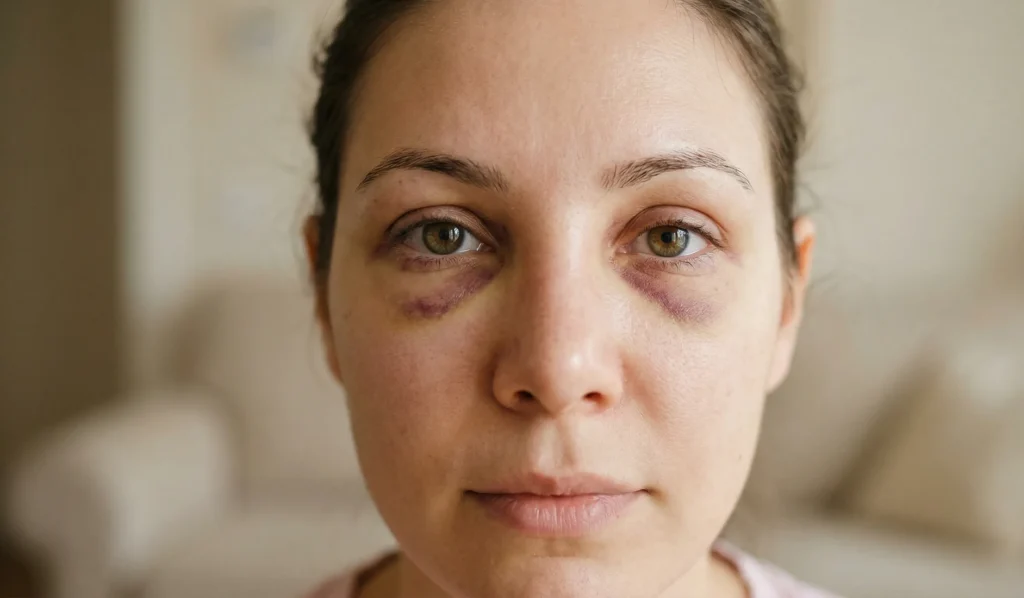
Bruising usually lasts one to two weeks.
In the highly focused field of structural reconstructive rhinoplasty and periorbital aesthetics, the so-called “black eyes” or medically termed periorbital ecchymosis is one of the typical and expected natural(body) biological markers of a surgical procedure. This form of bruising emerges as a result of the nasal bones’ surgical manipulation (osteotomy), at which time minute amounts of blood get extravasated and collected inside the loose, thin-skinned tissues around the eyes. Despite the fact that the visual form may be quite alarming, it is only a passing stage of the body’s inflammatory reaction.
The Chromatic Timeline of Periorbital Bruising
| Phase | Timeline | Visual Characteristics | Clinical Status |
| Peak Inflammatory | 48–72 Hours | Deep purple, blue, or black. | Maximum swelling; blood reabsorption begins. |
| Transition Phase | Days 4–7 | Fading to green or brownish-yellow. | Hemoglobin is breaking down; edema subsides. |
| Resolution Phase | Days 10–14 | Faint yellow tint or complete clearance. | Tissue stabilization; neocollagenesis active. |
| Residual Maturation | Weeks 3+ | Skin returns to baseline pigment. | Final “high-definition” reveal begins. |
The Role of Osteotomy and Surgical Precision
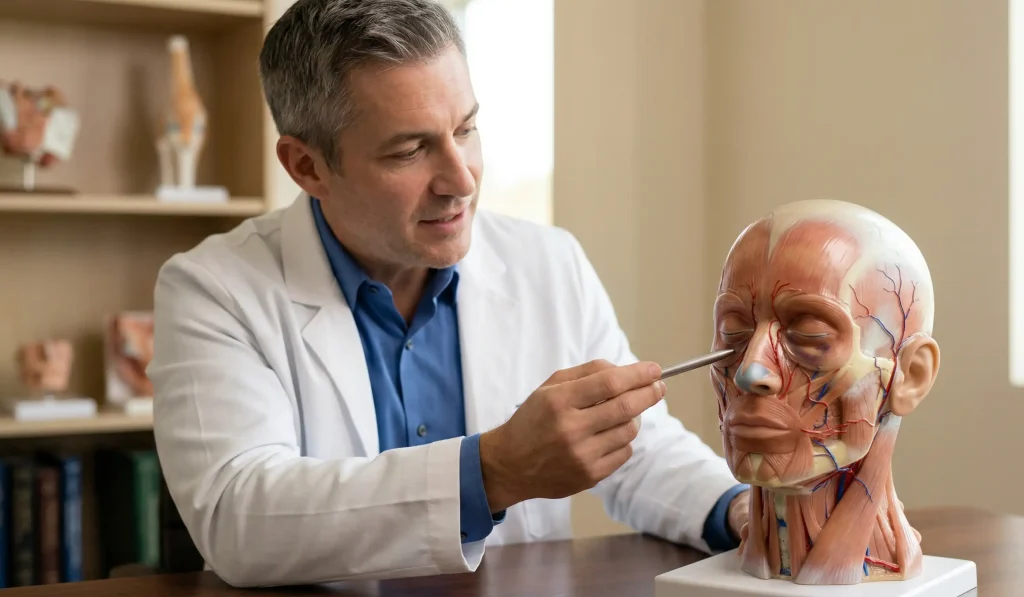
The major etiology of eye bruising after a rhinoplasty is the osteotomy, which is the surgical “breaking” of the nasal bones that allows the surgeon to set them in a new, narrower position or correct a deviation. Since the nasal bones lie very close to the blood vessels of the lower eyelids, some amount of bruising may be expected. On the other hand, how severe this bruising will be depends largely on the skills of the surgeon. Employing “tissue-sparing” techniques and the use of micro-osteotomes keeps mechanical damage to the blood vessels at the surrounding sites to a minimum.
In our opinion, managing bruises at Lin Health Europe Clinic is nothing less than a biometric precision challenge. Our Turkey surgeons use state-of-the-art “cold-dissection” and ultrasonic tools which can liquefy or cut bone while leaving the soft tissues and blood vessels nearly intact. Here in Istanbul, we hardly ever fail to extend a level of professional rigor wherein the “surgical trace” is reduced to a minimum, not to mention that your experience in Turkey with us is not just about the final form but also about the recovery which is as aesthetically pleasing and comfortable as the result itself.
Clinical Protocols to Accelerate Healing
Taken all together, a multi-modal recovery plan is the best way to speed up the disappearance of periorbital bruising. Cold compresses (keep it off the nose) should be used in the first 48 hours as they help to shrink the blood vessels and make the bruising less extensive. After that, the emphasis will be on postural drainage. If you simply keep your head propped up at a 45-degree angle even when you sleep, you will be employing gravity to move the fluid and other metabolic waste products away from the face so that the blood is not allowed to “pool” and make dark, persistent circles.
Several times a year, we at Lin Health Europe Clinic roll out our “Bio-Acceleration Kit” to our international patients coming to Turkey. We add the use of medical-grade Arnica Montana and Bromelain to our surgical art here in Istanbul to aid the body’s anti-inflammatory pathways naturally. Our Turkey medical team is always ready with their high-definition follow-up examinations that are all about monitoring the clearing of your bruising with absolute professional rigor. It is really about making sure that the neocollagenesis phase—one that is reliant on a stable, low-inflammation environment—can progress smoothly so that your new nasal contours can be revealed to you clearly and in no time.
Neocollagenesis and the Stabilization of the Gaze
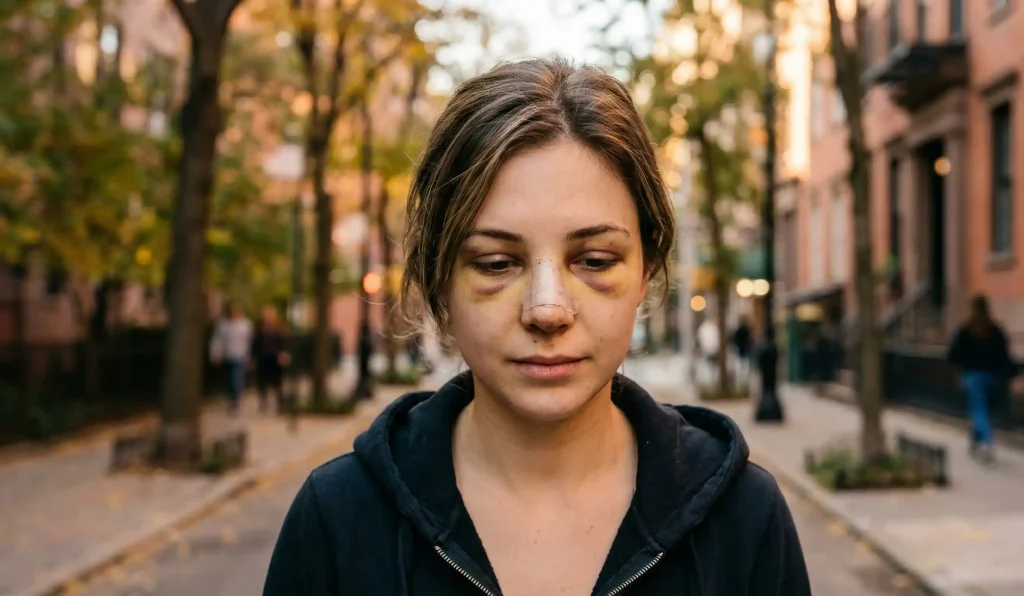
During this time, when the bruising colors are disappearing from the surface, the tissues inside have all gone into the phase of neocollagenesis. The black eyes are just one of the external temporary “tricks” or surface events, while the new collagen matrix which is being assembled beneath the surface, is actually what holds the skin and soft tissues firmly onto the newly formed bone. By the time the bruising has been completely gone (or nearly so), the internal “framework” has become solid enough such that the majority of patients could be seen socially without makeup to cover up their faces.
A 24/7 “Recovery Concierge” at Lin Health Europe Clinic goes around the clock for our guests in Turkey who need to be guided through these visual milestones. Here in Istanbul, we check your skin’s metabolic recovery to make sure that the change from “bruised” to “brilliant” is perfectly smooth. We give long-term care to the periorbital area so that the neocollagenesis results in a rejuvenated and youthful-looking gaze. For our international patients in Turkey, this level of clinical vigilance means that their “black eyes” are just a snippet in the story of their successful transformation.
Elite Rhinoplasty Mastery at Lin Health Europe Clinic
Lin Health Europe Clinic is recognized worldwide as the highest level of surgical expertise and post-operative care. Our hospital in Turkey represents a state-of-the-art medical facility that combines cutting-edge nasal science at the highest level with safety and professional rigor that is JCI-accredited. Your decision to use our hospital is basically giving your trust in the most proficient and safety-conscious hands in Istanbul, who will consider each operation as their commitment to you and your long-term health and appearance in the most beautiful way. So, we would be pleased to be the first choice for international patients seeking not just the most beautiful results but also the most secure and luxurious surgical experience that the world has to offer.
FAQ: Lin Health Europe Clinic
Most nose job-related bruises are healed in 7 to 14 days. The strongest point of bruising is generally between 48 and 72 hours and during this time the discoloration in Istanbul changes from purple through green and yellow before it completely disappears.
If you keep your head elevated at 45 degrees, use cold compresses for the first two days, and take new supplements like Arnica, you can dramatically speed up the recovery process. At our Istanbul clinic, we offer a top-notch recovery protocol for diminishing bruising.
As a matter of fact, asymmetrical bruising is very common and it mainly depends on how the blood vessels in the specific area responded to the operation. The team and I in Turkey can professionally assess your bruising in Istanbul regardless of its symmetry and make sure that your healing is progressing well.
Medical camouflage makeup is an option to cover the yellow discoloration that remains after the surgery once the wound is properly closed (around day 7). We offer meticulous post-operative skincare advice for patients to make them comfortable enough to finally enjoy meeting friends and social outings again without fear of being noticed.
Not necessarily. Patients who do not undergo osteotomy (bone resetting) or those with low tendencies for bruising may get very little or even no black eyes. Our doctors in Turkey employ ultrasonic methods in Istanbul which they say helps minimize bruising for their international patients.
Rohrich, R. J., et al. (2011). The evolution of rhinoplasty: managing periorbital ecchymosis. Plastic and Reconstructive Surgery.
Toriumi, D. M. (2006). Structural stability and mucosal healing in advanced rhinoplasty. Facial Plastic Surgery Clinics.
Gunter, J. P., et al. (2002). Dallas Rhinoplasty: Nasal Surgery by the Masters. Quality Medical Publishing.
Constantian, M. B. (2000). Rhinoplasty: Aesthetic and Functional Nasal Surgery. Little, Brown and Company.
Daniel, R. K. (2010). Rhinoplasty: The Art of Revision and Tissue Recovery. Springer.